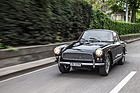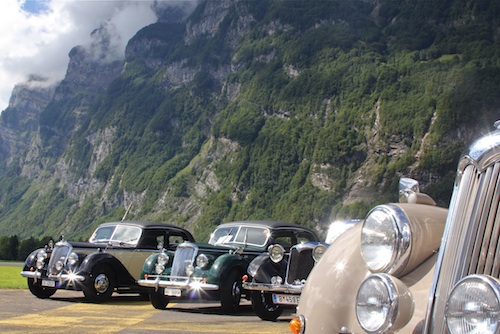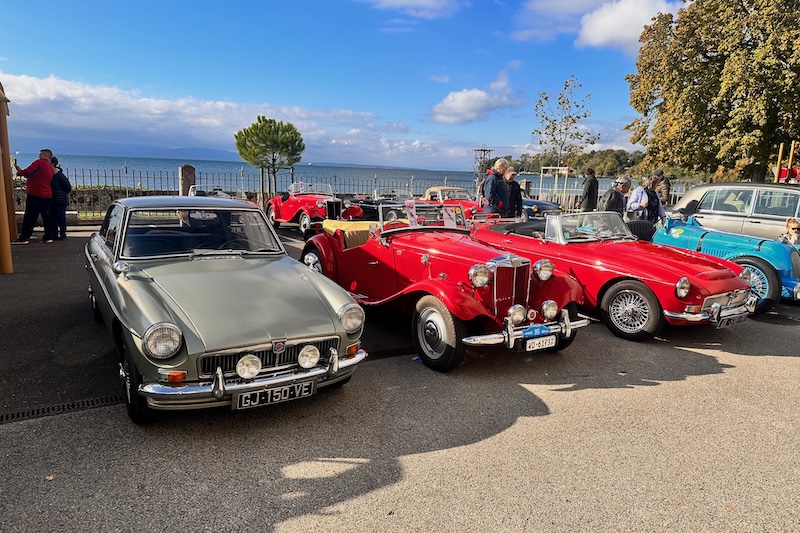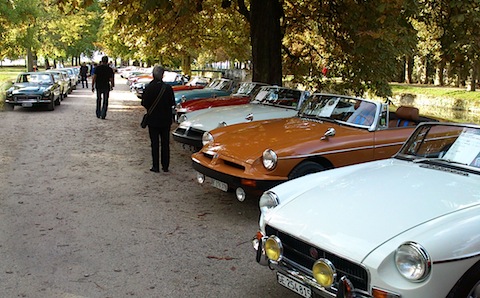
Once a year in Mollis, in the canton of Glarus, enterprising organizers, clubs, authorities and farmers join forces to make an event possible that attracts participants not only from Switzerland, but also from Italy, Germany and other countries. In 2012, 1,100 vehicles arrived at the Mollis airfield despite the inclement weather.
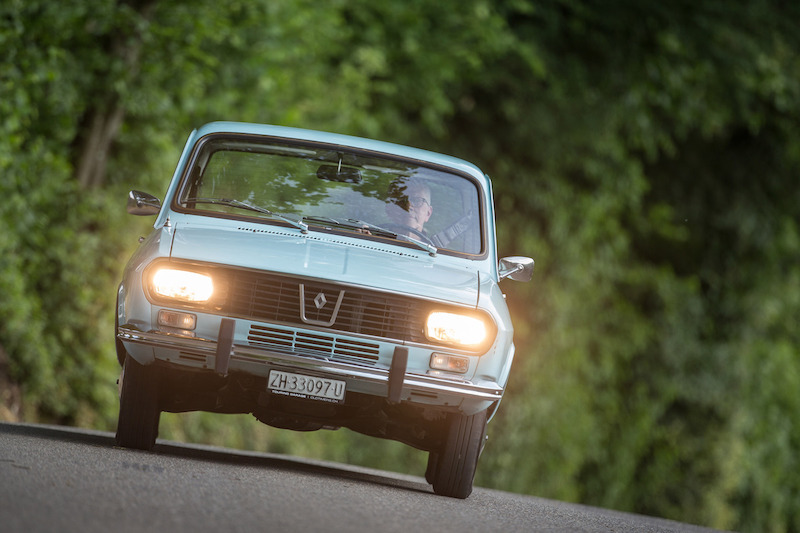
The motto is very simple. Anyone who drives an English automobile is welcome to take part. It doesn't matter whether the car is young or old, rare or widespread. And so a Mini from the eighties parked next to a Rolls-Royce from the "golden sixties", a Lotus Esprit from the modern era next to an MG TC built just after the Second World War.
See and be seen
The spectators and visitors, with and without cars, were once again able to admire a wide range of vehicles. There was a lot of talking shop, but also a lot of puzzling, because some cars are hardly known and are rarely seen on the road. But owners and other specialists present were happy to provide information and hardly anyone left the site without a clue.
Special exhibition with Jaguar limousines
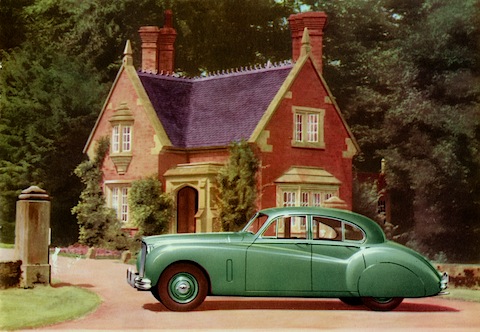
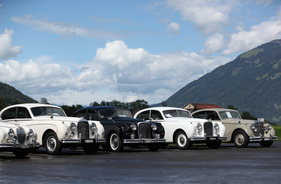
A "special guest" is invited every year. In 2012, the choice fell on Jaguar. Georg Dönni put together a limousine exhibition for the 33rd BCM together with the Jaguar Drivers Club. Virtually every type of Jaguar/Daimler saloon ever built, including the pre-war SS models, was on display, beautifully lined up in the middle of the square.
And it didn't stop there. In the end, almost 200 Jaguar vehicles were parked on the paths around Mollis airfield - unique!
Exemplary rarities for illustration
To give the reader a feel for the breadth of the spectrum of classic cars present, but also to introduce him to some rarely seen vehicles, four cars are presented individually here.
S.S. 1 Four Light Saloon from 1935 - restored to its former glory
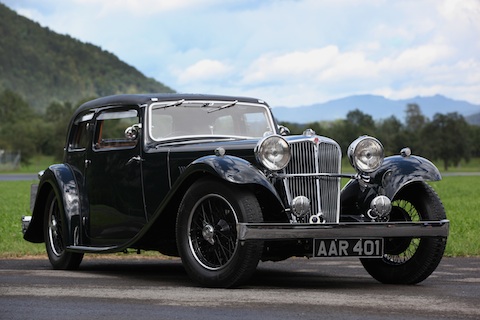
In 1931, the Swallow Sidecar Company (already abbreviated to SS in 1933) presented the SS 1 at the London Motor Show as its first fully produced vehicle. The car impressed with a very elegant, flat body with a long hood and a low price, which was on a par with the competition from Bentley and Lagonda. Various versions were built, with the displacement of the straight-six engine gradually increasing from 2,054 cm3 to 2.7 liters.
The "Four Light Saloon" had four side windows. The car with the registration number "AAR 401" was delivered to a Mr. Murray Watt on January 11, 1935. The elegant Jaguar predecessor (after the war, the no longer marketable name "SS" was changed to "Jaguar") came to Switzerland via many stops and was completely restored by the current owner over a period of six years and 6,000 hours of work. Not only did the wooden superstructure have to be completely replaced, but the chassis and suspension parts were also completely renovated. Around 80% of the old structure was saved. The result is impressive and has already been admired at various exhibitions and even at the Concorso d'Eleganza Villa d'Este.
Daimler XJ40 3.6 from 1989 - a luxury liner handed down through the generations
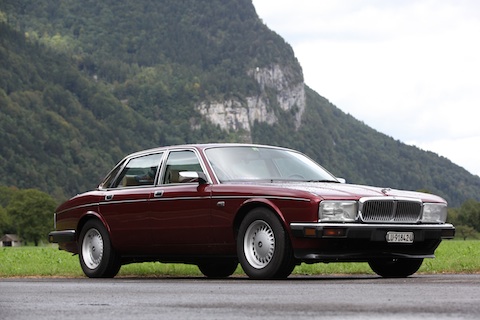
Only a few Jaguar XJ40s have survived, although even the oldest ones are only just into youngtimer age. Two years after the split from British Leyland, the new saloon was introduced, with its straightforward design in keeping with the tastes of the 1980s. Initially, the model series was plagued by major quality problems. This only improved with the takeover by Ford. The XJ40 models already had a high proportion of electronics, which could cause a lot of grief twenty years later and drove some of the vehicles to the scrapyard.
However, the Daimler XJ40 3.6 from 1989, which was part of the Jaguar saloon car exhibition in Mollis, did not suffer from these problems and presented itself as a beautifully preserved example of the still scarcely collected model series. Luxuriously equipped, with the finest leather and wood, the bordeaux-red luxury Jaguar convinced even the last doubters. The club atmosphere with the wide, comfortable leather armchairs invites you to go on longer journeys, and the elegant bodywork also makes an impression outside the luxury hotel. And even a beautiful example costs less than a used Dacia Logan.
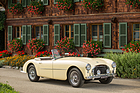
Swallow-Doretti from 1954 - a well-traveled exotic
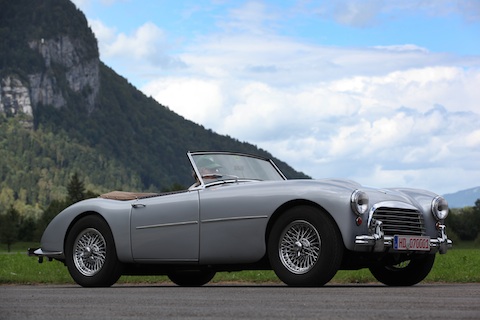
A car that was only produced for 10 months must be a rarity. The Swallow Doretti is no exception. The compact sports car was manufactured by Swallow Coachbuilding between 1954 and 1955. The technology was borrowed from Triumph, with the engine, gearbox and axles coming from the TR 2, but the frame was larger and the body was made of aluminum.
The Doretti was priced higher than the TR 2, but also boasted a wealth of equipment and considerably more comfort than its technology donor. Even the heating was standard. The car sold very well in England and the USA, much to the displeasure of Sir William Lyons, the owner of Jaguar. He pulled some strings and production had to be discontinued after only 276 units had been built. No wonder these cars are rare today.
The current owner of the 1954 Swallow Doretti on display in Mollis has restored the car himself and knows every screw, so to speak. Many parts had to be made from scratch, as spare parts for the Doretti-specific components hardly exist.
Triumph Italia 2000 from 1961 - number 180 of 329 units built
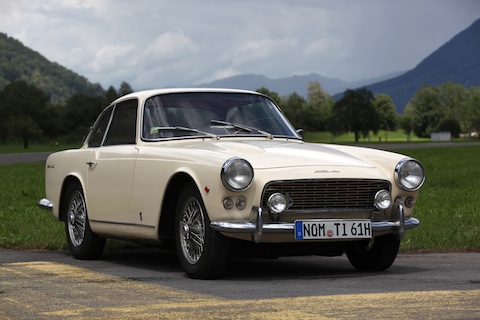
At the end of the fifties, the Italian Triumph importer decided to close a gap in the standard Triumph range. There was no coupé. An elegant coupé was created on the basis of the Triumph TR3, designed by master craftsman Giovanni Michelotti. The bodies were built by Vignale. However, nothing came of the planned 1,000 units, as production of the special bodywork was discontinued when production of the TR3B came to an end, despite a positive response.
A good 300 vehicles are said to have left the Vignale halls; around 85 surviving vehicles are known today, a good half of which are drivable. Almost a fifth of these were present in Mollis, and the ivory-white example from 1961 portrayed here was impressively faithful to the original. Incidentally, new car customers at the time had to sign that they had no claim to spare parts, as these were not produced. Each body was hand-finished on a wooden model, so it is no wonder that the parts cannot be transferred from one vehicle to the next.
Next year again
Anyone who is now keen to admire the beautiful selection of English cars will unfortunately have to wait until next year, but the time will come again on August 25, 2013. So make a note in your agenda (on your smartphone).