


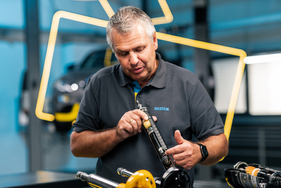

Not all shock absorbers are the same - a fact that is particularly true when it comes to suspension problems. Monotube shock absorbers, twin-tube shock absorbers and electronic systems: different types require different approaches to fault analysis in the workshop. One person who knows them all is Rainer Popiol. The Head of Bilstein Academy reveals what mechanics need to look out for - and why certain dampers become harder when oil leaks.
In the event of problems with the shock absorbers, mechanics should first be aware of which system they are dealing with in order to quickly and safely track down the source of the fault. "Most shock absorbers look the same from the outside. But there are fundamental differences and functional principles," explains expert Rainer Popiol.

Single-tube shock absorber
In the single-tube shock absorber, the working piston operates in a tube; the oil-filled working chamber and the piston chamber are located between the sealing package and a separating piston. From the piston chamber, the oil is pressed back and forth through the valve (spring washer assembly) in the working chamber, creating the damping forces required for the compression and rebound stages. The gas chamber is located behind the separating piston. This gas has two tasks, as Rainer Popiol reveals: "One task is to compress the oil column so that no bubbles form - known as cavitation. This keeps the monotube shock absorber stable. In addition, the gas chamber must accommodate the volume of the piston rod, because when the shock absorber is working, the piston rod is pressed into the working chamber. The separating piston therefore moves slightly."
Twin-tube shock absorber
In the twin-tube shock absorber, the working piston also works in a working chamber filled with oil. When the piston rod is pressed into the shock absorber, the oil is displaced and pressed down through the bottom valve into the compensation chamber, which is located between tube one and tube two. "Unlike the monotube shock absorber, however, the twin-tube shock absorber does not work independently of position," says Rainer Popiol. "If the shock absorber is tilted more than 45 degrees, it pulls the gas into the inner tube due to the inclined position. Then the gas pressure shock absorber no longer works in a force-fit manner."

Fault analysis for shock absorbers is not always easy
Whether monotube or twin-tube shock absorbers: mechanics need to bear a few things in mind when analyzing faults. Rainer Popiol: "In most cases, when the shock absorber loses oil, it becomes softer. But there is one design where the shock absorber becomes firmer. This means that the piston rod no longer enters the shock absorber properly. This is the monotube shock absorber. If it loses oil, the separating piston moves upwards towards the working chamber. And at some point, the piston rod touches the separating piston, which results in a loud knocking noise and the car becomes harder."
Even car professionals cannot always tell at first glance whether you are dealing with a monotube or twin-tube shock absorber. "Shock absorbers with a tapered tube are usually twin-tube shock absorbers because there is another tube inside," says Rainer Popiol. "The single-tube shock absorber is always cylindrical in its design because the working piston moves through the entire tube."

Special challenge: monotube shock absorbers in upside-down design
MacPherson struts are generally used on the front axle. Because they take on wheel guidance tasks and therefore have to absorb large forces, stable piston rods with a larger diameter are used. This is why monotube shock absorbers in an upside-down design are often used, as Rainer Popiol explains: "The shock absorber is then completely inverted. The piston rod is no longer at the top, but at the bottom. Two plain bearings then take over the guidance so that the high forces can be transmitted." The particular challenge when analyzing faults in the workshop: "With monotube shock absorbers, no oil at all can escape from the top because the piston rod is at the bottom."
This is why it is so important for mechanics in the workshop to make sure they know what kind of system they are dealing with. "In our technical support department, we are often confronted with the assumption that the twin-tube shock absorber is leaking some kind of emulsion. In most cases, however, it is just leaking grease, which is quite normal. This is because in upside-down twin-tube shock absorbers, we lubricate the plain bearings on the tube with grease.
Electronic shock absorber systems
Electronic systems can usually be recognized by their wiring and externally mounted valves. Rainer Popiol: "With these active or semi-active systems, I check the electronics with my diagnostic tools, go through the fault memory and take a look at the whole thing. I check whether there is anything wrong with the cable, whether I have a cable break or too much contact resistance, etc." But looking at the electronics is only part of the fault analysis, warns Rainer Popiol: "Of course, this is not a 100 percent test. And I can't check for wear at all: If the electronics are fine so far, but the handling is still poor, then it's quite possible that we're dealing with normal wear and tear. And then I have to check in the same way as with the passive systems."

Technical support from the Bilstein Academy to help with problems
The experts at the Bilstein Academy are available to help with persistent problems and uncertainties during fault analysis. Workshop professionals can always contact technical support by e-mail or telephone, even if the vehicle is on the lift and information is needed quickly. More information can be found on the Bilstein website.

