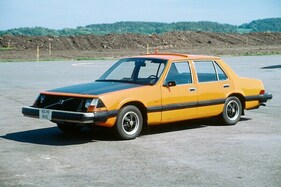
The Volvo VESC was not a particularly attractive concept car. Instead, it combined over 20 safety systems and new exhaust gas reduction technologies. These innovations were successfully tested in a safety car prototype program that had been running since 1969 with a total of ten vehicles and were later incorporated mainly into new Volvo series models.
Volvo VESC as a harbinger of the new vehicle safety
Seat belts, still the most important safety innovation today, have been standard at Volvo since 1959. The Volvo VESC presented a further development: semi-passive front seat belts that automatically buckled when the engine was started or automatically retracted when the driver switched off the engine and left the vehicle.

The Volvo also featured driver and front passenger airbags and, for the first time, airbags integrated into the parcel shelf for rear passengers. Safety head restraints were also new in the rear. Head restraints were also integrated into the front seats, which automatically deployed in the event of an accident. More protection in the event of a frontal collision was provided by the low-mounted engine, which then moved under the passenger compartment, while the pretensioned steering column jumped forward by 15 centimetres, i.e. away from the driver.
The rigid safety body was protected by a network of sturdy beams, innovative side impact protection and a massive roll cage. The fuel tank was mounted centrally under the second row of seats to protect it from collisions and the fuel supply was automatically cut off in the event of an accident. Even in the event of a fall from a height of 2.40 meters onto the vehicle roof, this was only dented by a good 7.5 centimetres.

Minor collisions at speeds of up to 16 km/h did not cause any permanent deformation to the body of the Volvo VESC, as 18-centimetre-thick telescopic bumpers protected against this. In 1972, it was not only a forerunner of today's ABS braking systems that looked futuristic, but also this driver assistance system: a reversing camera with a tube monitor in the cockpit made maneuvering easier and safer.

In addition, there was an acoustic reversing alarm, which was new at the time, and a rear window wiper with washer system. The Volvo VESC also featured warning lights in the open doors as well as a load-dependent automatic height adjustment of the headlights, which in turn were cleaned of dirt by an integrated washing device.
From prototype to mass production
In the Volvo VESC research vehicle, many pioneering safety features still gave the impression of science fiction, but by 1974 some of the innovations in the Volvo 240 had become the new series standard and thus part of everyday automotive life. The safety equipment in the Volvo 240 also impressed the US National Highway Traffic Safety Administration (NHTSA), which used this model, built until 1993, as a reference series for all its safety research.

The Volvo 240 could be ordered in an easily recognizable signal color recommended by road safety experts, which was similar to the orange of the VESC test vehicle. The Volvo 240's huge plastic bumpers were also derived from the Safety Concept. The sustainability approach of the Volvo VESC was also new; the prototype surprised with the introduction of an EGR exhaust gas recirculation system with catalytic converter. Just four years later, the Volvo 240 was launched in California as the world's first passenger car with a regulated three-way catalytic converter and lambda sensor.
Today, both the Volvo Experimental Safety Car and the Volvo 240 are part of the collection at the Volvo Museum in Gothenburg as particularly important milestones in safety research and the development of sustainable vehicle technologies.

There is a detailed report on the Volvo VESC in the Zwischengas magazine archive.