

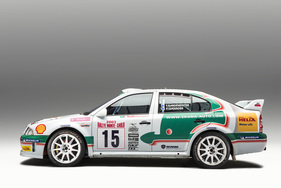
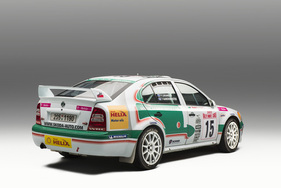
After the success of the Škoda Favorit in the World Cup for vehicles with a driven axle, naturally aspirated engine and a displacement of less than two liters (so-called F2 class) and numerous victories of the Škoda Felicia kit car, the Škoda Motorsport works team also wanted to prove itself in the highest class of international rally sport.
The first generation of the modern Škoda Octavia in 1996 and the decision of the International Automobile Federation (FIA) to introduce the WRC (World Rally Car) category in 1997 came at just the right time. Unlike previously in Group A, manufacturers who did not build supercharged special vehicles with four-wheel drive could now also take part. It was no longer necessary to produce a limited road version of the respective vehicles for homologation. It was therefore sufficient if the racing car was based on a series-produced model.

The design of the Octavia WRC was not particularly complex, as the company had previously only gained experience with modifications to the mid-range model during the development of the Škoda Octavia kit car with front-wheel drive. Consequently, components from the Group's shelf were used, thus relying on tried and tested components.
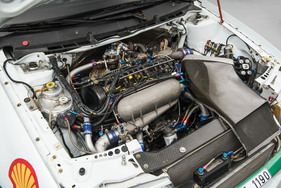
The WRC car was powered by a turbocharged two-liter engine with five-valve technology. It produced 221 kW (300 hp), with an initial torque of 500 Nm at 3,250 rpm and later up to 600 Nm. The unladen weight of the car was 1,230 kilograms and thus corresponded to the minimum value stipulated in the regulations. In the course of 1998, the technicians began to test the first examples, struggling with the scheduling of the first official use of the new car in the World Rally Championship.

The number one driver of the new Škoda Octavia WRC was the experienced German driver Armin Schwarz, who was considered one of the best test drivers in the rally scene at the time. His experience and intuition proved to be decisive in the set-up of the new rally car. The second driver was one of the two successful Czech drivers Pavel Sibera or Emil Triner, depending on the surface on which the rally was being held.
The Škoda Octavia WRC made its debut in the 1999 season at the legendary Monte Carlo Rally. The car manufacturer used the first season in particular to further adapt the car's setup and gain initial experience. In the last race of the season, the famous British RAC Rally, the Belgian Bruno Thiry almost achieved a place on the podium, finishing fourth overall.

Over the years, several drivers from the international rally elite have driven the Czech car. In addition to the above-mentioned trio, these included Bruno Thiry, Luis Climent, Roman Kresta, Jan Kopecký, Gabriel Pozzo, Toni Gardemeister, Kenneth Eriksson, Didier Auriol, Matthias Kahle and Stig Blomqvist.
The Škoda Octavia WRC is an important chapter in the history of Škoda Motorsport. It achieved victories in special stages, finished on the podium (Armin Schwarz, 3rd place overall in the 2001 Safari Rally) and proved its reliability on the international rally tracks. This prepared the ground for the manufacturer's next racing car in the WRC.


