


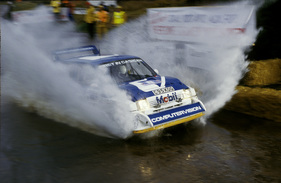
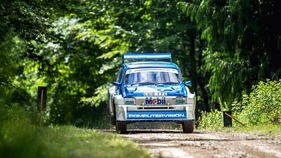


Many rally cars from Group B, which was held until 1986, are still familiar to car fans today: Audi Sport quattro, Lancia Delta S4, Peugeot 205 T16 Turbo, Ford RS200 ... The underdogs are often forgotten, such as the Englishman who only entered the rally stage shortly before the final whistle - the MG Metro 6R4. Derived from a small car that had already appeared in 1980, this racer relied on powerful Bilstein gas pressure shock absorbers and independent suspension, just like the majority of the establishment. Its engine, however, was an exotic one-off that was not powered by a turbo, as was usual in Group B circles, but relied entirely on natural ventilation.

The three-liter six-cylinder engine was only loosely related to Rover's V8 and was otherwise an MG creation. With the large-volume naturally aspirated engine, the aim was to beat the competition, which was still plagued by turbo lag. However, the supercharged fraction unleashed a veritable performance storm that swept the maximum 416 hp MG Metro 6R4 from the top places. To the car's credit, however, it must be said that the engine often tripped itself up due to its unreliability. The basic concept of the vehicle certainly had potential, as the initial success at the Lombard RAC Rally at the end of 1985 proved. There, the Metro was only beaten by two significantly more powerful Lancia Delta S4s and finished in third place. However, the "rolling spoiler" could hardly earn any further laurels in Group B. To make matters worse, the series was discontinued after the 1986 season due to a number of tragic accidents.

For the still young 6R4, however, this decision by no means meant the end of its career. Quite the opposite: as a popular rallycross car, it really came into its own and experienced a second spring, with some of the most powerful variants featuring a retrofitted turbo. The engine of the potent Rallye-Metro even had a much bigger career ahead of it - when the 12-cylinder engine initially intended for the Jaguar XJ220 super sports car was dropped for cost reasons, its time had come. With the addition of two turbochargers and half a liter of displacement, it went on to earn its keep in what was then the fastest road-legal vehicle in the world. With its 549 hp, the Jaguar reached almost 350 km/h during test drives - or 220 miles, as the model name XJ220 suggests. Incidentally, the name abbreviation for the Metro 6R4 stands for "six-cylinder", "rally car" and "4-wheel drive". Apart from the engine, this recipe for a Group B racing car doesn't sound all that exotic.
