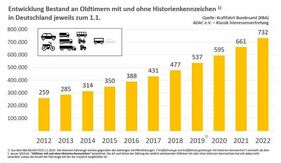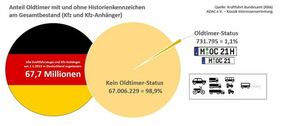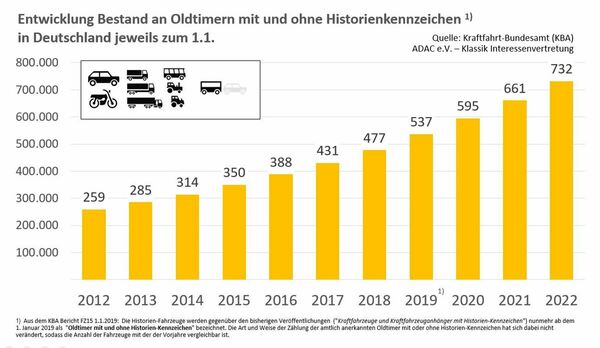
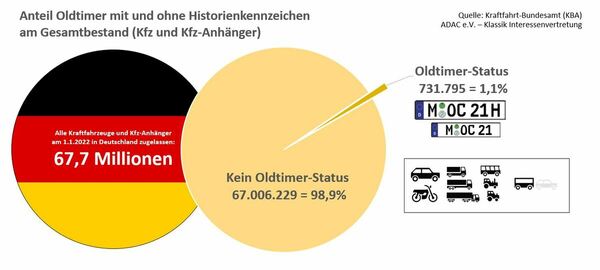
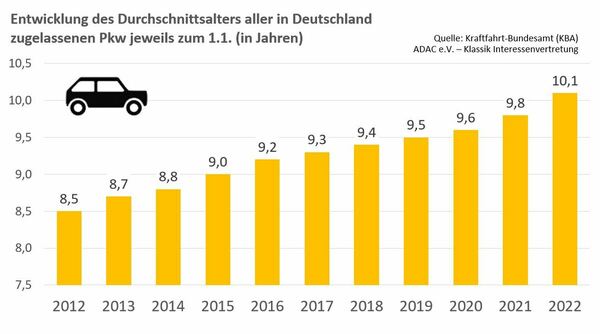
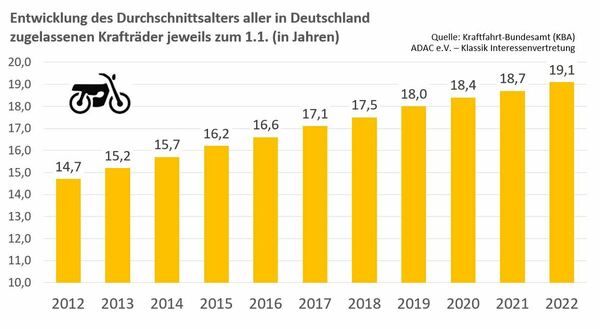
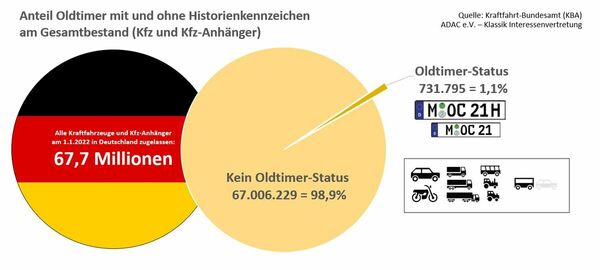
The German Federal Motor Transport Authority (KBA) has published the inventory figures as of January 1, 2022, which the ADAC has now evaluated. The car club's report shows that the number of classic cars (cars, motorcycles, trucks, tractors, buses, etc.) registered in Germany rose by 10.8 percent to 731,795 in 2021. This means that 71,275 more classic vehicles were registered in Germany on the reporting date than in the previous year. The total number of vehicles rose by just 1.3% to 67.7 million, which corresponds to 850,000 new registrations.
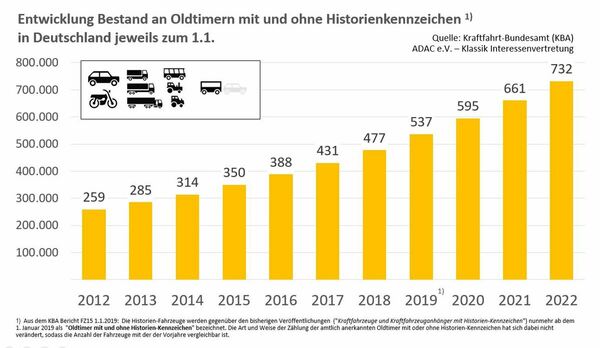
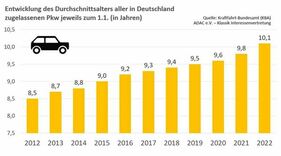
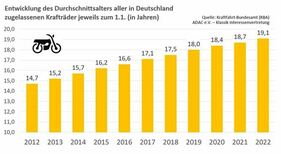
Compared to 2012 (259,000 vehicles), the number of classic cars has almost tripled. This development is also reflected in the average age of the entire German vehicle population, which has exceeded ten years for the first time. Nevertheless, classic cars only make up 1.1 percent of the total vehicle stock.
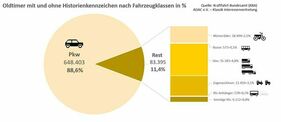
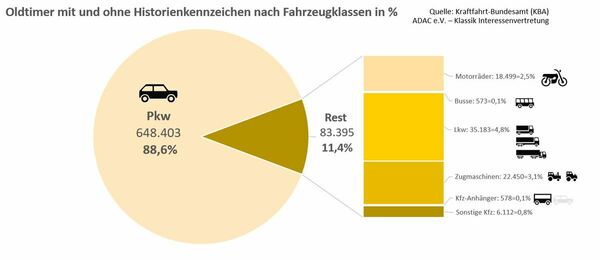
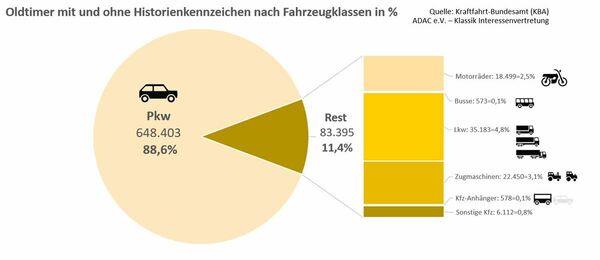
Passenger cars naturally account for by far the largest share of classic cars with 648,403 registered vehicles (88.6 %), followed by 35,183 trucks (4.8 %) and 22,450 tractors (3.1 %). Historic motorcycles ranked just fourth with 18,499 units (2.5 %).
The total number of German cars that are 30 years old or older is 1,130,909, meaning that just 59.3 percent of them are officially recognized as classic cars - which, according to the KBA, is possible even without an H license plate.
Note from the KBA:
Compared to the previous publications ("motor vehicles and motor vehicle trailers with history license plates"), the history vehicles are now referred to as "classic cars with and without history license plates" as of January 1, 2019. The way in which the officially recognized classic cars with or without history plates are counted has not changed, meaning that the number of vehicles is comparable to that of previous years.
This is supplemented by the "Definitions of vehicle registration statistics":
Classic cars: Vehicles that were first put on the road at least 30 years ago, correspond as far as possible to their original condition, are in a good state of preservation and are used to maintain the vehicle's cultural heritage (§ 2 number 22 FZV). They can be recognized as classic cars by means of a corresponding certificate in accordance with § 23 StVZO. Since 01.01.1997, vehicles that have been recognized as classic cars can also be given a special registration number (history registration number). In most cases, this special status has the effect of reducing the motor vehicle tax. In the official statistics, only those vehicles are shown as classic cars that are identifiable as such in the central vehicle register.
This is the case if the owner has the emission class changed accordingly when registering his officially recognized classic car (with or without the allocation of a history license plate) in order to be able to claim tax benefits. However, they can also have a history license plate registered for their officially recognized classic car without this change. It follows from the above that officially recognized and registered classic cars without the corresponding identification features (specific emission class, history license plate) cannot be shown as such in the official statistics.