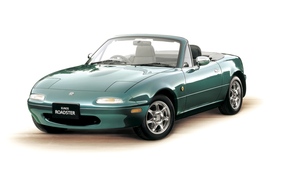
It's unbelievable how quickly time flies. The Mazda MX-5 celebrates its 25th birthday!

In February 1989, Mazda presented the small sports car at the Chicago Auto Show, triggering a storm of enthusiasm that even Mazda had probably not expected. To date, over 900,000 vehicles have been produced in three generations.

"Game Changer"
The Mazda MX-5 is reminiscent of the lightweight and simply designed sports cars of the sixties and seventies that enjoyed success all over the world. Affordable driving fun, agile handling and the sun on your neck - at the end of the 1980s, these were characteristics that the car industry seemed to have lost or were reserved for the luxury class (Mercedes SL, Porsche 911 Cabrio, Rolls-Royce Corniche, etc.).
was reserved for the luxury class. Mazda saw a niche and filled it.
The design of the Mazda is an ode to the Lotus Elan, which MX-5 inspirer Robert L. Hall counted among his favorite cars. The roadster was aimed at Americans, who had always had a soft spot for simple English classics. In fact, the MX-5 resembled its spiritual father, the Lotus Elan, but unlike the plastic sports car from England, it had a self-supporting body made of sheet steel and therefore weighed a little more. The American version with airbag and contemporary safety features weighed 972 kg.
With its 115 hp 1.6-liter four-cylinder engine, the MX-5 accelerated to 100 km/h in 10.5 seconds and reached a top speed of 185 km/h, at least in theory, as this was of course not allowed to be measured on the road in the USA when the first tests were published in the German-language press.

It was initially only available to buy in America and Japan, Europeans had to wait.
A variety of names
It was called the Mazda Miata in the United States and the Eunos Roadster in Japan. The first direct imports reached our latitudes as early as 1989, but the car could only be ordered in 1990 as the "MX-5", as it was known in Europe.
At that time, the Japanese had long since realized that the original target of 5000 vehicles produced per year would probably not be quite enough. But despite increases in production, demand was much greater than supply.

When dealers in Europe started accepting orders, the annual quotas were sold out within days. By picking up the phone and without any discount, the lucky Mazda sales partners were able to allocate their few vehicles (900 were planned for Switzerland in 1990), which were originally only available in blue, red, white and silver. No wonder the gray import business flourished.
The car cost USD 15,000 in America, DM 35,500 in Germany and CHF 29,300 in Switzerland, albeit (initially) without an airbag, which made it easier to retrofit a nice sports steering wheel ...
Simple and inexpensive
And what did you get for this considerable sum of money? A simple and user-friendly, truly open-top car with a sound reminiscent of the MG B and an ingenious soft top that could be opened by hand in seconds without having to leave the car.
The European version apparently ran a little better than the American version, the Automobil Revue managed the sprint to 100 km/h in 9.8 seconds and the top speed was correctly verified at 185 km/h. The fuel consumption remained the same. The fuel consumption remained at the popular level of 9.1 liters per 100 km, and the 3.95-meter-long and 1.68-meter-wide Japanese car excelled in the range below 100 km/h in particular with low consumption values, e.g. an average of 5.6 liters at a constant 80 km/h.

The design of the folding headlights was not necessarily convincing, the trunk was of modest dimensions and the Californian designers had not necessarily thought of attaching European license plates to the front, but these were minus points that hardly mattered. After all, there was finally a convertible that people could afford again. And the whole world took notice, triggering a real convertible boom that other manufacturers could not stand idly by and watch. That's a good thing!
500,000 units after 14 years
The success of the lively Mazda exceeded all expectations. By 1994, 300,000 vehicles had already been produced, and in 1999, 500,000 units were produced.

By then, however, the MX-5 had already been given a successor, which was presented in 1998 and did away with the folding headlights, appearing somewhat softer and more cumbersome overall. However, this did not stand in the way of continued success.
Guinness Book record holder
In 2000, the MX-5 made it into the Guinness Book of Records as the most-produced two-seater sports car to date.

Right from the start, Mazda's marketing strategists managed to make the car even more attractive with special edition models. Countless editions were sold, including a version in British Racing Green and with brown leather seats, which was sold in Germany with the slogan "vely blitish".

In 2004, a new turbo version provided more power; the engine's displacement had already been increased to 1.8 liters.
Complete redesign
In 2005, a completely redesigned version of the MX-5 was presented at the Geneva Motor Show, whose design had been adapted to modern times and looked really fresh again. At that time, the first MX-5s were already enjoying growing interest from the youngtimer faction.

The new MX-5 also sold well, with power rising to 118 kW or 160 hp (at 7,000 rpm). In 2009, a Superlight version was shown as a prototype at the IAA, the weight of which was reduced again from 1130 kg to 995 kg thanks to many measures.

The variant with retractable hardtop introduced in 2006 also contributed to the general increase in weight.

In 2007, Mazda reported 800,000 cars sold and to date over 930,000 have been produced, so the million mark is not far away.
To mark its 25th anniversary, Mazda has now also launched its own (English-language) website, which summarizes the history to date.
Further information
- ADAC Motorwelt No. 4 from April 1990 - Page 14: Encounter of the new open kind
- AR-Zeitung No. 10 / 1990 from March 8, 1990 - page 41: English role model - Japanese makers - MX-5 in Switzerland
- AR-Zeitung No. 22 / 1990 from May 24, 1990 - Page 21: Test Mazda MX-5