




It is now exactly 50 years since the Ford Transit saw the light of day on August 9, 1965.
It did not take over much from its predecessor, the FK 10000 - only the principle of the drive with a longitudinally mounted engine at the front and driven rear wheels remained the same.
Public interest was already high during the development phase, with speed tests being carried out on public roads in England. The local police became accustomed to the mostly night-time tests. Nevertheless, Ford engineers were often stopped to inquire about the progress of the tests.

The international project was a huge success and the Ford Transit immediately catapulted to number one in the van registration statistics in the UK. It has held this position ever since.
It took Ford another three years to produce the first 100,000 Transit units, but then things took off: the first million were reached after eleven years on September 15, 1976 and the 8 million threshold was exceeded in 2013. It can be assumed that the next mark of nine million will be reached this year with the 4th generation of the Ford Transit.
Statistically speaking, customers buy a Transit every three minutes on average. If all the Transits ever produced were parked in a row, this queue of vehicles would circle the globe once.

For 50 years now, the Ford Transit has played an important role in the lives and work of millions of people. Whether on construction sites, delivering parcels or transporting patients to hospital, people all over the world rely on the Transit.
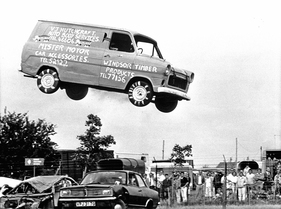
Numerous rock and pop groups started their first tours in the Ford Transit, including Coldplay, Status Quo and The Tremoloes. The British police described the Ford Transit as the "best getaway vehicle of the 70s" due to its driving characteristics and versatility, and it also became the first utility vehicle in the world that could jump over 15 cars. Stuntman Steve Matthews performed the feat in 1985 to raise money for cancer research.
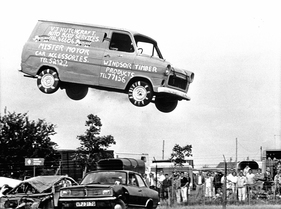
The London Regents Park Zoo, which transported two baby elephants, as well as 48 students from the British Barking College, who squeezed into a Ford Transit minibus in 1965, or a model maker from Kent, who created a life-size, 15-metre-long replica of a Cetiosaurus in a natural history park in Edinburgh, proved that the Ford Transit offers plenty of space and can take a lot more.

The Ford Transit of Spaniard Juan Garcia also amazed us, as his Ford Transit station wagon was buried by snow, but he himself was saved. Six months later in spring, he was amazed that his vehicle had survived the winter at an altitude of 3,000 meters virtually unscathed - and he drove the Ford Transit home safely.

