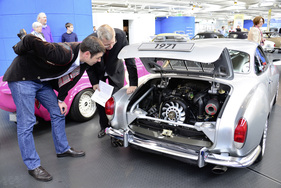
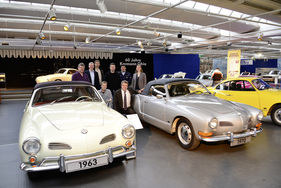
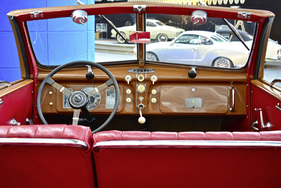
In 1955, the first series-produced Karmann Ghia Coupé (Type 14) rolled off the production line in Osnabrück. To mark the 60th anniversary of this elegant, timeless Volkswagen with Italian charm in 2015, the Volkswagen AutoMuseum is celebrating with the special exhibition "Beetle in sports dress". From January 29 to April 11, 2015, the show presents the success story of this model - from series models to converted one-offs.

First prototype as early as 1953
As early as 1953, Wilhelm Karmann presented Volkswagen General Director Heinrich Nordhoff with the prototype of a sporty coupé based on the Beetle. Karmann had commissioned the design from his friend Luigi Segre, owner of the Italian coachbuilder Ghia. The vehicle study is now on display in the AutoMuseum. Nordhoff approved the design and Karmann was commissioned to develop the car further until it was ready for series production.
Start of production in 1955
The first Karmann Ghia Coupé rolled off the production line in the spring of 1955. The first model series can be recognized visually by the small indicators and the "nostrils" as well as the low-set headlights. In the course of its 20-year evolutionary history, the Karmann Ghia received numerous visual upgrades in addition to technical improvements, including the 50 hp / 37 kW engine with a displacement of 1.6 liters:
With the second series in 1959/60, the front end was redesigned, the rear lights were changed and the rear windows could now be opened.

Continuous model upgrades
In 1969, slightly larger tail lights and rear cat eyes were added. And in 1971 it was given massive box bumpers and even larger rear lights, and the interior was also significantly refreshed. One representative of each evolutionary stage of the Karmann Ghia can be admired in the special exhibition.
Specials
The versatility of what is also possible with the Karmann Ghia is demonstrated by unique vehicles converted by enthusiasts, such as the Karmann Ghia Cabriolet with electric drive or the Coupé completely upgraded with Porsche 993 technology.
Also on display is a Karmann racing car from South America - Emerson Fittipaldi began his motorsport career in one of these cars. In addition to other prototypes such as the EA 47-12, a four-seater Volkswagen study with Ghia elements, the history of its "big brother", the Karmann Ghia Type 34 - also starting with the 1960 study - is also highlighted.
And of course, Karmann also developed into a global player very early on: The establishment of a plant in Sao Paulo, Brazil, was due to the rigid import regulations in the South American country, which were expensive for European goods. In addition to the Karmann Ghia Coupé and Cabriolet, a variant was also developed just for Brazil - the Touring Coupé TC 145.
A lot of coachbuilder tradition
The Karmann Ghia was preceded by a long tradition of Wilhelm Karmann as a coachbuilder and coachbuilder. In 1901, he took over the business from the widow Klages in Osnabrück in order to produce customized bodies in the future. He designed and produced numerous car bodies, particularly for the car manufacturer Adler in Frankfurt/Main. At the end of the 1940s, the decades-long cooperation with Volkswagen began, starting with the Beetle Cabriolet. Karmann also built bodies or complete vehicles for other car manufacturers such as BMW, Chrysler, Ford, Hanomag and Mercedes.
Broadly based
It took the support of private Karmann Ghia enthusiasts and Volkswagen Classic/Automobilsammlung Osnabrück to realize the exhibition in this diversity. The lenders have kindly made their gems and associated memorabilia available, from model cars to historic press photos. The exhibition can be viewed from January 29 to April 11, 2015.