


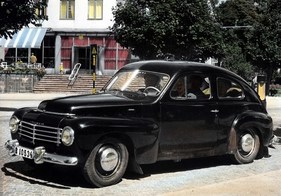


With the PV444, Volvo became a globally successful car manufacturer. The sedan with its streamlined design and pioneering safety technology was developed as an affordable mass model and exceeded all sales expectations right from the start. While Volvo had previously built a maximum of 2,000 units of a model series, a total of 195,959 vehicles of the advanced Volvo PV444 had been sold by 1958. Together with the further development of the Volvo PV544 and the Volvo Duett PV445 and P210 estate versions, which were also popular with families and recreational sports enthusiasts, sales amounted to over 540,000 units by 1969.
From "peace car" to brand ambassador and cult car
The Volvo PV444, initiated by Volvo company founders Assar Gabrielsson and Gustaf Larson, celebrated its premiere in Stockholm in September 1944 as a so-called "peace car". The price for this model, which was positioned as the first Volvo "small car" despite its impressive dimensions, was a reasonable 4,800 Swedish kronor, the same as the price charged in 1927 for the Volvo ÖV4 "Jakob", with which the company's history had begun.

As the shortage of raw materials and materials continued after the end of the war and costs rose, series production of the Volvo PV444, now priced at 6,050 crowns, did not get underway until early 1947. However, all those who pre-ordered this first car with a self-supporting safety body, innovative laminated glass windshield and independent front suspension still received their vehicle at the original price.
First place in the Swedish new registration statistics
The sales success of the Volvo PV444, powered by an efficient and robust four-cylinder engine with 29 kW (40 hp), led to an increase in production from the originally planned 8,000 to 12,000 units. With its aero design, the Volvo PV444, initially painted exclusively in elegant black, even won international Concours d'Elégance, which in turn boosted exports. From 1949, the so-called Roto-Dip phosphate coating increased the rust protection of the body, which was important for the lasting stability of the safety structure.

When all material bottlenecks were finally overcome in 1950, the fastback sedan catapulted Volvo to first place in the Swedish new registration statistics for the first time and shortly afterwards the Volvo PV444 was considered the "most important imported vehicle of all time" in the USA. This was helped by the fact that the mid-range car, which won many rallies and was advertised as a "family sports car", was also available with a 63 kW (85 hp) sports engine from 1955. Despite this, fuel consumption remained extremely low at 6.7 liters of petrol/100 km.
Even with an estate body, the car gained cult status as the PV445 Duett introduced in 1953. In 1958 and 1960, the saloon/station wagon duo was revised and from then on was called the Volvo PV544 and Volvo Duett P210 respectively. When the career of the humpback models came to an end 21 years after their debut - the Duett was even built until 1969 - Volvo said goodbye to the model series in advertisements with the words "Farewell, old friend".

Pioneering safety technology
The Volvo PV444 owed its sales success not only to its characteristics as a versatile family car, but also to its pioneering role in the field of vehicle safety. In particular, the development of the three-point seat belt began in the Volvo PV444. As early as 1956, a manual for the Volvo PV444 presented retrofittable harness seat belts, which were attached to the front seats and could be purchased as accessories.
The really important steps, however, were the firmly anchored two-point seat belts in the Volvo PV444 and finally the pioneering three-point seat belts installed in the further developed Volvo PV544 from model year 1959. With these innovations, Volvo consolidated its expertise in the field of safety research.
