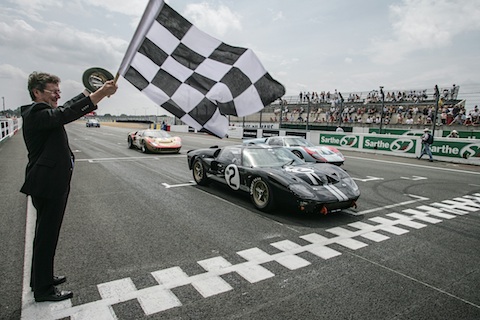
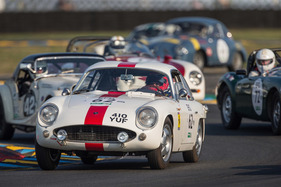
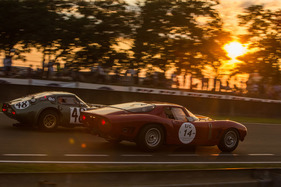
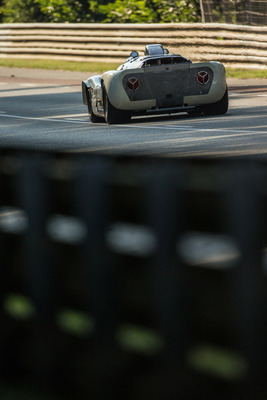
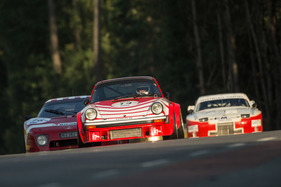
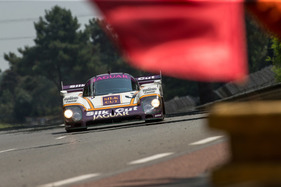
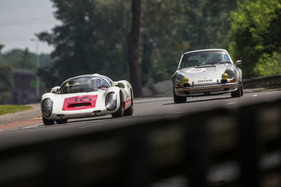
With 135,000 spectators, a new record was set at the ninth Le Mans Classic from July 6 to 8, 2018. The event on the legendary circuit in the Sarthe was organized by Peter Auto for the first time in 2002 and quickly rose to the top 5 in the world. Three weeks earlier, 256,000 people made the pilgrimage to the 86th 24 heures du Mans to watch Fernando Alonso's winning drive in the Toyota.

Full house
It was full house again at Le Mans. With 800 racing cars and around 1000 drivers, the French city once again became the Mecca of motorsport, only this time with a historical twist.
The absolute party went on every evening in the small village of Arnage, not far from the bend of the same name, where mainly English and Dutch drivers went full throttle. At one of the traffic circle exits, a self-appointed race director and party clown gave the signal for burnouts. He took no notice of three Cyclecars and wanted to force them into a launch control start. But the few horsepower were not enough to get the wheels spinning. Nevertheless, the crowd was enthusiastic and cheered. The police turned a blind eye for once.
In addition to all the Ferraris and Lamborghinis, a Lotus Esprit with an illuminated engine suddenly joined them and drifted around the traffic circle. It let the flames escape into the open via the exhaust.

Six plateaux and additional starting fields
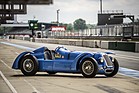
The 800 racing cars were once again divided into six different classes in 2018, each of which took over the track for a period of time. The vehicles were sorted by age group: plateau 1 comprised the cars from 1923 to 1939, plateau 2 those from 1949 to 1956, plateau 3 the model years 1957 to 1961, plateau 4 those from 1962 to 1965, plateau 5 the years 1966 to 1971 and plateau 6 the cars from 1972 to 1981.

In addition, around 50 Group C racing cars from the eighties and nineties also took part in the race. If you know what preparation is required to drive such a car, then you can only take your hat off to all the enthusiasts who go to such lengths.
The criterion for entry is that the type of car has already raced at Le Mans in its active time, and the entry fee excludes those who are too thrifty from the outset.
The monster on the circuit
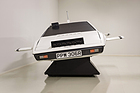
Probably the ugliest car by far at the ninth edition of the Le Mans Classic was a Cadillac with aerodynamic bodywork. It started in 1950 as the second car alongside a '61 production coupé. The two cars finished in 10th and 11th place, and the French called the "pizza tray": "Le Monstre". The design, if you can call it that, came from Howard Weinmann.

The car had a tubular frame with aluminum panels, powered by a 331 V8 OHV engine, whose power was transmitted to the rear axle by a three-speed gearbox. Its weight of 1678 kg was very high, in keeping with its appearance. What took some getting used to in 1950 has lost little of its beauty to this day. But it was something special to see this "part" driving on the Sarthe circuit.
Turbine power
Certainly the most interesting car was the Howmet TX turbine car from 1968. Powered by a helicopter turbine, it is the only victorious racing car with a gas turbine drive. Although it was not the first attempt to use a gas turbine in racing, no other project was truly convincing. Ray Heppenstall's design won two SCCA (Sports Car Club of America) races.

The TX later set six FIA land speed records for gas turbine cars. And laid down its very special soundtrack again in 2018.
Lapped several times
Perhaps the most atypical Le Mans racing car was the Panhard Dyna X84 with its 610 cc twin-cylinder engine.

A car that virtually starved on the long straights and was constantly and repeatedly lapped. But it was clearly the spectators' favorite and the applause was guaranteed lap after lap.
Beauty award
As the most beautiful car, the sports prototype enthusiast is torn between the Ferrari 512S from 1970 and the Porsche 917 longtail from 1969. If you factor in the sound and the color, you'd rather give the points to the Italian.

But there was also a struggle for beauty points off the track. A Toyota 94 CV came out on top as "Best of Show" in the Le Mans Heritage Club Concours. A class victory (age group 1972 to 1981) went to the Porsche 930 Turbo, which had finished 15th overall in the 1975 24 Hours with Claude Haldi at the wheel, among others. Nota bene, this was a road-going Turbo that was only marginally optimized for the 24-hour race and is now road-legal off the race track.

The other class winners were:
Class 1923-1939: Adler Trumpf Rennlimousine
Class 1949-1960: Triumph TRS
Class 1961-1971: Sunbeam Alpine
Class 1982-1991: WM Peugeot P88
Class 1992-2018: Toyota 94 CV
There were also special prizes for a Tracta Gephi, a Simca 8, a WM Peugeot P88, a Ford GT40 and a DB Coach Gignou.
Not everyone was lucky
The unlucky driver of the weekend was certainly Christian Traber. The 2016 Prewar winner broke down in his Talbot on the very first lap with a hole in the piston. After such a journey and so much preparatory work, it is particularly bitter not to be able to complete a single flying lap.
Not everyone expected on site
The absence of the weekend was Jensen Button. The ex-F1 world champion was entered in Group C with a Jaguar XJR-9 with starting number 1.
Together with Jan Lammes, the Briton would have been the second driver to start in both the modern and historic races.
70 years of Porsche
There was only one brand of the weekend: Porsche. Thanks to the 70th anniversary, there were more Porsches on site than ever before. The sheer number of cars was an indication of a major recall campaign by the brand. The cars from Zuffenhausen were omnipresent not only in the company's own parking lot, but also on the race track.

There was a dedicated Porsche plateau with, of course, exactly 70 participants. From the 356 to the 910, pretty much everything the 19-time Le Mans winner from 1953 to 1975 had to offer was represented.
Driving legends in action
Personalities such as Jochen Mass, Derek Bell, Jürgen Barth, Marco Werner, Jacques Lafitte, Henri Pescarolo, Jan Lammes, Romain Dumas, Jean Ragnotti, Gerard Larousse, Stéphane Ortelli and many more were also on site and drove themselves. Even Felipe Massa was there for the first time at the invitation of Richard Mille and immediately showed his enthusiasm.
Cold deformations and technical problems
Not all the vehicles could be loaded back into the trailer in the same way as they were brought here.

A Jaguar E-Type, for example, suffered a severe cold deformation and even worse was the fate of the beautiful long-tail Porsche 917, which crashed in "Tetra Rouge" on the very first lap of the night practice session and caused the practice session on Plateau 5 to be aborted.

The damage could not be repaired in a hurry and so unfortunately the fantastic car could no longer be admired in the race.
A little tip for all fans: It is better to arrive earlier and not stay until the end. Because some very interesting cars could only be seen in the two practice sessions on Friday.
Around the clock
As always, the schedule at Le Mans was tight and tight. It was certainly no wellness weekend and there was hardly any time for repairs or refreshments. The event began at nine o'clock on Friday morning and ended at three o'clock on Saturday morning. From Saturday at eight to Sunday at sixteen, the program ran non-stop.

What Patrick Peter and his team have put together is certainly unique. The traffic jam to the race track on Saturday morning was longer than that of the modern "24 Heures". The temperature was around 18 degrees Celsius higher and was just as much a strain on the engines as on the circuits. Many were unable to start the race after suffering engine damage in practice, while others ended up in the emergency room of the track hospital with a collapse.
Comparison with modern times
The difference between the modern "24 Heures" and the historic event was mainly evident in the hectic pace in the pits. While the winning Toyota came in 37 times to refuel and change tires on 16/17 June 2018 alone, each historic car made one stop per stint (4 in total) with a predetermined standing time. This made the pit lane of the historic event seem almost like a vacation camp in contrast to the event held a few weeks earlier.

Of course, the "speed" on the track is the main difference. Kazuki Nakajima in the LMP1 Toyota, for example, needed a ridiculous 3m 15.377s to cover the 13.626 kilometers for pole position.
In comparison, the fastest times on the historic plateaus:
Plateau 1: G. Burnett in a Talbot 105 GO52 from 1931: 5:50.203
Plateau 2: C. Monteverde/G. Pearson/A. Smith on aguar D-Type from 1955: 5:04.654
Plateau 3: C. Monteverde/G. Pearson/A. Smith on Lister Jaguar Costin from 1959: 4:51.328
Plateau 4: S. Lynn on ord GT40 MKl from 1965: 4:36.789
Plateau 5: G. Lopez/R. Maeden on Lola T70 MKlllB from 1969: 4:13.225
Plateau 6: Y. Scemama on Toj SC304 from 1976: 4:08.931
Group C: I. Vercontere/R. Kelleners in a Porsche 962C from 1990: 3:51.461
Compared to the 2018 models in June 2018, the old racing cars were a little more leisurely, but the driving dynamics of the individual cars were much more recognizable and therefore the fascination of watching them was much greater.
And the winners
Of course there were also winners. These are mentioned here, whereby we focus on the overall winners per plateau.

In the pre-war racing cars, G. Burnett won two of the races in his 1931 Talbot 105 ("GO 52") and also took the overall victory, ahead of another Talbot 105. 3rd place went to R. Spencer with a 1928 Bugatti 35 B.
Plateau 2 was won by C. Monteverdi / G. Pearson and A. Smith in their 1955 Jaguar D-Type, albeit with a lead of only around three seconds over another D-Type.
R. Wills / D. Clark were the winners in Plateau 3, driving a 1958 Lotus XV and taking around 25 seconds off the second-placed 1961 Ferrari 250 GT Breadvan.

In Plateau 4, the Ford GT40s dominated, but there were a few incidents involving open doors and accidents. D. Ferraro came out on top in the end. The first Cobra only followed in 4th place, with the two Iso/Bizzarrini cars finishing 8th and 10th.
Plateau 5 was won by J. Nicolet in the 1972 Duckhams Ford, which was not particularly successful during his active time. However, he was also helped by the retirement of the very fast 1971 Ligier JS 3 DFV in the third race.
C. Scemama won the youthful Plateau 6 with a total lead of four minutes. His 1976 Toj SC 304 was clearly superior to the competition. However, Urs Beck's third place in the 1980 Coca-Cola-Porsche 935 K3 is certainly worthy of note.

In Group C, which only had one race, Michael Lyons won in the 1991 Gebhardt C91, another car that could not keep up with the fastest in its active time, but is now in top form. Second place went to Shaun Lynn in the beautiful 1987 Jaguar XJR-9, followed by three other Jaguar prototypes.