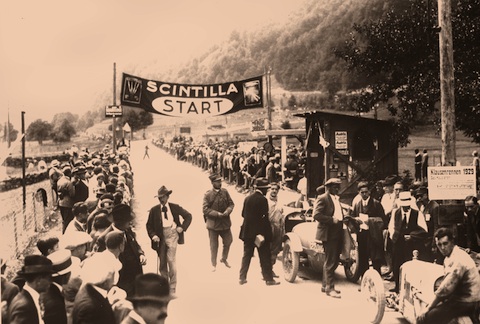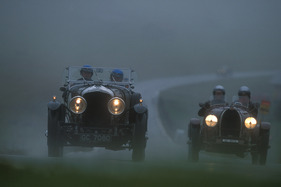


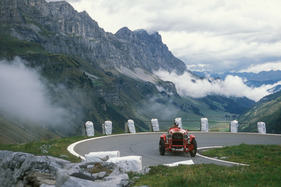

It was a gigantic event in every respect. The budget amounted to two million francs, and 600,000 had to be spent on security alone. In 1932, around 30,500 paying spectators followed the action of the race, which was last held in 1934, which was a record; according to estimates by the organizer BBO, there were also around 30,000 over all four days on the weekend before last.
The fact that no records were broken on the 21.5 km course from Linthal up to the 1952 m high Klausen Pass was partly due to the regulations (neutralization on the Urnerboden) and partly due to the weather, which was changeable in the first race run on Saturday afternoon and only wet in the second run on Sunday. However, it could have been much worse, as the Klausen Pass even had to be closed for a short time on Tuesday due to the onset of winter.
The event was also gigantic in terms of the number of participants. Of the 400 registered racing cars, 362 passed technical scrutineering. In categories A (75 sports and racing cars) and C (67 two- and three-wheelers), the race was purely for the best time, while in categories B (168 cars) and D (52 two- and three-wheelers) the aim was to come as close as possible to the ideal time of 50 km/h average.
Overtaking maneuvers
In order not to put too much strain on the time schedule, a vehicle was sent on its way every 15 seconds, which meant that the different speeds led to a number of overtaking maneuvers without the right to repeat the race.
It is clear that some of them fell by the wayside in one of the two race heats, mostly because the technology, but in some cases also because the driver was overtaxed. Urs Müller from Basel, for example, wrecked his beautiful Maserati 6CM on a tunnel wall in the very first practice session - despite being warned in advance.
However, with the exception of one motorcyclist who crashed, the few accidents were without personal injury, which is not a matter of course as the long route could not be 100% secured for cost reasons.
Nevertheless, 97 vehicles in the race categories made it to the finish twice, which was a prerequisite for classification. Of the more leisurely drivers, 138 were classified. The retirement rate was therefore around 35%.
Without Ferrari
Unfortunately, the Saturday audience felt a little cheated as they were deprived of some highlights. For example, the two Silver Arrows only drove the practice run, and in the evening "circuit race" in Linthal, the announced F1 Ferraris remained under the awning of their transporter due to the wet conditions.
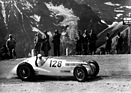
Mercedes-Benz's decision not to start in the first race was due to a problem in the fuel system. The fact that the Stuttgart-based company brought a W196 from 1954 to Linthal instead of the planned W154 was due to an engine problem that still paralyzed the spectacular pre-war racing car. Caracciola set the Klausen record in 1934 with the predecessor model W25.
Audi, on the other hand, had contractually agreed that the Auto Union Type C would only drive up once a day, in contrast to 1998, but on the entire route. After four hours of operation, the 16-cylinder engine would have to be completely overhauled, and with four uphill and downhill runs, this would otherwise almost be achieved.
At least both Silver Arrow drivers did not shy away from the Sunday rain. Mercedes driver Jochen Mass: "I'm not a wimp!" Audi deserves all the more credit for this, as the very rear-heavy Auto Union required a lot of sensitivity from the driver (DTM junior Martin Tomczyk) in the wet, and the one-off car (a full-scale replica), which is insured for several million francs, had to be completely dismantled and cleaned after a race in the rain, which meant five days of extra work.
Victory for three-wheelers
Historic racer Ueli Eisenhut (MG Magnette), on the other hand, didn't care about the weather: "It doesn't matter whether it rains or not. The main thing is that we can take part in this fantastic event." Most people probably shared his opinion.
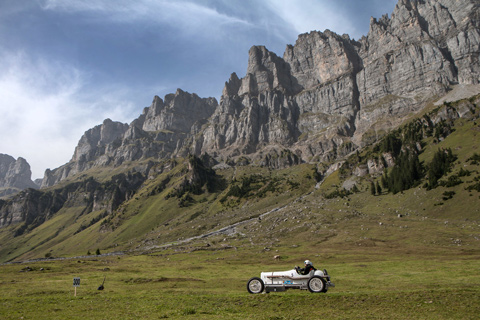
The overall classification was won by neither a traditional car nor a real motorcycle: the best time from two runs was set by Bill Tuer (GB) with his three-wheeled Morgan Racing from 1932 in 29'33.18''. The Liverpool rider had already set the fourth-best overall time in 1998. His little partner could only see the cloudy sky because she was invisible on the passenger seat and was not supposed to offer any unnecessary air resistance. With a vehicle weight of 300 kg and an engine output of 120 hp, every detail counts.
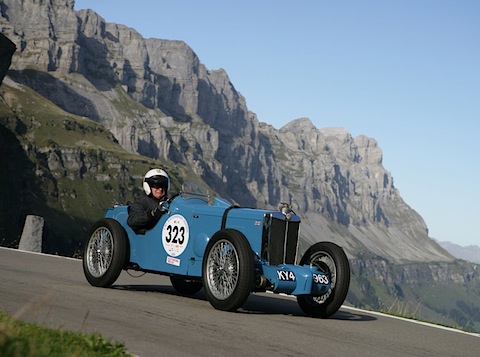
On Sunday in the rain, the fourth wheel on Rod Jolley's car was obviously so much better that he achieved the best time of the day with the Riley Brooke (1936) in 14'49.83'' and the best of any car overall (29'51.67'').
Carlo Vögele's performance in the visually and acoustically sensational Alfa Romeo 158 "Alfetta" was also outstanding; as the best Swiss driver, he achieved the sixth-fastest time in 31'45.19''.