The British are a special people. You can see that as soon as you start queuing. Even on foot, it would never occur to an Englishman to cross the safety line (!) at the tunnels to pass under the Goodwood Circuit. The effect is so convincing that even Grand Prix drivers like Jean Alesi line up at the back without resistance.
And almost without exception, the English (and their guests) are motivated to turn a classic car event into an automotive play in period dress. And they come in droves even when the weather is rainy and chilly. It's just really British.

What Lord March organizes every year at the Goodwood Revival is the best entertainment for the spectators. And this goes far beyond historic racing, as the journey into the past continues in the pits and around the track. It does not stop at the veneration of war veterans who helped secure victory for the Allies with daring actions during the Second World War.
A race track like in the fifties
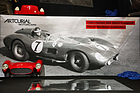
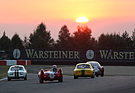
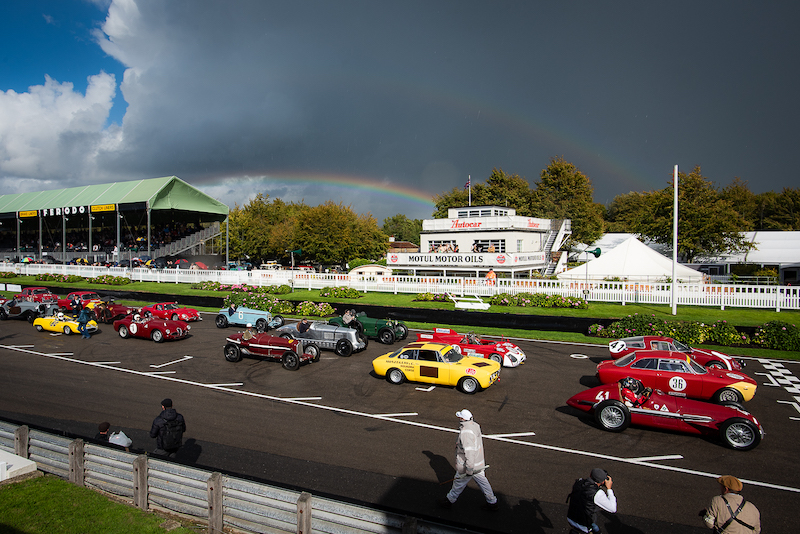
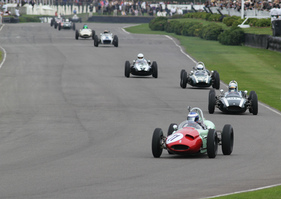
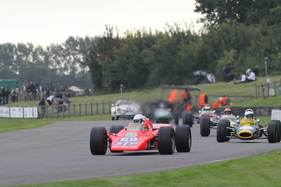
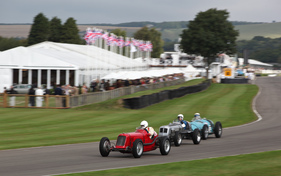
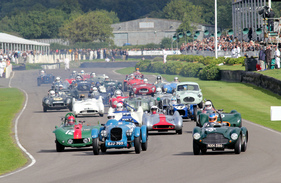
However, the focus of interest is of course on the cars, as these, together with motorcycles, were the attractions of the Goodwood Circuit in its heyday between 1948 and 1964. The 2.38-mile (3.83-kilometer) circuit has remained virtually unchanged and still exudes the spirit of the fifties and sixties. Built on a former military base with its own (grass) airport, it is the perfect base for a trip back in time.
Jim Clark and Jackie Stewart hold the lap record ex-aequo with one minute and 20.4 seconds, which corresponds to an average of 163.4 km/h and shows the character of the fast circuit, which hardly has any really tight bends and today slows the cars down somewhat with a chicane at the start and finish.
Many of the buildings and grandstands are still almost in their original state and only the discreet displays of the sponsors remind us that we are in 2013.
Close to the action
One of the reasons for the success of the Goodwood Revival is certainly the efforts made by the organizer to bring the action as close as possible to the spectators. A well-made program, a race radio that you can hang on your ear, huge screens and competent trackside commentators, as well as live broadcasts via YouTube, Twitter and the Goodwood online platform leave nothing to be desired.
It is a shame that "ordinary" visitors are not allowed in the paddocks (pits), but you are always right in the middle of the action around the track.

Of course, members of certain automobile clubs were particularly privileged to be able to park their cars right next to the circuit, unpack their picnic table and watch the many races in comfort.
Enthusiasm for touring cars
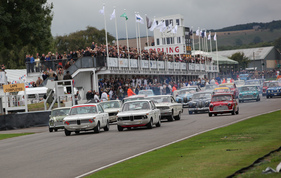
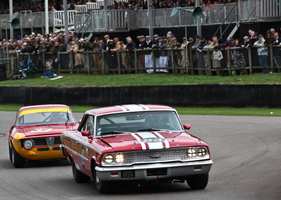
The touring car race is a particular highlight every year. Different vintages alternate, and this year the St. Mary's Trophy was for touring cars from 1960 to 1966. The field of vehicles was rich and, above all, technically diverse. Front- and rear-wheel drive were at the start, as were narrow-chested 1.2-liter engines and huge seven-liter V8 bigbangers.

It was exciting to see how the Mini Coopers drove relatively far to the front in practice on the damp track and even took pole position with Oliver Gavin. They were followed by three BMW 1800 TiSAs, driven by Johnny Cecotto, Jackie Oliver and Steve Soper. Jochen Mass was fifth in one of the three Ford Galaxie 500s . The Lotus-Cortina, the Ford Anglia, the Renault R8 Gordini, a 1965 Isuzu Bellett, a Mercedes-Benz 300SE, a Vauxhall VX 4/90 and a Fiat-Abarth 1500S as well as several Alfa Romeos, including Frank Stippler's 1600 GTA, were unable to compete at the front.
But in the first race, which was contested by the professional drivers, everything turned out differently. Stippler started a furious race to catch up from 15th place, which took him to the front on lap 9. But the fast Alfa, whose engine had had to be replaced for Goodwood and was still clocking up kilometers in practice, had not reckoned with Tom Kristensen, who put his Ford Galaxie 500 ahead of the Alfa shortly before the end. This made him the fourth leader in this exciting race, Jackie Oliver had led the first laps in the BMW, Jochen Mass had taken over from him until the Stippler-Christensen express train passed him.

Despite slipping to third place, Mass was delighted: "These Galaxie 500s are wonderful to drive, incredibly good-natured; you're almost always forced to drive crossways because you can hardly get the power on the ground."
On Sunday, in the second race, the amateurs (and mostly owners) get behind the wheel of the fast touring cars. Bill Shepard in a Ford Galaxie 500 (previously driven by Jochen Mass), Alex Furiani in an Alfa GTA (previously driven by Stippler) and Michael Steele in a Ford Galaxie 500 (previously driven by Tim Kristensen) were the top three this time.
The overall winners were Stippler/Furiani in the Alfa Romeo 1600 GTA, ahead of Kristensen/Steele and Mass/Shephard in the Ford Galaxie 500, followed by Oliver/Clark in the BMW 1800 TiSA and Gavin/Swift in the Morris Mini Cooper S. What a spectacle!
Full risk
Goodwood is racing for die-hards, many of the drivers competing are professionals, just like in the St. Mary's Trophy race. Neither the value of the jewel nor the fragility of the material matters. It's full speed ahead.

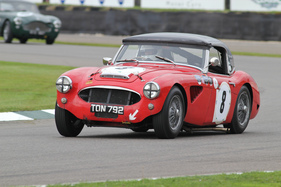
During the race for the Fordwater Trophy, Jochen Mass in the classy Mercedes Benz 300 SL almost had his heart stopped when the leading David Smithies in the Austin Healey six-cylinder spun directly in front of him and almost rammed him off the track. Mass was able to avoid disaster and took the lead. Smithies, however, fought his way back into the lead with a lot of heart and probably even more power in the Healey engine, which he kept until the end.
Behind him, Max Girardo in the beautiful 1958 Ferrari 250 GT Tour de France fought off Paul Malcolm in the Morgan Plus Four. In this race, no one was given a place and the equipment was pushed to the limit.
At the finish, Jochen Mass said that the situation with Smithies had been a bit hairy and thanked him for the excellent preparation of the 300 SL, as did all the other pros. To his credit, he grumbled that the Mercedes rear axle would certainly need some work to keep up with the surprisingly strong Austin-Healey.
An army of Ford GT 40s
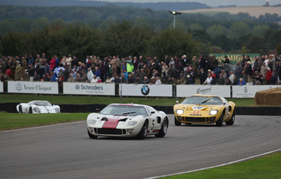
Ford GT 40s are currently changing hands at prices of well over a million euros/CHF in some cases, so a race exclusively with such vehicles to celebrate the 50th anniversary (of the project) almost sounds like a dream. But even this idea could be realized in Goodwood. 27 Ford GT 40s were entered for the race, and a few more drove around the circuit in supporting demonstration runs.

All in all, there must have been just over 30 GT 40s at Goodwood. The fact that absolute rarities such as the 1964 prototype, a Mark IV from 1967 and the large Mark IIs also took part in the race made the mouths of connoisseurs and enthusiasts of this successful racing car water. And the soundscape was more than just impressive anyway.

The 50-minute race with obligatory driver changes offered racing action at its best. Steve Soper initially took the lead, but was soon replaced by Hart, who lost his position to Emanuele Pirro (TESIE) on lap 7.
From lap 18, however, Adrian Newey/Kenny Brack took the lead in their obviously excellently prepared GT 40 after an overlong pit stop by Emanuele Pirro and did not relinquish it until the end. Pirro, in second place at the end, said that these cars were wonderful to drive and that the pit stop was probably not quite Le Mans standard. "It's an honor to drive such a famous race car here," said Pirro and didn't seem unhappy despite losing the victory.
Kenny Brack, who drove Adrian Newey's GT 40, also made an interesting comment: "The GT 40 is not easy to drive because it has a mid-engine, a lot of power and a relatively high center of gravity. Anyone who watched him in the rainy practice session on Friday will know what effect this combination of characteristics had. The speedy sports car slithered along the straight like a rattlesnake (see also the onboard video under "Multimedia"), Kenny certainly got the last out of the car.
An Aston Martin for the first time

The GT race with the title "Royal Automobile Club TT Celebration" came to a dramatic head. In practice, the two AC Cobras of Bryant/Bryant and Caron/Minassian were still leading ahead of the Lister-Jaguar Coupé of Harris/Reid and the Ferrari 250 GTO/64 of Alesi/Newall, but the one-hour race had its own rules.
Jean Alesi was (unjustly, in his view) penalized for a jump start and initially drove in the lead, which was initially held by Hart/Colonel in the AC Cobra. The Cobra was then overtaken by the fast Lister-Jaguar Coupé on lap 15, but around the middle of the race rain started to fall and get heavier, leading to some hairy situations, especially as the fierce winds twice clipped the chicane, triggering the deployment of the safety car. Tom Kristensen in the Jaguar E-Type ran out of road at the back, which also triggered yellow flags and a towing maneuver.
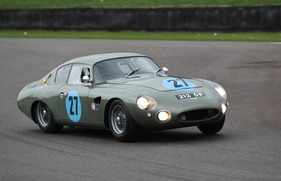
Meanwhile, the pairing of Wolfgang Friedricks/David Clark had more or less inconspicuously worked their way up from 23rd place (lap 14 after the pit stop) to the front and won the race by almost 14 seconds over the 1961 Aston Martin Project 212.
This victory was a minor sensation, as nobody had expected the Aston's success. Second place went to Chris Harris/Anthony Reid in the Lister-Jaguar Coupé, with Grahame Bryant/Oliver Bryant in the AC Cobra in third. The Ferrari GTO, SWB and LM finished 9th, 10th, 11th, 13th, 15th, 23rd and 24th, it was not their day. Hüni/Vögele only completed 24 laps with the 330 GTO and were just as poorly classified as Rauno Aaltonen, Emanuele Pirro and Rob Huff, or rather their companions.
The show alongside the race
Between and around the races, there was plenty on offer for the, as always, enthusiastic and patient audience. For example, the Tour de France was celebrated, not the car race, but the bicycle race. Forty-year-old bikes and even older bikes cycled around the course, accompanied by authentic support vehicles.

Spitfire bombers and other aircraft flew their circles in the sky and at the many stands you could stock up on everything you needed for a future visit to Goodwood or for your own classic car.
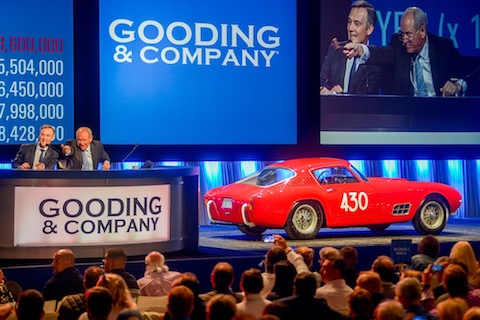
The Earl's Court Motor Show on the festival grounds and the lovingly arranged fairground, which even featured a "Wall of Death" with daredevil stuntmen, were also well worth seeing. Bonhams also offered an interesting portfolio of sports and racing cars for sale at auction for people with strong purchasing power and an appetite for investment.
For those who were not only interested in cars, but also in motorcycles, the race for the Barry Sheene Memorial Trophy offered not only excitement, but also the acoustic pleasure of the three-cylinder MV Augusta and a Le Mans-style start with mechanics holding the ready-to-ride machine for the riders rushing up to it.
The parking lots around the race site could easily have served as a mobile museum elsewhere, except for the dirt caused by the rain, which dampened the joy and probably gave the owners a lot of cleaning to do afterwards.
In memory of Jim Clark
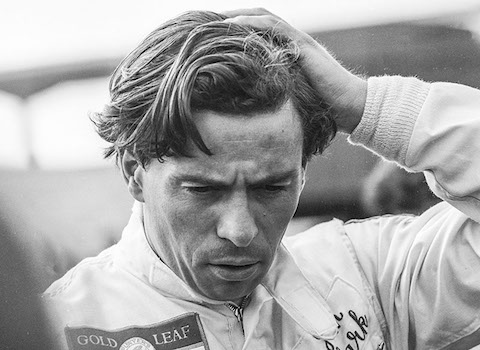
Every year, a special personality is commemorated at Goodwood. In 2013, it was Jim Clark who was honored. Clark, born 75 years ago, had a special relationship with Goodwood, as he not only drove the lap record, which still stands, but also several races on the square-shaped circuit.
Several racing legends commented on his achievements and it was Jackie Stewart who said that Clark was probably the best and most versatile racing driver of his time. Clark not only won Formula 1 races, but also finished first on the podium at the Indianapolis 500 miles. He also competed successfully in sports car races and other classes and his career would have lasted several years longer had he not been killed in an accident in his Formula 2 car in Hockenheim in 1968, aged 32.

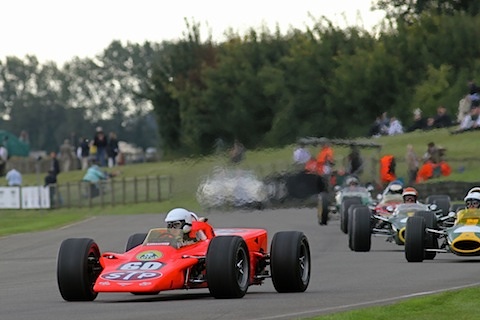
Many of the cars he drove during his racing career were on display at Goodwood, from the two-stroke DKW he borrowed from a friend for his first races, to a Porsche 356 he took to the track. Of course, a whole series of Lotus racing cars were also part of the action, with Jackie Stewart driving a 1967 Lotus-Ford 48 around the Goodwood Circuit. The 1968 Lotus 56 STP Special with gas turbine, which Clark was unable to drive in the Indianapolis race but had tested, was certainly particularly impressive. The special exterior with its wedge-shaped silhouette and the instrumentation required by the turbine set this monoposto, which was not successful in racing, apart from its siblings.
Rarities on and off the track
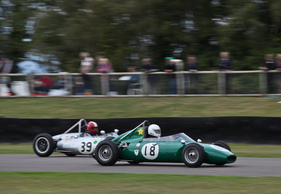
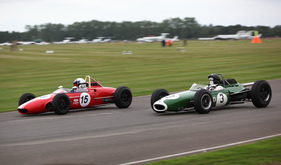
As is the case every year, automotive historians were once again able to discover vehicles in 2013 that they had probably hardly ever seen before. For example, a North Star Ford from 1960, a one-off from England, took part in the Chichester Formula Junior race.

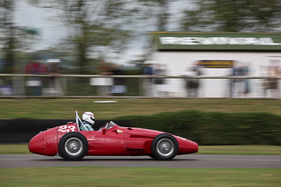
An Isuzu Bellett from 1965, imported to Europe in small numbers, competed in the St. Mary's Trophy. In the Fordwater Trophy, a beautiful 1958 Rochdale GT with a Coventry Climax engine shone until a puncture knocked it out of the race. A Jensen 541R is also rarely seen on a circuit. In the race for the Richmond Trophy, a Maserati 250F in an unusual South American livery delighted the spectators and in the Glover Trophy, a Ferrari 1512 from 1964 sounded its crescendo.
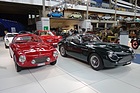
The list could go on and on. However, many rarities were on display not only on the racetrack, but also as exhibits around it, such as the 1966 Vauxhall VRX, which made its debut as a concept car at the Geneva Motor Show. Only one of the three showpiece cars built at the time has survived and now delighted Goodwood visitors with its bright orange paintwork. Or at least those who had noticed the car at all.
Further results
The race for the Sussex Trophy was won by Julian Majzub in a Sadler-Chevrolet Mk2 ahead of Anthony Reid in a Jaguar D-Type and Emanuele Pirro in a Lister-Jaguar Knobbly.
First place and thus the Richmond Trophy went to Gary Pearson in a BRM Type 25 after Julian Bronson in the leading Scarab-Offenhauser had a mishap with a competitor. Tony Wood finished second in a Maserati 250F and Roger Wills third in a Lotus-Climax 16.

In the competition for the Madgwick Cup, Tony Wood on a Lister-Bristol emerged victorious, followed by Gareth Burnett on an Alta Two Seater Sports and Ron Gammons on a Lotus-MG MkIX.

The Gordon Trophy went to pole man Miles Griffiths in a Cooper-Climax T51. Second place went to Rod Jolley in a Cooper-Climax T45/51 and third to Jonathan Hughes in a Cooper-Climax T53 'lowline'. The first non-Climax driver to finish in 8th place was Denis Welch in a Lotus-Alfa Romeo 18.

The fastest driver in practice, Mark Gillies, was unable to enjoy his position in the Goodwood Trophy race for long, retiring on lap 7. The winner was David Morris in an ERA B-Type R11B ahead of Paddings Dowling in an ERA B-Type R10B and the surprisingly fast Calum Lockie in a Maserati 6CM. The ERAs were hard to beat in this field, so Maserati, Talbot-Lago, Alfa Romeo and Frazer drivers had to make do with places of honor.

The Glover Trophy for 1.5-liter Formula 1 and 1-liter Formula 2 monoposti was taken home by Andy Middlehurst in a Lotus-Climax 25, followed by Rob Hall in a Lotus-Climax 21 and Nick Fennell in another Lotus-Climax 25.
In the Freddie March Memorial Trophy, three Jaguar C-Types drove away at the front, with Young/Buncombe winning ahead of Hancock/Ziegler and Cussons/Blakeney-Edwards.
Finally, in the Formula Junior single-seaters, the practice classification also decided the race result for the Chichester Cup. Chris Drake in an Elva-Ford 300, Andrew Wilkinson in a Lynx-Ford Mk3 and Johne Delane in a Lotus-Ford 18 crossed the finish line in the same order as in qualifying.