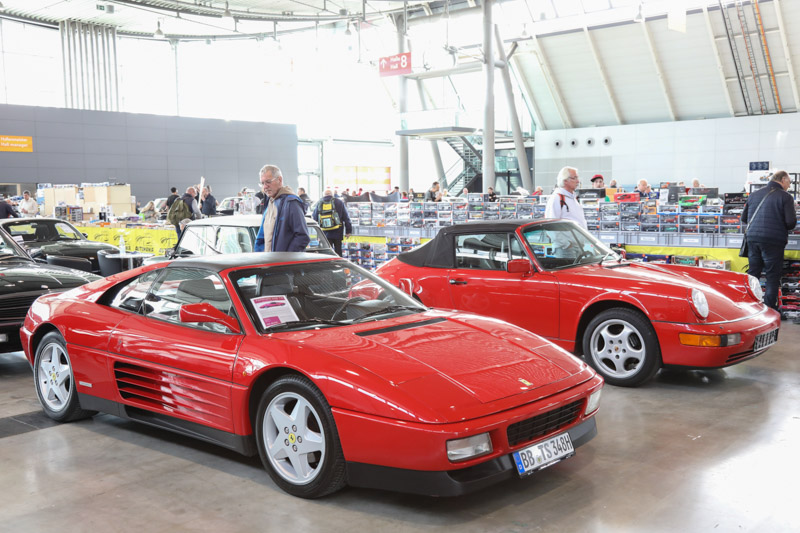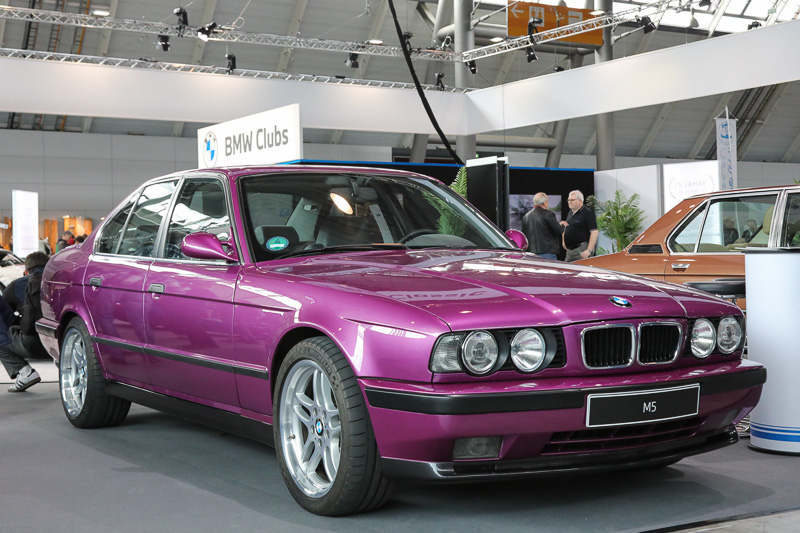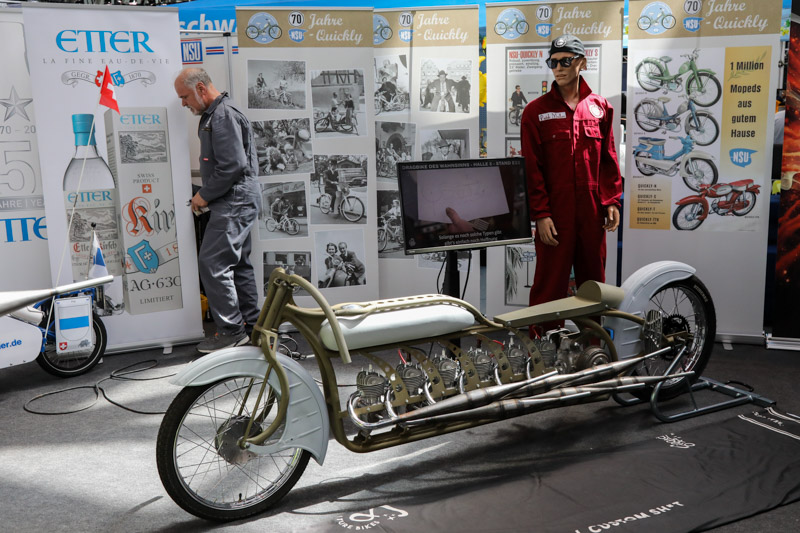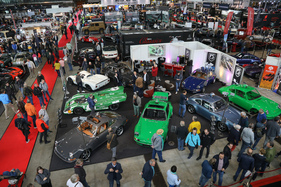


Retro Classics Stuttgart took place for the first time from April 25 to 28, 2024 under the new management of AFAG, steered by Henning and Thilo Könicke. Trade fair organizers are currently facing a relatively cold wind, so it is not surprising that the 23rd Retro Classics was no longer quite as large as its predecessors.

Of the ten halls, only six were used, the others were closed or assigned elsewhere. By concentrating on Halls 1, 3, 5, 7 and 9 as well as Hall 6, the classic car trade fair took place primarily on the right-hand side of Messe Stuttgart when looking from the East Entrance. In terms of space, this meant 80,000 square meters, but also slightly fewer exhibitors.

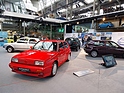
The visitors came anyway, 70,000 were counted according to the organization. And they were able to see 2,000 cars, as well as many elaborately prepared presentations by specialists, service providers, event organizers and museums.
Bitter in the atrium
The largest special show was presented by Bitter. As is well known, Erich Bitter died last year, but his brand is now being continued by his descendant Markus Bitter.

All the well-known sports cars were on display in the atrium, in particular the elegant Coupé CD and its successor SC, also available as a convertible. Visitors could also admire an Intermeccanica Indra, which Bitter designed but which, for various reasons, did not fully blossom.

Also on display in the atrium were Bitter one-offs and two Bitter Aero, as well as modern finishing projects.
The central location of the special show in the atrium was probably suboptimal in 2024, as visitors no longer had to commute between the two halls. One or two visitors may have overlooked the slightly lower atrium.
50 years of Porsche Turbo
It was in 1974, 50 years ago, that the German super sports car Porsche Turbo was first shown in production form. Naturally, this anniversary had to be celebrated and Porsche dedicated its entire stand to this theme.

Not only various Turbo generations were on display, but also the Schmal-Turbo built for Luise Piëch, the first road-going Turbo ever, so to speak.

A GT1 '98 could also be admired on the stand, a car that you don't get to see every day.
60 years of the Ford Mustang
The 60th anniversary of the Ford Mustang was then celebrated in Hall 3.

Early and other Mustang models "drove" towards the "Dunlop arch" in a starting grid, so to speak. As is well known, the Ford Mustang was presented for the first time on April 12/13, 1964 and became a huge success.
Many more anniversaries
There will be no shortage of anniversaries in 2024 anyway and many were commemorated at one stand or another.

On our tour, we stumbled across 25 years of the BMW Z8, 40 years of the Mercedes-Benz 190E 2.3-16, 40 years of the Lancia Thema and 30 years of the Lancia Kappa, 50 years of the VW Golf, 50 years of the Ford Capri II, 50 years of the Citroën CX, 60 years of the Trabant (P601), 70 years of the Mercedes-Benz Gullwing, 70 years of the "Grosser Ponton" and 90 years of the Citroën Légère.
Round birthdays are always a good reason to highlight forgotten and lesser-known models, especially at trade fairs, and the exhibitors in Stuttgart made good use of this.
The golden age of tuning
Two special shows on the subject of tuning from the seventies to the nineties generated a lot of interest.

For example, there was the Opel Manta B from the Manta films, which certainly became one of the most visited selfie objects.

Right next to it, K.I.T.T., the Pontiac Trans Am from the TV series "Knight Rider", attracted attention with its snappy slogans.

Refined Opel, Volkswagen, BMW, Porsche and a Helme HE 111 completed one of the two special shows.

Directly opposite, visitors could then view products from the work of Chris Hahn's SGS Styling Garage, including the SGS Arrow based on the C126, as well as convertibles and gullwing coupés with a Mercedes star.

From an observer's point of view, these two special shows could perhaps have been staged a little more with a suitable setting and sense of time, but the cars alone were also worth a close look.
BMW, Mercedes-Benz and Porsche
BMW, Mercedes-Benz and Porsche had a factory presence.

BMW showed interesting exhibits from the V12 Le Mans to the M3 GTR, but also had unique pieces such as the BMW 530 iX Enduro Touring Individual from 1992 and a BMW Z8 Safety Car on the stand.

Mercedes-Benz celebrated the 70th anniversary of the Gullwing, but together with the clubs also showed many other post-war classics as well as a few pre-war cars.

As already mentioned, Porsche used its presence for the 50th anniversary celebrations of the Turbo, but also presented the Porsche 914-6 as an ONS track safety vehicle in memory of Herbert Linge, a Porsche 356 Carrera 2 and a Porsche 968, partly together with the clubs.
There were no more official manufacturer appearances. Brands such as Audi, Ford, Skoda or the Stellantis manufacturers Alfa Romeo, Fiat, Opel Citroën/Peugeot left it to dealers, museums or clubs to represent their colors.
Active clubs and interest groups
As always, the numerous represented clubs and associations stepped into the breach.

They presented rare cars from their club collections and celebrated one or two anniversaries. 50 years of the Ford Capri II, for example, gave rise to a beautiful installation, but the group of Ford Model T on the upper level of Hall 1 was also nice to look at.

The colorful NSU Wankel spiders, which were complemented by a Herkules Wankel motorcycle, were also a delight.

In the "English Corner", a sunflower yellow Austin A40 Somerset drophead coupé was also on display alongside many British classics.

Meanwhile, friends of the Peugeot brand presented a Group B Peugeot 205 Turbo 16, as well as veterans such as the 203 and 402 models on their stand.

Elsewhere you could see a safari version of the BMW Baroque Angel or the Citroën Légère as a convertible.
And as always, it was worth studying the many information boards of the clubs, as there was a lot of interesting information documented there.
Brisk trade
Compared to previous years, the private vehicle trade was significantly smaller, but there were still interesting cars to buy.

A striking number of these vehicles were still relatively young; there were hardly any pre-war saloons or sports cars.

The majority of the vehicles on offer at the dealers were also from the decades after the war, with neo-classics and youngtimers well represented.
Quite a few things were also sold, with "sold" signs on classic cars on offer at the very first dealership.
Raisins and rarities
As a long-time visitor to the fair, you naturally notice many cars and stands that you have seen several times before. But every year there are always vehicles to discover that you have never seen before at a classic car show.

During our tour, for example, we came across a B.N.C. from 1929, which the Boxenstop Museum was exhibiting. From 1923 to 1931, B.N.C. built lightweight sports cars with small-displacement four-cylinder engines, and from 1925, superchargers were also used, typically from the Cozette brand. The two-seater on display with a 1.1-liter Ruby engine and supercharger produced 70 hp and took part in the 1936 Bol d'Or in Montlhéry.

Much younger was a convertible based on the Ford Fiesta Mk III, which we discovered a few miles away at the Old Ford Friends. There was no factory convertible of this type, the conversion was carried out by the Sllath company in Egelsbach. Only one example is said to still exist in Germany.

The only surviving example was the 1943 BMW 335 with Autenrieth coupé bodywork on display in the BMW hall. There were two of these coupés in total, the other one was scrapped in Switzerland. The surviving example was completely restored by BMW Classic partner Renocar in Brno-Slatina and could be shown in new car condition.

There were also raisins among the cars that were offered privately. For example, we came across a TVR 3000 S from 1979. Only 258 examples of this open-top TVR with a Ford Essex V6 engine were built in total, and only a few of them made it to Germany as left-hand drive models.
Further rarities can be found in the extensive picture gallery .
Lots of accessories
Of course, there were not only cars to admire in Stuttgart. There were also products more or less closely associated with the automobile, from whirlpools to beach chairs, from loungers to remote-controlled cars and garage lifts.

This may have been too much for one or two visitors, but after all, Retro Classic sees itself as a trade fair for driving culture and that includes a lot of things that pure car enthusiasts would not necessarily look for at a classic car fair.
Was the visit to Stuttgart worthwhile? Definitely! A trade fair always offers the opportunity to get a feel for the market, but also to meet acquaintances and friends, to be reminded of things long forgotten and to come across surprises. Retro Classics succeeded in doing all of this in the best possible way, so even a few lost halls, square meters and cars didn't hurt.