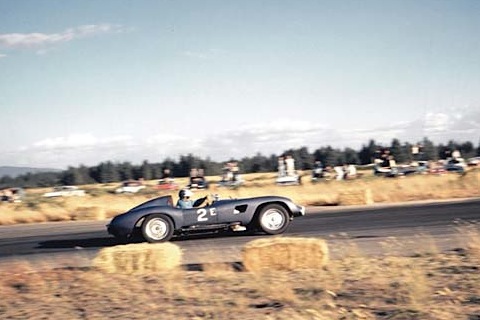
From the late 1950s onwards, plastic became popular as a basis for car bodies (and more), especially for small manufacturers, as investments were low even for the smallest series. Thus, apart from the better-known brands such as Lotus or Alpine, a large number of different vehicles were created, many of which have been forgotten today.

The "Fantastic Plastic" meeting is intended to give these plastic cars a stage that connects eras, countries and construction concepts and has the use of plastic in body construction as a common denominator.

On May 30, 2015, the time had come for the third time. Nearly one hundred sports cars and limousines from America, England, Spain, France, Italy, Israel, Germany and Switzerland gathered at the Swiss Museum of Transport in Lucerne to spend an eventful day together under favorable weather conditions.
Three program points
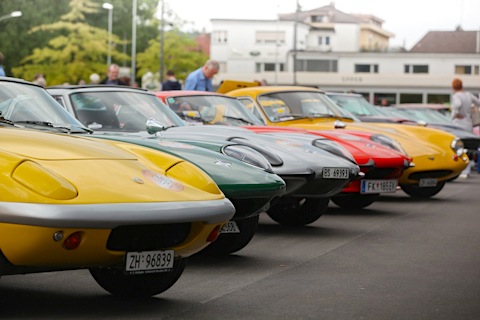
While coolness counted at the Swiss Museum of Transport and the most interesting vehicle was chosen by the public and participants, the afternoon was all about navigation skills, as the first task was to find the "Swiss Classic World" classic car fair in Lucerne. There, all the participating cars were lined up in front of the halls, much to the delight of the visitors to the fair. Then it was time to head for the outside storage area of the Swiss Museum of Transport in Rain, an exercise that led to some participants clocking up more kilometers.

There they then had to complete a skill slalom twice with the lowest and most identical passage time possible.

Matra brand of honor
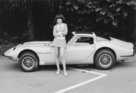
The Matra brand was particularly honored in 2015. Although the French manufacturer, which originally came from the armaments industry, built plastic cars for many decades, it is less well-known today than some of its competitors at the time. This is due to the fact that the late vehicles, which were produced in their millions, were not sold under the Matra name but under the Renault name (Espace, Avantime), although development and production took place at Matra. The brand's best-known sports car is the Bagheera, which had an exceptional position with its Maserati styling and three front seats, but only survived in small numbers due to its rust-sensitive structure.

The closely related successor, the Murena, was better built and a larger number of these still exist today.
The first Matra, however, was called Jet or Djet and was in principle the heir to the small series manufacturer René Bonnet, which was taken over, which is why the cars were initially also called Matra-Bonnet. The Jet/Djet was the first road-going mid-engined sports car to be built in large series.

It was followed by the 530, which again had a mid-engine but now had four seats. At the same time as the Murena, Matra also built the Rancho off-road vehicle, which, with its plastic body and pure front-wheel drive, remained an exceptional model that did not sell badly at all.

Significantly, at least one vehicle from each of the model series was on site, only one Bagheera was missing.
The show star Sterling GT
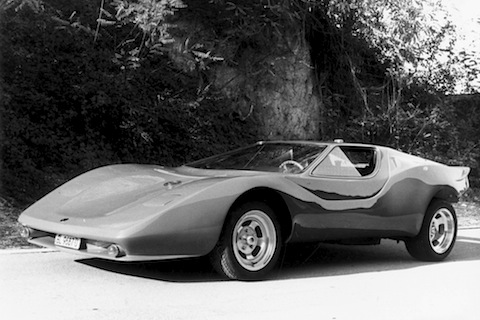
A classic show car from the seventies arrived at the Museum of Transport as a surprise guest. Back then, they were called Nova GTs or Sterling GTs and were consistently wedge-shaped. The special feature, however, was the dome above the driver and front passenger, which could be raised by hand or electrically and drew applause when the crew got out.

It is only when the engine is started that you realize that simple Volkswagen Beetle technology lies beneath the spectacular shell.
Almost complete Marcos program
Marcos had one of the largest brand contingents on the stand. Almost all variants of the GT from the sixties were on site, as well as one of the rare Marcos Mantis with a 2+2 configuration, two Mini-Marcos and a Mantula.

Marcos also presented the only type of car with a wooden chassis, while Rochdale offered the only sports car made entirely of plastic in terms of chassis and bodywork.
Forgotten brands
Among the more than 30 brands represented were some that only a few car enthusiasts are still familiar with. Bond, Ginetta, Ogle, Reliant, Sabra, Tornado, etc. What they have in common is that (almost) all of them (more or less) originate from England.

But Germany also built plastic cars in large numbers, Trabant was the simplest car and it was the people's motorization of the GDR. In Lucerne came a P50 with an attached caravan, made of plastic of course.
Rare Panhard CD
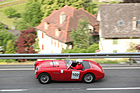
No car at the 2015 meeting was boring or like thousands of others, but this was particularly true of the Panhard CD from 1964. The 14th of less than 200 CDs produced attracted attention not only because of its design. The sound of the air-cooled two-cylinder boxer engine was also more reminiscent of a 2 CV than a sports car. However, the CD should not be underestimated: the car won its class at Le Mans, won the performance index and reached 204.8 km/h on the Hunaudières with a displacement of 701 cm3.
The production version then ran at around 180 km/h and when tuner Hampe revved up the engine a little more, as with the example on show in Lucerne, the sports car weighing just over 600 kg ran even faster.

Owner Mettler has the car under control, as evidenced by his victory in the skills slalom, which he completed twice with a difference of 12 hundredths and in the fourth fastest time against competitors such as the Lotus Elise, Alpine A110 and Ginetta G4.
And an Enzmann
Plastic was also the material used by Dr. Emil Enzmann when he developed his VW-based sports car in the 1950s. These cars had no doors, you simply climbed over the side. The Volkswagen platform was adopted largely unchanged, while an elegantly shaped GRP body with many interesting ideas provided more speed.

The participants in the Concours of Coolness opted for the red Enzmann 506.
In the public vote, the yellow Lotus Europa Special from 1973 was voted the coolest.
The Achilles heel of electrics
Plastic does not conduct electricity, which means that these vehicles in particular are plagued by electrical breakdowns more often than others, as cable connections for the positive and negative terminals have to be routed to the consumers instead of the conductive bodywork. It is therefore not surprising that several participants had to call on the breakdown service on the journey, albeit more frequently due to defective power generation than a lack of conductivity. Not everyone was able to continue the journey to Lucerne, so some exciting cars ended up staying away from the meeting. But maybe it will work out next time, as there are plans for another Fantastic Plastic in 2016.