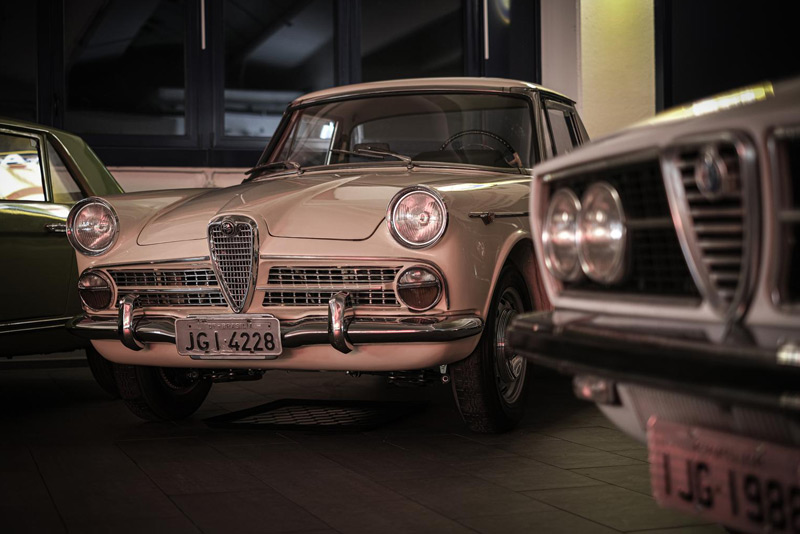
In "CulturAlfa", two "Alfaholics" have come together who share a passion for the cars from the "Casa del Biscione": Axel Marx from Ticino, who owns one of the most extensive and probably most beautiful Alfa Romeo collections in the world, and Elisabetta Cozzi, owner of the Alfa Romeo museum of the same name in Legnano near Milan.
This April, a special topic was on the agenda at "CulturAlfa": "Biscione d'Africa - la storia segreta di Alfa Romeo in Sudafrica". Many people are unaware that the Milan-based manufacturer set up production in South Africa from 1958 and was also extremely successful in motor racing there. Well over 300 Alfa Romeo enthusiasts gathered in Mezzovico (TI) on a Sunday afternoon in April to learn about the history of Alfa Romeo South Africa.

Alfas from South Africa
Alfa Romeo models were assembled in Booysens (near Johannesburg) from 1958. Giuliettas were shipped in parts and packed in wooden crates (CKD) by ship from Genoa via the Suez Canal to South Africa, where they were assembled by local employees. Alfa Romeo was thus able to save high customs duties. After an initial batch of 262 assembled Berlinas, the Booysens site became too small and the company moved to East London. The Giulietta was followed by the Giulia, and the 2000 models with Berlina and Spider (102 series) were also offered in South Africa. In 1962, now under the name ARSA (Alfa Romeo South Africa), over 1,200 cars left the production halls. In the following year, sales increased to over 2,000 Alfa Romeos. The 1750 and 2000 series (Berlina and GT) replaced the previous models.
At the beginning of the 1960s, there was already a special feature for motor racing in South Africa compared to Europe: Virgillo Conrero, the in-house tuner from Turin at the time, built a four-cylinder engine with 1470cc that could rev up to 10,500 rpm - especially for the South African market. This engine was installed in both touring cars and monoposti. Local matador Peter de Klerk took third place in the 1963 Formula 1 race in Kyalami (near Johannesburg) with his "Alfa Romeo Special" behind the two Ferrari drivers John Surtees and Lorenzo Bandini.
This engine was also used in touring car races (Giulia TI, Giulia GT). The Conrero engines were characterized by high revs rather than longevity. Well-known drivers of the time were Peter de Klerk, Basil van Royen, Sam Tingle, Ottele Nucci and Jackie Pretorius.

Production picks up speed
The production figures for the street models continued to rise. After another move to the vicinity of Johannesburg, the company finally got down to business: in 1971, a new factory was built in Brits, near Pretoria, under the management of Dr. Vittorio Bianco. The market continued to demand Alfa Romeo models - the famous "Bertone Coupés" were now also assembled in Brits. The Alfetta, Alfasud and Giulietta models rolled off the production line at Brits, as did the Sprints and the 2000 GTV and then the GTV6. The cars were built with the support of the local population - a small miracle: The mostly semi-skilled locals manufactured the Alfa Romeos to a similar level of quality as is usual in Europe... The Spiders and the Alfa6 model were shipped as a "complete car" over the sea route from Italy to South Africa. In 1985, the economic environment and the effects of apartheid policy led to the closure of the South African production site.
The GTV6 had a special significance in local racing: it is a mixture of motorsport homologation, South African engineering solution and a very special Alfa Romeo era of the 1980s. The GTV6 3.0 was a special South African development. The "Busso" engine known in Europe was developed for South Africa by Autodelta and bored out to 2,934cc, the crankshaft and bearings reinforced, pistons and compression modified and the torque (and not the speed) optimized in particular. The road version had around 200 hp, the racing version probably over 260 hp. Thus equipped, the GTV6 3.0 competed against the successful and winning BMW 528i and 535i and the Ford Sierras (with V8!) or the fast Nissan Skyline. Carlo Chiti (Autodelta) and, in South Africa, Dr. Vittorio Bianco, Director of Alfa S.A., Roger McCleary and Sampie Bosman (Head of the Racing Department at Alfa S.A.) were involved in this project. Among the fastest drivers were Nico Bianco, Sarel van der Merve, Dick Pickering and John Moni, Abdel d'Olviviera and Mick Formato. And for a change, Derek Bell also took the wheel of a South African GTV6.
The GTV6 3.0 won the 2-hour race in Kyalami in 1983, followed by first and second place in the 3-hour race in Cape Town. At the 1,000 km race in Kyalami, a GTV6 3.0 won the index classification. Nico Bianco won the Group 1 championship in 1984 with a GTV6 3.0.

Production figures in South Africa
| Alfa Romeo Giulia (1964-1976) | 25'000 |
| Alfa Romeo Alfetta (1974-1982) | 20'000 |
| Alfa Romeo Alfasud (1975-1985) | 15'000 |
| Alfa Romeo Giulietta (1978-1985) | 8'000 |
| Alfa Romeo GTV6 (1981-1985) | 3'000 |
| Alfa Romeo GTV6 3.0 | 200-300 |
Production figures in comparison
|
|
Alfa Romeo South Africa | Alfa Romeo Italy |
|---|---|---|
| 1978 | 4'310 | 219'499 |
| 1979 | 6'645 | 207'512 |
| 1980 | 6'880 | 219'571 |
| 1981 | 7'700 | 189'500 |
| 1982 | 8'000 | 176'000 |
| 1983 | 6'500 | 200'284 |
| 1984 | 2'300 | 197'800 |
| 1985 | 1'000 | 157'600 |