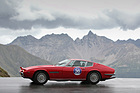
Maserati Indy - the most successful and spacious sports car of its generation


You have only
5 out of 54
images seen in high resolution


Summary
When the Maserati Indy was launched in 1968, there was no shortage of alternatives in the Modenese sports car manufacturer's range. The Mexico, Ghibli and even the Quattroporte appealed to similar customer segments. As a four-seater, the Indy designed by Vignale was in a position to overtake all other Maserati sports cars over time. And yet today it stands in the shadow of the more sophisticated Ghibli. This vehicle report portrays a Maserati Indy from 1970 and tells the story of this Italian Gran Turismo, supplemented with many historical illustrations and three sales brochures.
This article contains the following chapters
- Between Mexico and Ghibli
- Restrained in performance?
- Larger than (then) mid-range saloons
- Space for four people and luggage
- Faster than most
- Safe to drive and largely reliable
- Parking instead of bodybuilding
- A bargain?
- Further information
Estimated reading time: 6min
Preview (beginning of the article)
It had everything to impress the sports car-loving youth of the time, who pressed their noses against its side windows: an elegant shape with a fastback rear end, a classy, leather-trimmed, light-flooded interior, a speedometer with "300 km/h" at the right-hand stop and a rumbling V8 exhaust sound when it was started. It was hardly less convincing than the Ghibli, which was built at the same time, and yet today it is largely overshadowed by its shorter brother in terms of value and image. At the end of the 1950s, Maserati presented its first luxurious Gran Turismo sports car, the 3500 GT with an inline six-cylinder engine. This was followed in 1963 by the Mistral, which, in contrast to its predecessor, only had two seats. Accordingly, the Mexico with V8 engine was positioned more strongly in the GT corner again in 1966 and thus once again had a four-seater sports car in the range. In 1963, however, Maserati also introduced a four-door saloon, the Quattroporte. And in 1967 another sports car, the Ghibli.
Continue reading this article for free?
Images of this article