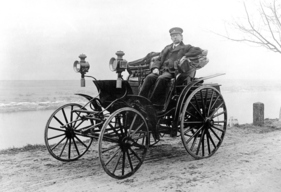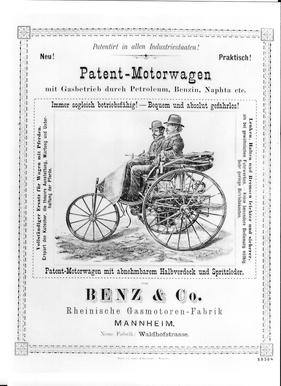
The year 1896 was an eventful one for Rheinische Gasmotorenfabrik Benz & Cie. in Mannheim: the product range, previously dominated by open passenger cars, was not only expanded to include the delivery car, but also the first coupé with an internal combustion engine. The vehicle range was thus successfully diversified at an early stage.
Transporter for automobile-loving France
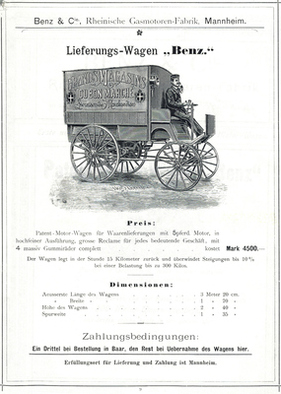
The "Benz delivery van" was mentioned for the first time in a Benz & Cie. catalog in May 1896. The new concept of a "patented motor vehicle for goods deliveries with a 5-horsepower engine in a highly refined design" was immediately well received. Motor in highly refined design" (original spelling) met with interest. However, it was not customers from Germany who were interested in this pioneering design. Instead, the first documented example was delivered to the Parisian department store "Du Bon Marché". Even the catalog page for the delivery van was illustrated with a depiction of this vehicle together with an advertisement for the Parisian department store.
The fact that the first customer for the delivery van came from France was in keeping with the development of the automobile market at the time: the new means of mobility was invented in Germany in 1886 - independently of each other by Carl Benz and Gottlieb Daimler. However, the pioneering innovation was initially well received in France and Great Britain in particular. So it was only logical that on December 5, 1896, this first combustion-powered delivery van produced directly by an automobile manufacturer made its way to Paris.
Underfloor construction made optimum use of space
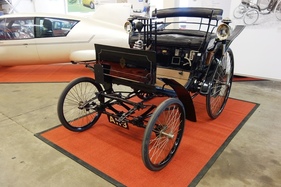
The first delivery van in history had a payload of 300 kilograms and was built on a chassis that Benz also used for the "Victoria" and "Vis-à-Vis" models. The designers made optimum use of the overall length of the vehicle by placing the engine under the loading area. The delivery van was therefore also the first commercial vehicle with an underfloor design. The driver sat directly above the front axle, the front wooden-spoke wheels with solid rubber tires were smaller than those on the rear axle.
The driver and loading area were almost on the same level, although this was not immediately apparent to the observer. This was because the vehicle was designed as a panel van with a magnificent advertisement on the side walls - for the department store and the purpose of the automobile imported from Germany: "Grands Magasins Du Bon Marché. Livraison des Marchandises." ("Department store Du Bon Marché. Delivery of goods"). The premiere customer implemented what the manufacturer recommended in the 1896 catalog. Benz & Cie. emphasized the potential advertising effect of the delivery van: "Great advertisement for every important business", the sales brochure stated.

Urban delivery traffic with 3.7 kW
The delivery van was powered by a horizontally mounted single-cylinder engine with a displacement of 2.9 liters and an output of 3.7 kW (5 hp). A total of three gear ratios transferred the engine power to the road: first stepped pulleys, then the planetary gearbox and finally the primary reduction gear. From here, two chains led to the sprockets on the rear wheels. The clutch was engaged by engaging and disengaging the belts. With this combination of engine and transmission system, the delivery van reached 15 km/h with maximum payload and overcame gradients of up to ten percent.
The selling price of the vehicle was 4,500 marks. A third of this had to be paid "when ordering in Baar", the rest of the sum was due when the vehicle was handed over in Mannheim. It is not known how many customers besides the Parisian department store opted for this innovative delivery van at the time.
Also at the end of 1896, Émile Roger, Benz's general agent for France, developed a plan for his own delivery van based on the Benz Velo. His partner in the project was Léon L'Hollier from Birmingham, Great Britain. Several such Benz "Combinations delivery vans" were built in the Digbeth district there. After the death of Émile Roger in 1897, the project came to an end.
The Benz Coupé
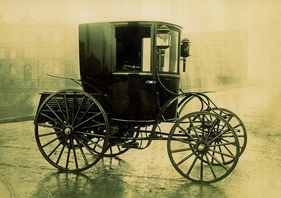
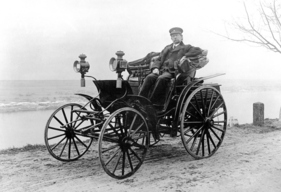
Parallel to the light commercial vehicle, a new body shape for passenger cars was also introduced at Benz in 1896, the coupé: the filigree-looking automobile with the short, closed body was probably a one-off. Like the first delivery car, the Coupé was handed over to a customer in the French capital 125 years ago. A contemporary photograph has survived, but the Coupé was not mentioned in any price list or other Benz publications from this period. The top speed is said to have been 32 km/h.
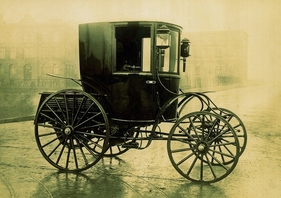
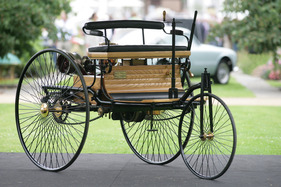
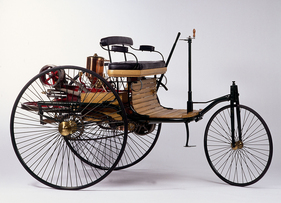
Comparisons with photos of other Benz automobiles from the mid-1890s show that this vehicle was based on a Benz Victoria. This first four-wheeled vehicle from Benz was built from 1893 and replaced the three-wheeled Benz Patent-Motorwagen. The "Vis-à-Vis" model was the four-seater version and had opposing benches. The modern design was made possible by the invention of the functional Ackermann steering system, for which Benz applied for patent DRP 73151 on February 28, 1893.
A particularly striking difference to the Victoria was the curved windshield of the Coupé. It did not yet have a windshield wiper, as this would not be invented until the beginning of the 20th century. The Coupé was therefore difficult to drive in the rain. As in the delivery car, a 2.9-liter single-cylinder engine with an output of 3.7 kW (5 hp) was presumably installed in the rear. The power transmission to the rear axle was probably similar. The Coupé was decelerated by a shoe brake and a band brake on the rear wheels.