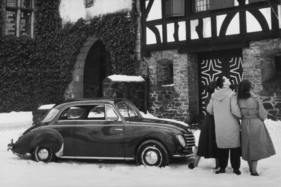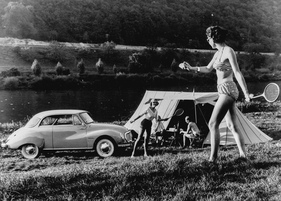
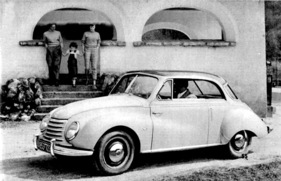
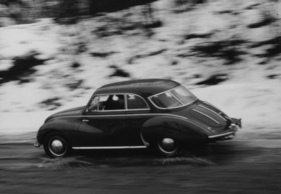
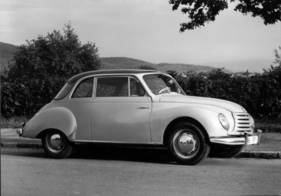
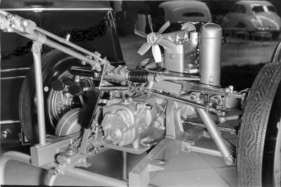
As early as 1939, Auto Union AG in Chemnitz had developed a new DKW model with a three-cylinder two-stroke engine up to the prototype stage, which was to be launched on the market in 1940 as the DKW F9. The outbreak of the Second World War prevented this.
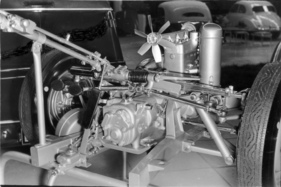
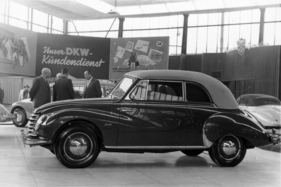
At the IAA in Frankfurt in March 1953, Auto Union finally presented the long-awaited three-cylinder car under the designation 3=6 Sonderklasse, Type F 91. The somewhat strange-sounding additional designation 3=6 was intended to express the fact that a three-cylinder two-stroke engine had the performance characteristics of a six-cylinder four-stroke engine due to the double number of power strokes.
The magazine "Auto Motor und Sport" noted in its 19/1953 issue:
"At the Frankfurt Motor Show, Auto Union presented its DKW special class with 900 cm3-34 hp three-cylinder engine for the first time. During the start-up phase of the special class long awaited by the old DKW friends, the company limited itself to the delivery of a four-seater coupé with all-round glazing and the Karmann convertible known from the Meisterklasse, i.e. two quite luxurious and therefore not exactly cheap models.While DKW had been waiting for two rather luxurious and therefore not exactly cheap small car models, the time had now come to launch the standard saloon, which was to be the focus of the DKW passenger car range from now on, with the start of large-scale production of the Special Class."
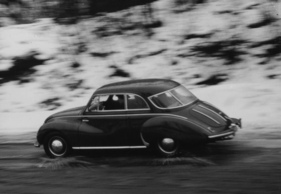
The three-cylinder DKW ran at around 120 km/h and cost no more than its two-cylinder predecessor, i.e. DM 5985. However, an attractive price was sorely needed, as car manufacturers were rapidly lowering their prices at the time, which naturally increased competitive pressure.