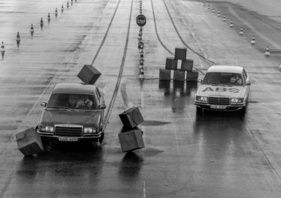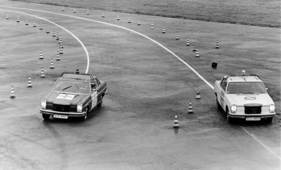
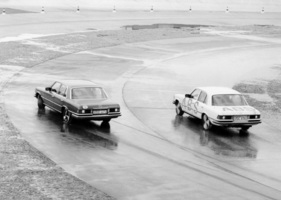
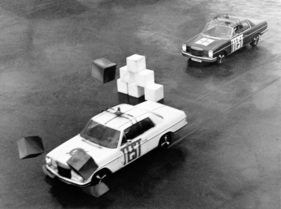
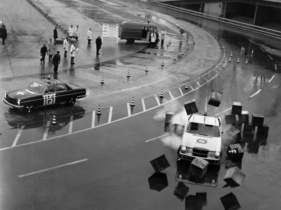
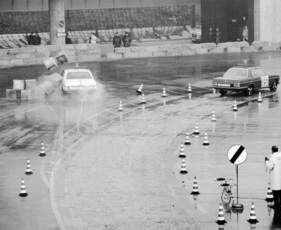
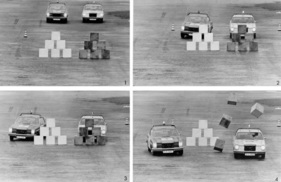
In August 1978, Mercedes-Benz presents the second-generation anti-lock braking system (ABS), developed jointly with Bosch, to the press in Untertürkheim. This world first maintains a vehicle's steering capability even during emergency braking. From December of the same year, it will initially be available in the Mercedes-Benz S-Class saloons (116 model series).
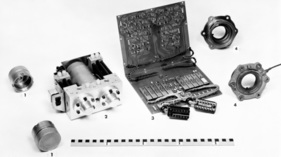
Eight years earlier, in 1970, the first-generation anti-lock braking system for passenger cars, developed jointly with TELDIX, had its world premiere. ABS is therefore also an example of the staying power that is sometimes required to bring a product to series maturity - a responsibility that the Mercedes-Benz brand has taken on time and again with its numerous innovations.
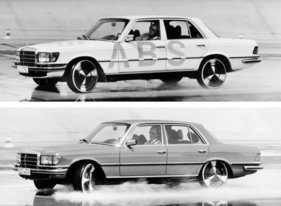
Development over decades
An anti-lock braking system has been a dream of car designers for decades, as it could drastically increase driving safety by maintaining steering ability during emergency braking. As early as 1928, the German Karl Wessel was granted a patent for a brake force regulator for automobiles - but it never made it past the paper stage.
In 1941, test drivers tried out a locking regulator, about which the "Automobiltechnische Handbuch" reported succinctly that "only modest successes were achieved".
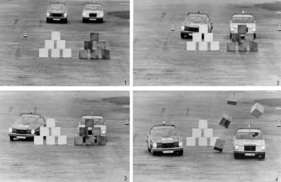
However, these initial tests show the way: an anti-lock braking system must have sensors to measure the wheel rotation on each front wheel and a control unit to register and compare the sensor measurements. This control unit is intended to correct impermissible deviations by individually regulating the brake pressure on each wheel until immediately before the wheel locks.
However, implementation on the road proved to be much more difficult than expected. It is true that corresponding sensors were already working satisfactorily in 1952 as an anti-skid system for airplanes and in 1954 in the "Knorr anti-skid system" for railroads. But in cars, the mechanical friction wheel sensors are expected to do much more: they have to register rotational deceleration and acceleration, be reliable when cornering and on uneven surfaces and also work flawlessly even when heavily soiled and at high temperatures.
Induction instead of mechanics
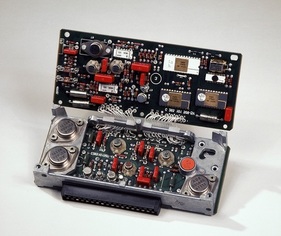
Engineers are not only working on this problem at Daimler-Benz, but also at TELDIX GmbH in Heidelberg. Both companies were unable to make any progress with mechanical sensors and were looking for a different, new solution. In 1967, in a joint effort, they found the solution to the problem in non-contact speed sensors that use the principle of induction. Their signals are to be evaluated by an electronic system that controls the brake pressure via solenoid valves.
At this time, the electronics were still working on the basis of relatively fragile analog technology and with complicated circuits. Integrated components do not yet exist. Nevertheless, a promising initial approach was emerging. Daimler-Benz therefore presented this first generation of an anti-lock braking system for cars, trucks and buses to the world public on December 12, 1970 on the test track in Untertürkheim - with a lasting response from enthusiastic experts and the press. The principle is convincing.
The road to production-ready ABS
It took another eight years before Daimler-Benz was able to offer a reliable anti-lock braking system in series production, in order to give the prototype the level of technical maturity and reliability that was essential for series production. The revolution in electronics comes to the engineers' aid. Only the invention of integrated circuits made it possible to build robust, small computers that could record the data from the wheel sensors in a minimum of time and reliably control the valves for regulating the brake pressure.
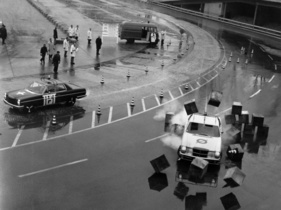
It takes five years for development partner Bosch to deliver the first fully digital control unit for testing purposes in Untertürkheim. Digital instead of analog means, above all, fewer components, with the advantage of reducing the risk of malfunctions to almost zero.
Thanks to digital technology, the electronic components are now able to record, compare and evaluate sensor data in milliseconds and send corresponding control pulses to the solenoid valves of the brakes. In addition, not only the front wheels but also the rear wheels are included in the control system.
1978: The world's first series-produced ABS
So it was a long time before Mercedes-Benz became the world's first car manufacturer to officially introduce the second-generation anti-lock braking system in August 1978 and offer it as an option from December 1978, initially in the S-Class at an extra charge of DM 2217.60. ABS became standard equipment on Mercedes-Benz passenger cars for the first time in 1984. Ten years after its initial introduction, one million Mercedes-Benz passenger cars with ABS are already on the roads of the world.
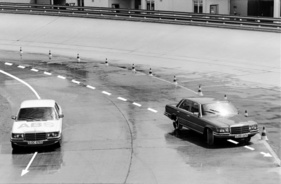
Mercedes-Benz also plays a pioneering role in commercial vehicles. As early as 1981, ABS was offered for air brakes, developed together with the company Wabco. Since 1987 all coaches and since 1991 all trucks of the brand are equipped with ABS. At the end of 1990, ABS also found its way into Mercedes-Benz racing cars in the German Touring Car Championship.
Basis for innovations
ABS development does not stand still. The entire control system becomes ever smaller, more powerful and more robust. The typical pulsation of the brake pedal when the control system is activated has now largely disappeared. However, the system is not only used for optimum braking while maintaining the car's steering capability, but also as the basis and pulse generator for the traction control system ASR, the Electronic Stability Program ESP®, the brake assistant Brake Assist and, of course, for the electro-hydraulic braking system Sensotronic Brake Control SBC™.
In Mercedes-Benz passenger cars, the data from the wheel sensors is also used for non-obvious functions such as the electronically controlled automatic transmission, which adapts to the driver's wishes, the trip computer, Distronic adaptive cruise control, engine and windshield wiper control, ABC active chassis control, 4MATIC - in short, everything that is controlled in the car depending on speed. Of course, the same applies to commercial vehicles and buses.
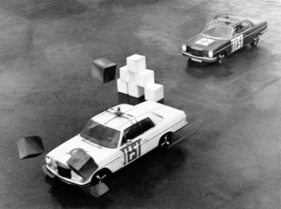
Anti-lock braking systems are now a matter of course worldwide
The fact that the anti-lock braking system is now a standard feature in almost all vehicles of many car brands around the world is thanks to the commitment of many engineers and technicians at Daimler-Benz and its cooperation partners Bosch, TELDIX and Wabco, who have searched for the best solution for this technology, which increases driving safety, prevents accidents and can even save lives.
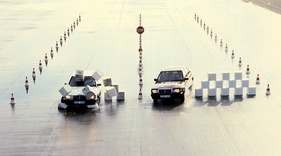
The former head of this development at Daimler-Benz, Heinz Leiber, also known as the "father of ABS", says: "The anti-lock braking system is also the pioneer when it comes to vehicle-compatible digital electronics, and so is Mercedes-Benz."