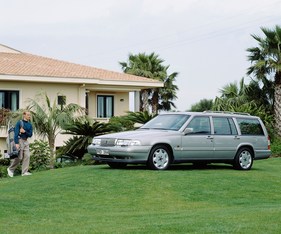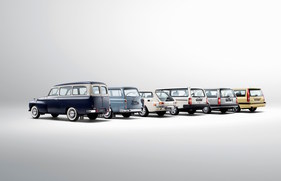









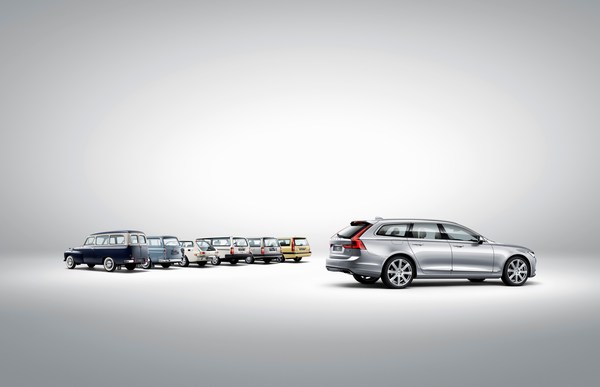
Volvo's trade fair appearance at this year's Techno Classica from April 6 to 10, 2016 in Essen will be all about legendary station wagons: The Swedish premium brand is presenting six historic estate car models from the past six decades at the world's largest classic car show - and the new Volvo V90. The top model, which was shown to the world for the first time at the Geneva Motor Show at the beginning of the month, is making its German debut in the Ruhr metropolis. The Volvo S90 premium saloon also celebrates its debut in Germany on the opening day of the show.
60-year estate car tradition
The new Volvo V90, which rolls into German dealerships in September, builds on the brand's more than 60-year estate car tradition. In 1953, the Volvo Duett was the first model to fulfill the seemingly contradictory requirements of a car for work and leisure. Since then, the Swedish premium manufacturer has sold more than six million estate cars worldwide. This means that around a third of all Volvo models ever sold can be attributed to this vehicle category. No wonder Volvo enjoys such a high reputation in the estate car segment.
The modified M-module of the Volvo Forum is integrated into the 312 square meter Volvo stand (No. 3.0-164 in Hall 3). The mobile brand house, with which Volvo Car Germany will be present at around 50 events in Germany this year, offers a modern ambience for the new top model Volvo V90 with its glass cubes.
Of course, Volvo's presence will not be complete without the station wagon icons that have significantly shaped the company's history over the past six decades: the Volvo Duett, the Volvo Amazon, the Volvo 145, the Volvo 1800 ES, the Volvo 245 and the Volvo 850 T5-R.
Station wagon icons of the last six decades
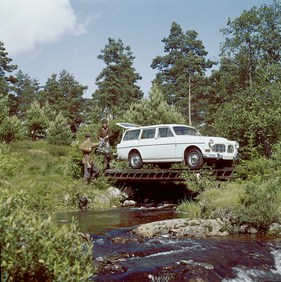
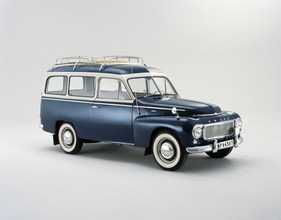
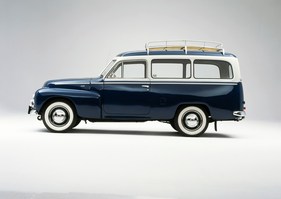
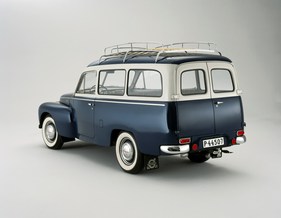
With the Volvo Duett, launched in 1953, the name said it all. It embodied the philosophy of offering "two vehicles in one": one for work and one for leisure.

As a result, the estate became the most successful Volvo to date and a global bestseller, as the Volvo Duett was the brand's first model to be exported to the USA. Almost three decades after the end of production, in 1997, the pioneer even got its own stamp in Sweden.

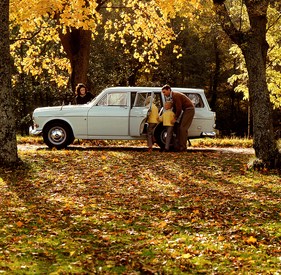
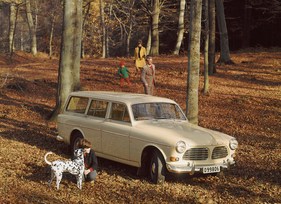
The Volvo Duett was followed in 1962 by the Volvo Amazon, which officially bore the model designation 221. It was not only significantly more elegant than its predecessor, which had its roots in the delivery van segment, but also boasted a larger trunk.
The darling of the 140 series
At the end of November 1967, the Volvo 140 series was completed with the introduction of a third variant: the Volvo 145 estate car. Its clearly contoured, angular rear design became the distinguishing feature of all Volvo estate cars. The Volvo 145 quickly enjoyed exceptional popularity and also played an increasingly important role within the model series.
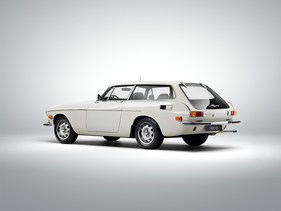
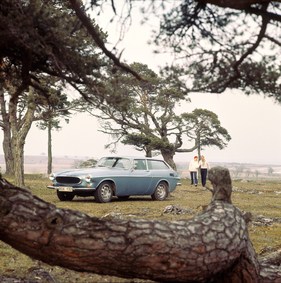
The Volvo 1800 ES, affectionately referred to by the press as "Snow White's coffin" due to its large glass tailgate, is considered the forefather of modern shooting brakes. Launched in the fall of 1971, the model was actually a further development of the cult Volvo 1800 coupé, but the sports estate still impressed with plenty of space - and not just for large golf equipment.
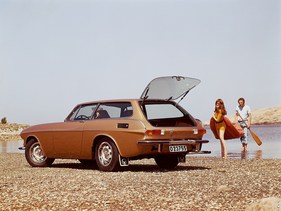
Due to new safety regulations, the Volvo 1800 ES was discontinued after 8,000 vehicles had been built. Despite or perhaps because of this small number, the estate became one of the most sought-after Volvo classics of all time.
Model for today's Volvo station wagons
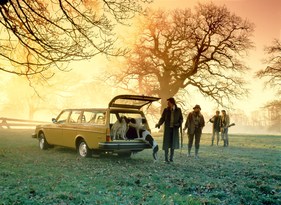
In 1974, the model for today's Volvo station wagons was introduced: the Volvo 245 - a model that is still closely associated with the brand today. The number sequence stands for four cylinders and five doors. The spacious model was built for almost 20 years, until 1993, and regularly set standards during this time: thanks to turbocharging and 113 kW (154 hp), with which the vehicle accelerated from zero to 100 km/h in 8.9 seconds, the Volvo 245 was the fastest estate car in the world at the time. A particularly exclusive variant was the Volvo 265, which featured a six-cylinder engine under the hood.

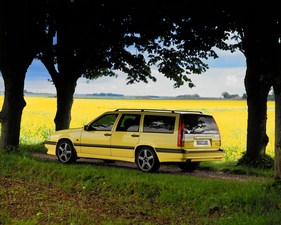
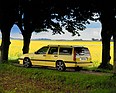
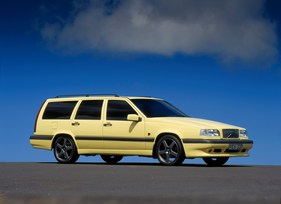
A station wagon like the Volvo 850 T5-R had never been seen before: Painted in eye-catching yellow, the 177 kW (240 hp) edition model sprinted to 100 km/h in 6.9 seconds. No wonder the model immediately became a coveted collector's item.