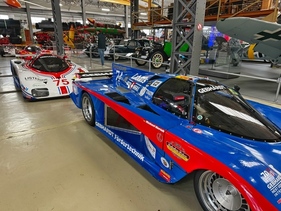
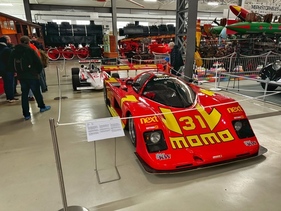
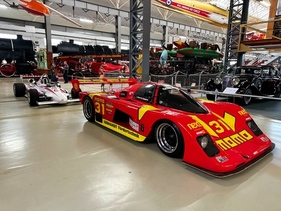
Since the end of November 2024, motorsport and technology enthusiasts have been able to experience four outstanding racing cars from Gebhardt Motorsport up close in the historic Liller Halle at the Technik Museum Speyer. The exhibition presents the legendary models Gebhardt JC853, Gebhardt C88, Gebhardt JC843 and March F2-832. These racing cars exemplify the innovative power and success of Gebhardt Motorsport and offer visitors a fascinating insight into the history of motorsport.
Gebhardt Motorsport is a traditional racing team from Kraichgau, which made a name for itself in the 1980s and 1990s with successes in endurance and prototype racing. Founded by Günter and Fritz Gebhardt, the team specialized in the construction and use of racing cars that competed primarily in Group C, one of the most prestigious racing categories at the time. Gebhardt Motorsport competed in the German Racing Championship (DRM) and the legendary 24 Hours of Le Mans, among others.
The racing team's best-known models include the Gebhardt JC 853, a Le Mans prototype that attracted attention with its aerodynamic efficiency and innovative technology, and the Gebhardt C88, a racing car that caused a sensation with its powerful design. Other models such as the Gebhardt JC 843 and the Gebhardt March F2-832 bear witness to the team's versatility and pioneering spirit. All four racing cars are now on display in the Liller Halle of the Technik Museum Speyer until spring 2025.
Gebhardt JC 843-Ford (1984)
The Gebhardt JC 843 Ford is a further development of the Gebhardt JC sports car series, which was built in Sinsheim from 1983. The vehicle was used in the World Sports Car Championship, the Interseries, the German Racing Championship and in the American IMSA series. Many international successes were achieved with the Gebhardt JC 843, including the group victory at Le Mans in 1986. The Ford Cosworth engine has a displacement of 3.3 liters and produces 500 hp. The first race after the restoration was in 2022 at the KW Group C Supercup of the Bosch Hockenheim Historic.
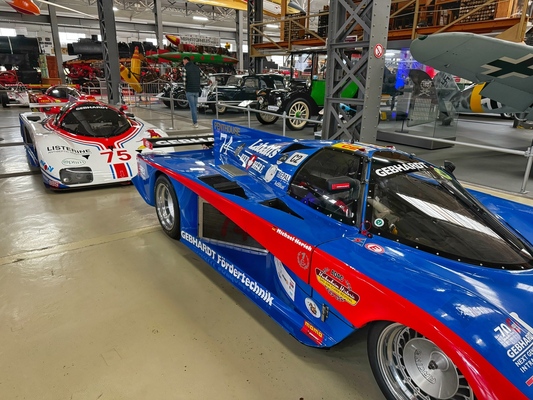
Gebhardt JC 853-Ford (1984)
This car is also a further development of the Gebhardt JC sports car series with a Ford Cosworth engine with a displacement of 3.3 liters and over 500 hp. Numerous international successes were achieved with it, including victory in Monza in 1986. This design also competed at Le Mans.
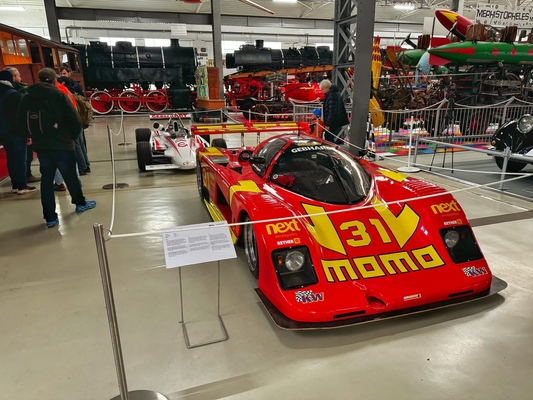
Gebhardt C88 (1987), chassis 872/1
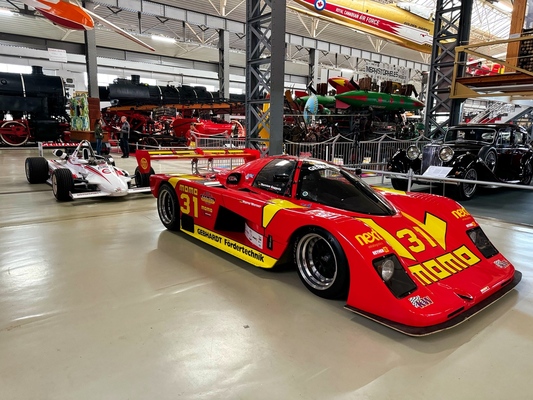
A 2.1-liter five-cylinder Audi turbo engine is used in the Gebhardt C88, which produces almost 500 hp depending on the boost pressure. It only has a two-valve system and a rather unfavorable weight distribution: the intake tract and exhaust including turbocharger are mounted on one side - an atypical racing engine. Similar to other models of this model year, the KKK turbocharger still has a rather large "turbo lag" when accelerating. Its inventor, Fritz Gebhardt, rescued the car from an auction and brought it back to its "birth workshop", where he had it completely overhauled. In 2019, the car competed in historic racing again for the first time in Monza with the MOMO livery. At the 2022 Gulf Historic Dubai GP Revival, the Gebhardt C88 was driven by three-time Le Mans winner Marco Werner.
Gebhardt March F2-832 (1983)
This racing car is based on the successful March 832 chassis, which was used in Formula 2 in the 1980s. Gebhardt Motorsport reworked the vehicle to adapt it to its own requirements and take it to a new level of performance. The chassis of the March 832 was originally developed by March Engineering, a British racing car manufacturer, and was characterized by a lightweight but robust design. Powered by a high-revving BMW M12/6 2.0-liter four-cylinder in-line engine with around 300 hp and equipped with a Hewland 5-speed gearbox, it impressed with its technical sophistication and reliability. In the hands of Gebhardt Motorsport, the March F2-832 underwent optimizations aimed in particular at the aerodynamics and chassis in order to further increase the vehicle's competitiveness. These modifications reflect the creative spirit of Gebhardt Motorsport and the ability to refine existing designs and adapt them to their own ideas. In the 1983 Formula 2 European Championship, the car finished third with race wins at Silverstone, Thruxton, the Nürburgring and Vallelunga and was regarded as a powerful competitor, especially on twisty circuits.