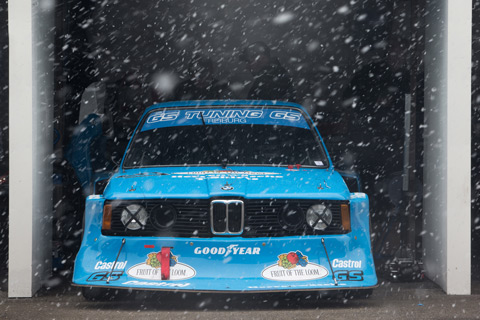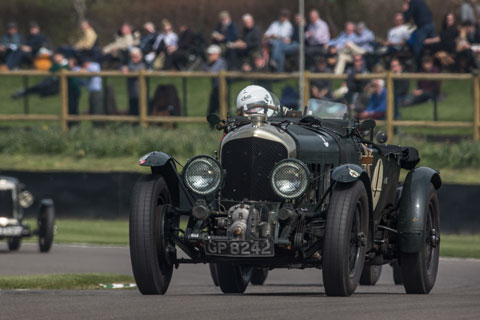


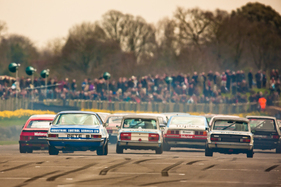
The great Goodwood circuit in West Sussex, England, was the venue for the 73rd Members Meeting on March 21-22, 2015. In 2014, the tradition of the Members Meeting was resumed after a break of several years and it already enjoys an excellent reputation and offers top-class historic racing with the best of the best in terms of vehicles and drivers.

Relaxed atmosphere
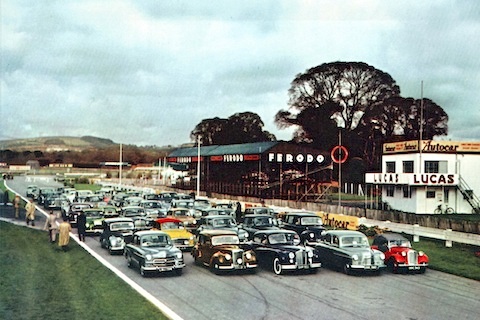
As always, the atmosphere was very relaxed and friendly throughout the weekend. The mood was similar to a club meeting in the sixties or seventies. You could look at the cars or talk petrol with some of the most famous names in motorsport from the past to the present. The pure opposite of modern Formula 1!
Great program, perfect organization
There was non-stop action on the race track, everything ran like clockwork. The variety of vehicles was breathtaking, the spectrum wide - from the first Type 35B Bugatti from 1925 to the Mercedes AMG Petronas F1 W04 from 2013, everything was there and created the most diverse sounds.
Breathtaking high-speed demos
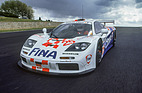
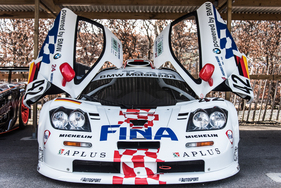
A total of twelve races were held, plus three impressive high-speed demos. One of them celebrated the 20th anniversary of the McLaren F1 GTR's Le Mans victory.

To mark the occasion, McLaren had assembled the largest number of this type of car ever seen together at one event at Goodwood. 15 cars lapped the Goodwood circuit, some driven by well-known drivers including Derek Bell, Nick Mason, Kenny Brack and Steve Soper.
When Formula 1 was still building upwards
In the mid-seventies, Formula 1 constructors were building higher and higher scoops on their cars to shovel as much fresh air as possible into their engines. The Ligier JS5 was the extreme with its two-meter-high air intake; many remember its blue and white hood with the Gitanes logo. To prevent further excesses, the height was then reduced and the air intakes moved downwards just above the roll bar or next to the driver. Most of the cars were converted; in historic motorsport you hardly ever see a vehicle with a high "air box".

Lord March obviously liked these cars too, at any rate he put together a field of these cars for a demonstration run, including no less than four Shadows, two Ferrari 312s, three Lotuses, two Heskeths and monoposti from Tyrrell, Penske, McLaren Surtees, BRM, Trojan and thus probably created the best soundtrack of the entire weekend, because between the Cosworth V8s and Ferrari twin-cylinders, a 12-cylinder Matra-Simca also roared!
Group C cars as a rolling museum
The third demo featured Group C cars. For this year's version, 18 cars were brought together. The Mazda 787B did not take part, but was on display. You can still look forward to it, because it will be roaring up the hill at the Festival of Speed in the summer - get your ear defenders ready by then at the latest.

At the Members Meeting, two Aston Martin, two Porsche 962, the famous Silk Cut Jaguar, two Nissan, two Toyota plus cars from Lancia, Peugeot, Spice, Gebhardt and (Sauber-) Mercedes-Benz drove around the circuit and the engine noise fans got their money's worth here too
Mercedes Shoot Out
Another Intermetto outside of the twelve races was a run of three Mercedes racing cars from different decades. These included the fantastic Mercedes touring car W109, 6.8 300 SE from 1971, which was driven around the circuit by Jochen Mass in a very committed manner.
The second car was a contemporary Mercedes AMG GTS Sports from 2015, which was exceptionally "quiet" compared to all the other racing cars! Karl Wendlinger did his laps in it. The third Mercedes in the group was the AMG Petronas F1 W04 from 2013, which was driven by Anthony Davidson. As usual in a so-called "shoot out", the "slowest" car (Jochen) was sent off first, with the others following behind. The result of this "shoot out" was of course obvious!
Twelve races - mostly close results
Each of the twelve races was a spectacle in itself - each starting field, consisting of various racing cars with cult symbolic character, was driven as competitively as possible and of course there was a fight for every place! In some heats, the front runners finished less than a second apart, with positions being fought for right up to the last lap - no comparison with the processions often seen in modern racing.
Touring cars from the seventies and eighties in the clinch
One of the highlights for many visitors was the Gerry Marshall Trophy, in which Group 1 touring cars that raced between 1970 and 1982 battled for victory in two rounds. And anyone who has ever seen the great Gerry Marshall race knows why the local race is named after him!

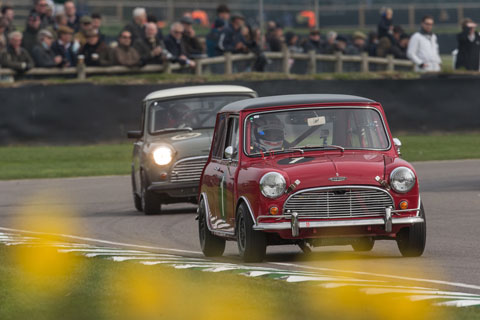
At the start were huge Camaro Z28s, small Minis, melodious Rover SD1s, fast Ford Capri, Triumph Dolomite Sprint, VW Golf GTI, Ford Escort RS 2000, as well as BMW, Opel and Mazda vehicles.
And it was by no means a triumphant procession of the displacement giants, because at the start of the race, which lasted 45 minutes, there was a Mini alongside Stuart Graham's Camaro and the battle for the first corner will remain in the spectators' memories for a long time to come. Just as entertaining was the race to catch up with Chris Harris and Chris Ward, who had to start from the back of the field in the big race and still managed to finish second. The winners were Clark/Neal in the Chevrolet Camaro Z28.
A one-make cup in a class of its own
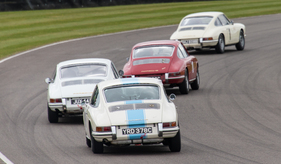
The John Adlington Trophy was also a special race, in which only Porsche 901/911 two-liter models up to 1966 were allowed to compete.

The early 911s with the short wheelbases delivered thrilling drifts, with Andrew Jordan winning the race by a clear margin in the end. According to Chris Harris, he had the worst start in Goodwood history when, after several attempts, he gave up on shifting from first to second gear and had to make do with third. However, he still managed to finish in 6th place.
English touring cars almost among themselves
In the Sopwith Cup, the English touring cars of the fifties were almost among themselves, from the Jaguar Mk1 and Mk VII, to the Austin A35 and A40, to the Hillman Minx or Riley One-point-Five, Ford Anglia or MG Magnette, everything that used to move fast in touring car races was at the start.

Among them were two Alfa Romeo Giulietta TIs, a Mercedes-Benz 220S, a BMW 502 and even a VW Beetle, but the "foreigners" had nothing to do with the outcome, as the English saw the chequered flag much earlier. A mere 0.796 seconds separated the winner Andy Wallace in the Jaguar Mk1 from the runner-up Richard Meins in the Austin A40 - these were no coffee runs!
Two days of non-stop racing action
The other ten races also offered the best of historic motorsport and showcased some of the most appealing racing cars of past decades in proper forward motion.

In the race for British sports cars from 1960 to 1966, Chris Ryan came out on top in an MG B Le Mans, followed by Rod Begbie in a TVR Grantura MK III.

In the Graham Hill Trophy, GT sports cars from 1960 to 1966 raced against each other, including the ISO Bizzarrini A3C, the AC Cobra, the E-Type and various Aston Martins. The winning pairing was Lynn/Pirro in an AC Cobra Le Mans Coupé. Particularly attractive for the spectators - the races were also held at dusk.
Sports prototypes from 1955 to 1960 battled it out in the Salvador Cup. With a lead of just half a second, Sam Hancock in the Lister Jaguar "Knobbly" took victory ahead of Shaun Lynn in the same car. He was followed by a Tojero-Jaguar and then the slender Lotus 15 and 17.
In the Bruce McLaren Trophy, the early CanAm racing cars from 1960 to 1966 were on the grid, guaranteeing a great soundtrack. Nicholas Padmore crossed the finish line as the winner in a Lola-Chevrolet T70 Spyder.

Formula 3 cars from the 1964 to 1970 era formed the field of the Derek Bell Cup. The so-called "screamers", monoposti with high-revving 1000 cc Ford engines, offered exciting motorsport, with just 18 thousandths separating the winner James King in a Chevron-Ford B17 from runner-up Simon Armer in a March-Ford 703 and third-placed Peter Thompson in a Brabham-Ford BT21 just 1.3 seconds behind.

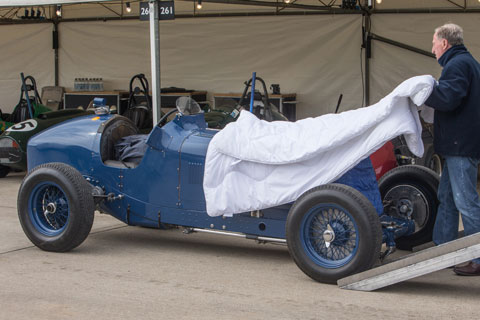
The Earl Howe Trophy brought Grand Prix and Voiturette racing cars from the era up to 1935 to the starting line, including magnificent Bugatti, Frazer Nash, Alfa Romeo and Maserati. In this race too, fractions of a second decided the outcome of vehicles with very different concepts. Sean Danaher won in a Maserati 8CM ahead of Eddie Gibbs in a Frazer Nash Single Seater with supercharger.
The races for the Hawthorn and Taylor Trophies were clear-cut, with Barrie Baxter in a BRM Type 25 winning the Grand Prix cars of the fifties and Andrew Wilkinson in a Lynx-Ford Mk3 winning the Formula Junior race.
So another fantastic weekend of motorsport by Lord March and his team came to an end. The Members Meeting is now firmly on the calendar and the Festival of Speed in June and the Revival in September complete the triple - these events really are three of the best, at least if you've got petrol in your blood!