


After a slight easing of the political situation at the end of the 1950s, Škoda returned to international motorsport and in 1956 competed in the prestigious Monte Carlo Rally for the first time since 1949. The Škoda Octavia Touring Sport (TS) drove to numerous successes in international rallies in the early sixties and continued the motorsport tradition of the car manufacturer from Mladá Boleslav.
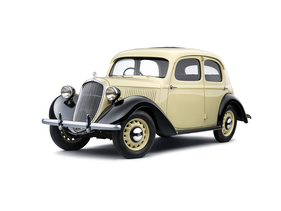
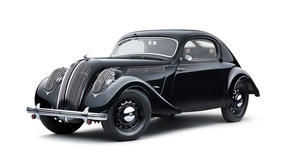
The tradition of dynamically designed Škoda vehicles that were also suitable for everyday use began in the mid-thirties with the Rapid. It was slightly larger than the Popular, and the powertrains of the two model series also differed. In 1960, the Octavia Touring Sport (TS) continued this tradition of sporty models from Mladá Boleslav.
Škoda returns to the international motorsport stage
The sixties were a politically eventful decade: the car manufacturer from Mladá Boleslav also wanted to take advantage of the cautious opening of Czechoslovakia. Success in motorsport had always been a good way to promote new models, and Škoda entered its vehicles in prestigious international rallies. Long cross-country rallies were endurance tests for man and machine, and the ever more powerful and faster rally cars made for attractive races. Taking part in motorsport events at this time involved little effort and many teams modified their cars themselves. A solid and reliable basic model such as the Škoda Octavia TS was enough to drive right up to the front of the field.

Škoda Octavia TS: Targeted modifications provide more power
The Octavia TS was available in two displacement and therefore also performance variants. In contrast to the base version of the Octavia, the initial version with a displacement of 1089 cc had two Jikov 32 SOPb downdraft carburetors. The engine was later fitted with a new intake manifold and, thanks to the deflectors on the pistons, had a compression ratio of 8.4:1. These modifications increased the power output to 50 hp at 5500 rpm, while the maximum torque of 74.5 Nm was available at 3500 rpm.

Octavia TS 1200 from 1962
In 1960, production of the modernized Octavia and Felicia began, both of which Škoda also offered as Super versions. In these models, the car manufacturer increased the bore of the engine to 72 millimetres, increasing the displacement to 1221 cc. The Super version had a compression ratio of 7.5:1 and produced 47 hp. Thanks to an even higher compression ratio of 8.4:1, the Octavia TS 1200 presented in January 1962 had 55 hp at 5100 rpm. The engine developed a maximum torque of 86.2 Nm at 3500 rpm. The model was a popular tuning object among private customers: with appropriate technical modifications and the necessary experience, it was possible to increase the engine's output to almost 100 hp. In total, more than 2270 units of the Octavia TS and Octavia 1200 TS rolled off the production line in Mladá Boleslav between 1960 and 1964.
Octavia TS: 920 kilograms, four-speed gearbox and independent suspension all round
Although the Octavia TS 1200, with an unladen weight of 920 kilograms, was 20 kilograms heavier than the Felicia convertible, the manufacturer claimed identical driving performance with the same fuel consumption. The car reached speeds of up to 130 km/h and required an average of 9.1 liters of petrol per 100 kilometers. The second to fourth gears of the four-speed gearbox were synchronized and the gearshift was located on the central tunnel. The four wheels were individually suspended from the central tubular frame.
First successes of the only slightly modified rally cars against the international competition
The vehicles modified for rally use had 15-inch rims with Barum tires, while Michelin tires with studs were used for special stages on snow and ice. The Octavia proved to be a strong competitor in the under 1300 cc category right from the first rallies. This was noticed not only by Scandinavian teams but also by participants from Austria, Poland and Greece. Their decision in favor of the comparatively inexpensive vehicle from Mladá Boleslav proved to be a good choice.

Esko Keinänen and Rainer Eklund dominate their class at the 'Monte' in the Octavia TS
The Octavia TS achieved its greatest successes in the hands of private drivers at the Monte Carlo Rally and the Finnish Thousand Lakes Rally. In 1961, the Finnish duo Esko Keinänen/Rainer Eklund took sixth place overall and first place in their class in Monaco. One year later, 16 driver teams from eight countries took part in the Monte Carlo Rally with the Octavia. As in the previous year, the Finn Esko Keinänen dominated his class and won ahead of four vehicles from Alfa Romeo.
The vehicles of the works team were only slightly modified for this edition of the Monte Carlo Rally - the compression ratio remained unchanged compared to the production version, and an aluminum oil pan was also installed. Two overall ratios were homologated and the final ratio was 4.78. During the rallies, cut Barum OS 11 5.60x15 tires and Michelin Valiart with studs provided the necessary grip on any surface.
Octavia TS continues its success story at the Thousand Lakes Rally in Finland and the Tour d'Europe
At the Thousand Lakes Rally, Esko Keinänen left almost all competitors behind - with the exception of Pauli Toivonen in a Citroën DS 19. Keinänen dominated his class and finished second overall. In 1963, the Octavia TS continued its winning streak. It won its class for the third time in Monaco, this time with the Norwegian duo Gjölberg/Karlan on board. It also enjoyed great success in Finland: Esko Keinänen drove the vehicle to fourth place in the overall standings on ice and snow. In addition, Josef Vidner and Bohuslav Staněk took first place in the class up to 1300 cc in the 1963 Tour d'Europe and finished in an excellent fifth place overall.
In the years that followed, the light and agile Octavia TS continued to prevail against the international competition. Among the best-known Czech drivers of the Octavia Touring Sport and the TS 1200 were the brothers Jaroslav and Václav Bobek, Miroslav Fousek, Vladimír Hubáček, Zdeněk Mráz, Leopold Lancman and Jiří Srnský.