

The importance once attached to the legendary 'Monte' by its founding fathers can still be seen today in the traditional January date as the start of the World Rally Championship: outside of the summer season, it was intended to attract drivers and tourists to the Mediterranean principality. The event was once conceived as a rally: the participants set off from different starting points throughout Europe.
The number of points they received on arrival in Monaco also depended on the length and difficulty of the route. They could then score further points in Monte Carlo itself - for example for the elegance and comfort of the cars and their technical condition when they arrived on the Riviera. There were also skill tests in which the chauffeurs had to demonstrate their driving skills.
As early as 1912, at the second edition of the Monte Carlo Rally, a vehicle from Mladá Boleslav was also part of the field of participants: Alexander 'Sascha' Count Kolowrat-Krakowsky set off from Vienna on January 21, 1912 on the 1,319-kilometre route to the Principality. In temperatures as low as -18 degrees, the count's jack-of-all-trades wore a thick coat in his open Laurin & Klement to brave the icy conditions.

The Škoda Popular Sport Roadster (1936) and the Škoda Rapid Coupé (1937)
From 1925, the cars from Mladá Boleslav bore the Škoda emblem and soon enjoyed further success on their way to Monte Carlo. In January 1936, the duo Zdeněk Pohl/Jaroslav Hausman took second place in the displacement class up to 1,500 cc with the Popular Sport, a roadster. This result prompted Škoda to expand its model range with the Popular Monte Carlo. Between 1936 and 1939, a total of 70 of these vehicles were built, which the company offered as roadsters and coupés.
One year later, 85 years ago, Pohl and Hausman chose Palermo as the starting point for the rally, which took place from January 26 to 30, 1937. At 4,134 kilometers, the Sicilian metropolis was another 282 kilometers further away from Monaco than Athens, from where the Czech duo had set off twelve months earlier. This earned them 500 additional points. Only four out of a total of 30 cars survived the rigors of this difficult route, which consisted almost entirely of hard or muddy gravel roads.
With their Škoda Rapid, powered by a four-cylinder engine with a displacement of 1.4 liters, Pohl/Hausmann successfully passed all of the passage controls. Nevertheless, the duo from Mladá Boleslav picked up two curious penalty points and dropped from second to fourth place in the overall standings as a result: Their English rivals had lodged a protest against the coupé's rear-view mirrors. Although these had the external dimensions specified by the regulations, the reflective surface was a little too small without the frame.
Of course, Pohl and Hausman could have swapped the mirrors for slightly larger ones before the official inspection, but this went against their sense of fair play. After their return, the management of the car manufacturer at the time also publicly acknowledged this sporting spirit in Prague.
Škoda as the measure of all things among the 'thirteen-hundreds': Octavia, 130 RS and Favorit
The political and economic developments after the Second World War meant that Škoda was cut off from many of its traditional markets and prestigious sporting events by the 'Iron Curtain'. As a result, from 1949 only private drivers were able to compete in the Monte Carlo Rally with cars from Mladá Boleslav, and the works team only returned to Monaco in January 1956.
However, foreign owners of Škoda vehicles seized their chance: the best results in the wintry conditions were achieved by participants from Scandinavia. Their triumphs included, for example, the hat-trick in the 1,300 cc class in 1961 with the Škoda Octavia Touring Sport. Esko Keinänen/Rainer Eklund were also delighted with sixth place in the overall standings. The two Finns also dominated the 'Thirteen Hundred' class in 1962. Twelve months later, the Norwegians Edward Gjolberg and Carl Karlan built on these successes with the Octavia TS 1200.

In the years that followed, rallying in general and the Monte Carlo Rally in particular took on an increasingly professional format. In 1973, it was the season opener of the first-ever World Rally Championship, which at the time was still exclusively about the manufacturers' title. The Škoda vehicles with the classic drive concept and central tubular frame were followed by more modern models with a self-supporting body and engine in the rear, which gave them more traction, especially on snowy and icy roads.
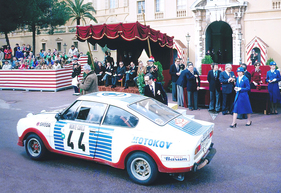
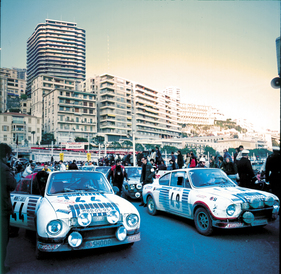
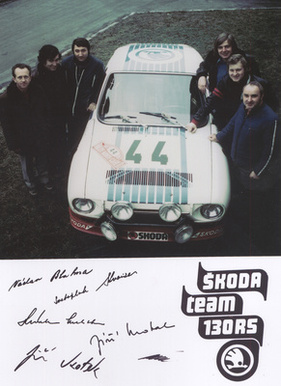
The successes of the 130 RS still stand out today. In 1977, when only 43 out of 198 vehicles reached the finish line at the particularly wintry 'Monte', Škoda won the category up to 1.300 cc: while Václav Blahna/Lubislav Hlávka won the class, their works team colleagues Milan Zapadlo and Jiří Motal took second place, making the one-two victory perfect. In the overall standings, they finished a remarkable 12th and 15th.
With front engine: from the Škoda Favorit to the Fabia R5 Rally2 evo
60 years ago, sporty versions of the Škoda Octavia family saloon dominated the 'Thirteen Hundreds' at the Monte Carlo Rally. 30 years later, the Favorit 136 L with its modern hatchback body continued this series of successes. Its four-cylinder aluminum engine above the driven front axle had a displacement of 1,289 cc and helped the duo Pavel Sibera/Petr Gross to numerous victories in Group A up to 1.3 liters. From 1991 to 1994, they achieved four triumphs in a row.
A detail from the 1993 'Monte' proves just how good the Škoda Favorit was: even in the displacement class up to 2,000 cc, in which much more powerful rally cars competed, it finished fourth among the vehicles with only two driven wheels.

The Favorit was followed by the even more radical Felicia kit car before Škoda entered the top class in 1999: the Škoda WRC with a 2.0-liter four-cylinder turbo engine and all-wheel drive heralded a whole new era for the Czech brand. The works drivers Armin Schwarz/Manfred Hiemer caused a sensation in 2001 with a fourth place in the overall standings.
From 2003, Škoda entered the much more compact and lighter Fabia WRC. Its turbocharged four-cylinder engine also mobilized 221 kW (300 hp), while the maximum torque increased from 500 to 600 Nm. Despite all-wheel drive, Škoda's World Rally Cars (WRC) were also able to use the hydraulically operated handbrake, which is so popular in rallying, especially in the tight hairpin bends of the 'Monte' mountain passes: The center differential then switched off the power flow to the rear wheels.
The short WRC break
In 2009, Škoda said goodbye to the WRC cars and opted for the new Fabia Super 2000. At the Monte Carlo Rally, which that year was part of the Intercontinental Rally Challenge (IRC) instead of the World Championship, the car finished fourth overall. In 2010 and 2011, the Super 2000 finished in second place, before taking victory in 2013.
In January 2011, Škoda also presented the special Fabia Monte Carlo model in Monaco - a tribute to the 100th anniversary of the Monte Carlo Rally, which coincided with the 110th anniversary of the motorsport activities of the car manufacturer from Mladá Boleslav.
After many victories, which were mainly celebrated by private teams in the WRC2 category with the Fabia Super 2000, Škoda opened another very successful motorsport chapter in 2015 with the Fabia R5: From then on, it relied on a 1.6-liter four-cylinder turbo engine. The works team took first and second place in its class at the 2017 Monte Carlo Rally. The following year, Jan Kopecký/Pavel Dresler won not only the WRC2 category but also the higher-level RC2 classification.
In the meantime, the Fabia R5 has evolved into the Fabia Rally2 evo. Thanks to support from Škoda Motorsport, the Toksport WRT team has its sights firmly set on class victory at the 2022 Monte Carlo Rally: Norwegian Andereas Mikkelsen, together with co-driver and compatriot Torstein Eriksen, wants to confirm his victory from last year with this model.