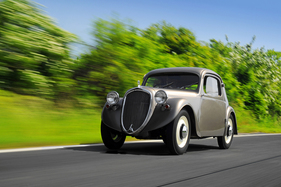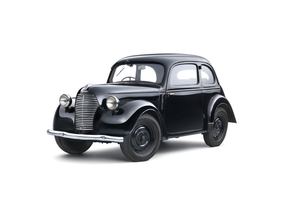
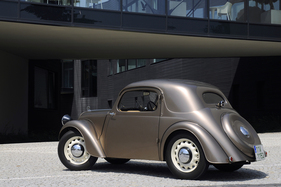
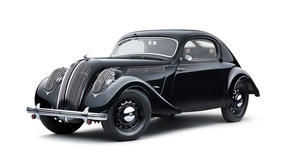
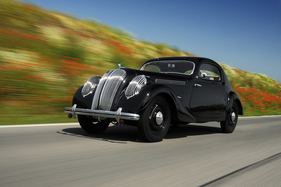
Mladá Boleslav - Škoda's best-selling car between the two world wars was the Popular. However, the Mladá Boleslav-based brand's bestseller, launched in 1934, continued to increase in displacement and engine power, dimensions and price in the years that followed. As a result, the mid-range model opened up space in the model range for a more affordable alternative: the 995 Popular 'Liduška' with a water-cooled four-cylinder engine. Its development began in 1936 with special prototypes in which the Bohemian manufacturer experimented with unusual drive systems. Two of these so-called Škoda Sagitta have been preserved.
The automobile as a luxury item - but not for long
In the 1920s in Czechoslovakia, as in many other countries, only a few wealthy citizens could afford an automobile. This was partly due to the very low production figures and partly due to high taxation, which further dampened demand. When the global economic crisis hit in the fall of 1929 and the spirit of optimism of the 'Golden 20s' cooled, the situation became even more acute. Škoda was comparatively well prepared for this turning point: Founded in 1895 - 125 years ago - by Václav Laurin and Václav Klement, the company had commissioned a plant with modern assembly line production in Mladá Boleslav months earlier and was able to manufacture at correspondingly low prices. By moving away from vehicles based on a ladder frame, Škoda also took an important step towards cars that a larger proportion of the population could afford. The development of the new model generation with a significantly lighter central tubular frame and advanced independent suspension, which offered greater driving comfort with lower maintenance requirements, began in the summer of 1932 under the direction of Josef Zubatý in Prague's Letňany district.
The search for the perfect model
The various engine concepts that engineer Zubatý tried out at the time show how consistently Škoda questioned and rethought the tried and tested for the new vehicles, although the Bohemian car manufacturer had gained a lot of experience with water-cooled inline four-cylinder four-stroke engines since 1906. Nevertheless, in January 1933, an air-cooled V2 four-stroke engine with a displacement of 750 to 800 cc and an output of around 12 kW (16 hp) was developed as an alternative. In June, the Škoda 112, a prototype whose rear wheels were driven by a 500 cc two-stroke single-cylinder rear engine, made its debut. But that was not all: another air-cooled V2 four-stroke with a displacement of 850 cc followed in the fall and a V2 two-stroke in September. But even this Type 222 failed to convince the company management. In October 1933, they again gave the green light to a four-stroke concept for further trials. This ultimately led to the prototype 215 with an 804 cc, 11 kW (15 hp) in-line two-cylinder engine.
Less for more
For the new series model, on the other hand, the 420 Standard presented in 1933, the smooth-running, economical and reliable four-stroke four-cylinder had once again prevailed. Like the 418 Popular introduced in February 1934, it had a displacement of 902 cc. From April 1934, the Škoda 420 Popular with a 995 cc, 16 kW (22 hp) four-cylinder engine was added to the range.
Although the production of these engines cost around 650 crowns more, Škoda was able to offer the new vehicle concept at a price that was on a par with the two-cylinder models of its competitors. Despite the use of significantly higher quality materials, the new price of the 418 Popular fell from 29,800 to 18,800 crowns compared to the comparable predecessor model - the four-seater Škoda 420 Standard - thanks to efficient assembly line production.
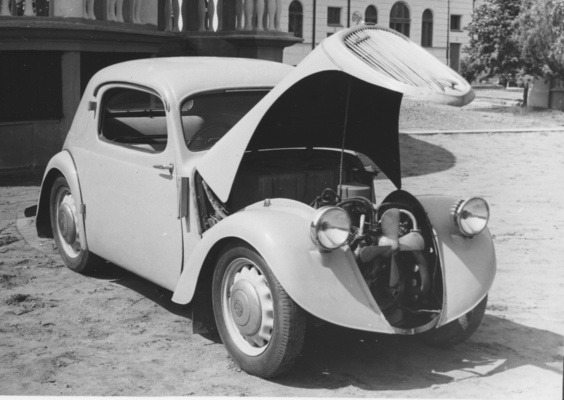
Nevertheless, with an impressive exterior length of up to four meters, the Popular had become increasingly larger and was still too expensive to appeal to a broad customer base, even in its simpler variants. At Škoda, plans began to take shape for a smaller, more affordable vehicle that would trigger genuine mass motorization - in the form of the so-called Sagitta prototypes, whose Latin name stood for 'arrow' and thus referred to the brand logo. Although it is no longer possible to trace exactly when its development began in the Škoda Auto archives, other records date the project to the years between 1936 and 1938. However, the dimensions of the small car are certain: with a wheelbase of 2,100 millimetres, the test vehicles were 3,400 mm long, 1,320 mm wide and 1,420 mm high.
Clever layout - later a success
The first test vehicle was on its wheels in April 1936. With a central tubular frame and four individually suspended wheels with transverse, semi-elliptical leaf springs, it was based on Škoda's now proven concept. It is no longer known which body this prototype wore. In any case, it was followed by two convertibles, a two-door model with four full-size seats instead of a 2+2 arrangement and four coupés, which differed from each other by, among other things, sliding or lowered side windows. Similar to the Popular, their three-speed gearboxes formed an advanced 'transaxle' unit with the transfer case on the rear axle - it was only later that this clever layout became established, for example for expensive sports and racing cars. In the Škoda Popular and Sagitta, it gave the driver and front passenger more legroom and lowered the vehicle's center of gravity.
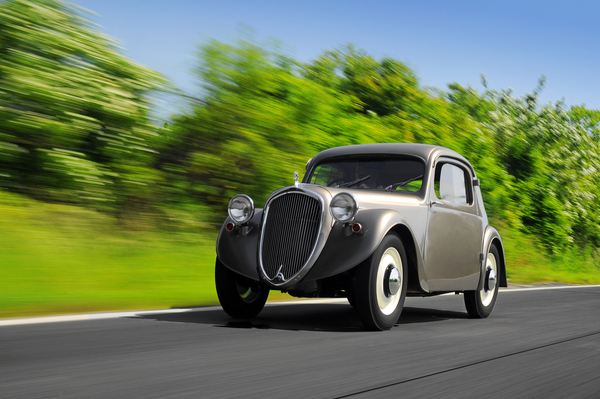
The fact that this transaxle principle also improved traction was another plus point on the mostly unpaved, muddy or sandy roads and tracks of the time - although the Sagitta, with its narrow track width of just 1050 mm, did not require a differential gear, the 16-inch wheels spun significantly less, even on snow. The precise rack-and-pinion steering also contributed to the easy controllability. Empty, the Sagitta weighed only 580 kilograms; fully loaded, it could weigh up to 860 kilograms.
Untypical Škoda engine cooling
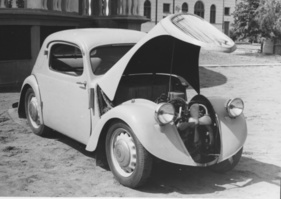
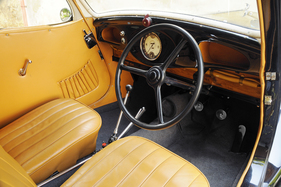
Under the hood with integrated radiator grille, the V2-cylinder four-stroke engine from engineer Zubatý's test program did its work - now with SV valve control, 844 cc displacement and an output of 11 kW (15 hp) at 3000 rpm. Unlike other Škoda engines, they were air-cooled instead of water-cooled and had a four-blade fan made of light metal as well as a capillary thermometer behind each of the finned cylinder heads. Their displays, which were clearly visible to the test drivers, were mounted on the dashboard, which in turn was similar to that of the Popular. Instead of the originally used Zenith 26 VEH carburetors, the more modern Solex BFRH were used. They already had an air filter consisting of an oil-soaked wire mesh. Preheating the intake manifold with exhaust gases made it easier to start the engine. The electrical system was based on a 6-volt system from the Swiss specialist Scintilla. The prototype reached a top speed of 70 km/h, with average fuel consumption settling at 5.5 liters per 100 kilometers.
Never series production despite good attributes
Two examples of the rare Sagitta are now owned by the ŠKODA Museum in Mladá Boleslav. The extensively restored coupé, painted in metallic brown, is an integral part of the permanent exhibition. It has sliding windows in the side doors - a well thought-out solution that does not require window cranks and thus improves the feeling of space at elbow height.
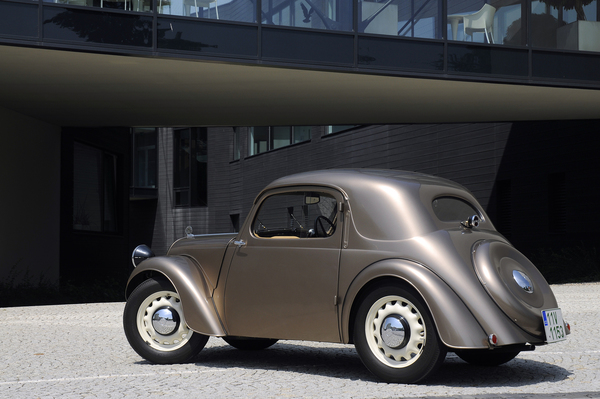
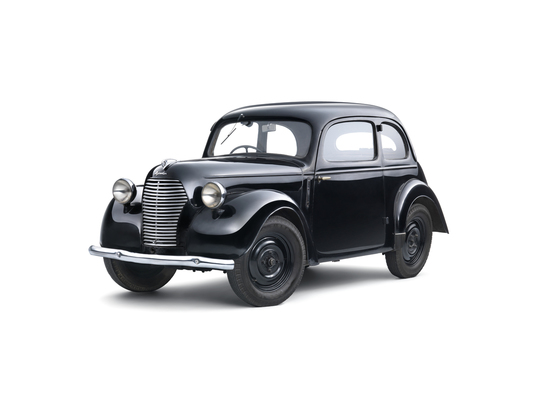
Another coupé model is waiting to be revived in the museum warehouse. Although the attractive small cars did not go into series production, they still fulfilled their purpose: many elements, including the engine arrangement longitudinally in front of the front axle and the radiator grille integrated into the hood, which made it easier to work on the water-cooled four-cylinder engine, found their way into the 995 Popular 'Liduška', which was built from November 1938.
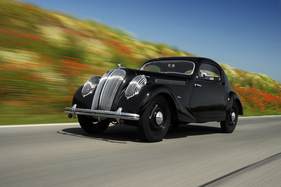
Despite its more complex, 995 cc, 16 kW (22 hp) engine and 400 millimeter longer body, it was a real price and sales hit: Škoda only charged 17,300 crowns for it, excluding VAT. By 1946, a total of 1478 examples of the 'Liduška' had rolled off the production line.