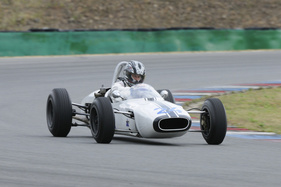
When the regulations for the traditional Formula 3 monoposto category changed in 1964, Škoda was able to react quickly thanks to the 1000 MB. This model was already in preparation at the time. During the 1965 season, three completely new single-seaters competed with the experienced drivers Václav Bobek, Jaroslav Bobek and Miroslav Fousek. The newly established formula class offered the brand and its drivers a unique opportunity to compete with rivals from Western Europe.
In addition to the complete selection of images accompanying this press release on the media portal skoda-media.de, a 32-page brochure in English on various topics from 120 years of Škoda Motorsport is also available.
The Czechoslovak Grand Prix in September 1949 was to be the last international motor race in the then socialist country for a long time. The big stars of the Grand Prix on the Masaryk Ring were later involved in the founding of Formula 1. Even at the last race, enthusiasm compensated for a lack of financial resources, a shortage of equipment and a lack of political will. Under the simplest of conditions, single-seater racing cars were created that met the requirements of international formula racing.
The first Formula 3 races took place at the end of the 1940s. On the engine side, affordable single-cylinder motorcycle engines with a displacement of 500 cc were used, which subsequently became established. In 1951, the series was renamed 'International F3'. However, at the end of the 1950s, the more modern Formula Junior made its debut in Italy with production four-cylinder engines with a displacement of less than 1,100 cc. This eventually evolved into the classic Formula 3 on January 1, 1964, with vehicles up to 1,000 cc displacement.
The Škoda monoposto project was given the name Š 992 in Mladá Boleslav - a reference to the technical relationship with the Š 990 model, which was ready for series production as the newly designed Škoda 1000 MB model in spring 1964.
Construction details
The first Š 992 single-seater was completed in February 1964. It had a tubular steel trellis frame and independent wheel suspension, with trapezoidal semi-axles at the front and five-link suspension at the rear. A progressive solution - even by international standards - was the installation of coil springs and shock absorbers on both axles inside the body, which had a positive effect on the aerodynamics of the monoposto.

The adjustable shock absorbers made it possible to vary the ground clearance of the car. Its 13-inch alloy wheels with Dunlop tires were braked by four disc brakes from the British manufacturer Girling. A Škoda in-line four-cylinder engine with OHV valve control and triple-bearing crankshaft was installed longitudinally in front of the rear axle. This engine was produced in numerous modifications until 2003 and was last used in the first generation of the Škoda FABIA. In the F3 Monoposto, the engine had a shorter stroke and larger bore with a displacement of 999 cc. Starting from the vertical axis of the vehicle, it was tilted 12 degrees to the left and the clutch was flange-mounted at the rear end.

The so-called 'intermediate transmission' was located between the clutch and the gearbox. It made it possible to lower the engine's center of gravity and thus adapt the overall transmission ratio to the character of the respective race track. The differential gear had a transmission ratio of 4.44 and came from series production. The water and oil coolers were located at the front of the vehicle in front of the driver's feet. The fuel tanks with a total capacity of 30 liters were located next to it on both sides. The sleekly designed body was made up of several parts and was removable. It was developed in the wind tunnel and was initially made of aluminum in its first version, but was soon made of glass fiber-reinforced plastic. Space in the cockpit was limited - which is why the small steering wheel only had a diameter of 300 millimeters. The unladen weight of the Škoda F3 was just under 420 kilograms, with 41.5 percent accounted for by the front axle and 58.5 percent by the rear including the engine.

The engine with a displacement of one liter originally produced 53 kW (72 hp) at 7,250 rpm. However, a gradual increase in compression and further optimizations brought it to an output of 66 kW (90 hp) at 8,000 rpm in the 1966 season, while the overall weight was reduced by 15 kilograms. While the Škoda F3 reached a top speed of 188 km/h during test drives at the airfield in Hoškovice at the end of 1964, it broke the 200 km/h barrier two years later.
Racing successes
Right from the start, the Škoda F3 was among the front-runners in all races. At that time, the races were still held on challenging circuits that were not man-made or took place on inner-city courses with cobblestones and deep manhole covers. The traditional 'Mezi pavilony' race in the city of Brno was also held on an improvised course between the pavilions of the exhibition center. In 1966, Václav (Sen.) and Jaroslav Bobek took the first two places with their Škoda cars. Jaroslav Bobek became Czechoslovak Formula 3 champion in the same year, and two years later his team-mate Miroslav Fousek triumphed in the F3 championship of the socialist countries.

With these successes, the successful career of the visually and technically successful Škoda F3 monopostos slowly came to an end. In international races at the end of the 1960s, they increasingly had to contend with competition from Western European countries, such as the Brabham and Tecno cars. In domestic races, it was mainly Lotus Cosworth cars that prevailed, with well-known drivers such as Vladimír Hubáček and Vladislav Ondřejík driving for the Dukla Prague team.
Nevertheless, the Škoda single-seaters were successful in the often unequal battles and rightly play an important role in the history of Czechoslovak motorsport. The final end for the monopostos from Mladá Boleslav came with the change to the Formula 3 regulations in 1971 - it stipulated an engine with a displacement of 1.6 liters. Subsequently, the Škoda F3 cars were only used as technology suppliers for the new Škoda one-make formula.

Whereabouts of the racing cars
Václav Bobek Sen.'s Škoda F3 remained in the possession of AZNP and is now part of the Škoda Museum collection. Miroslav Fousek's car was donated to the National Technical Museum in Prague in 1971 and Jaroslav Bobek's single-seater was converted into the two-seater Spider Baghira by Václav Král in the mid-1970s. The functional prototype with which it all began was dismantled after the 1965 season and is now waiting in a private collection for its restoration to be completed.