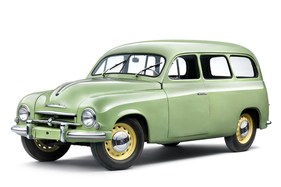
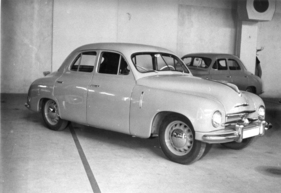

Production of the Škoda 1200 Sedan with an all-steel body began 70 years ago in Mladá Boleslav. This technological advance enabled efficient mass production. In addition, the body made it possible to increase the interior space and improve passive safety while simultaneously reducing the vehicle weight. The pontoon body of the Sedan was one of the first in Czechoslovakia to be optimized in the wind tunnel.
The first automobile from Mladá Boleslav ever developed by the team of engineer Václav Laurin was presented to the public by the Laurin & Klement brand back in 1905. The legendary L&K Voiturette A featured an open wooden body, but had no windshield and no doors. Later, manually formed sheet metal parts were attached to a wooden frame with small nails. This method was still used in the automotive industry half a century later.
First all-steel construction
On July 11, 1952, there was a major change in manufacturing technology. Due to the switch from wooden to metal bodies, the carpenters responsible for building the wooden frames for the bodies had to switch to the production of transport boxes for vehicle export.
The new Škoda 1200 Sedan was the first model with an all-steel construction in pontoon form with integrated mudguards. This enabled more efficient use of the interior space and increased passive safety. The smooth, rounded surfaces also made it easier to maintain the vehicle.
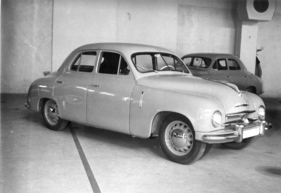
Development of the new Škoda model began as early as 1948, with the first prototype being built a year later. Other versions soon followed, such as the variable STW (Station Wagon) with folding rear seats. A prototype with an open body was also developed.
The Škoda 1200 Sedan was a further development of the chassis concept with a central tubular frame. This was forked at the front and could therefore accommodate the petrol engine with OHV valve control and other modern components such as wet cylinder liners. The individually suspended rear wheels were driven via a synchronized four-speed gearbox, and the car reached a top speed of 105 km/h with a fuel consumption of ten liters per 100 kilometers.
The father of the sedan
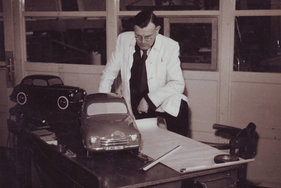
Josef Velebný (1906-1989) was one of the most important people in the field of car body construction at this time. He had been working at the automobile plant in Mladá Boleslav since 1925 and was head of the body design department from 1946. Systematic research and development in the field of aerodynamic optimization also began during this time. This increased the top speed of the vehicles while simultaneously reducing fuel consumption. The vehicles were also quieter and the bodywork became less dirty while driving. Research at the time was based on measurements on wooden models on a scale of 1:5 and 1:10 in a wind tunnel with a diameter of 1.8 meters. At the time, only the Aviation Research and Testing Institute in Prague-Letňany had such a facility. Škoda initially tested the Škoda 1101/1102 Tudor models, but the main focus was on the Škoda 1200.

Thanks to the new body, the vehicle benefited from a low kerb weight of just 1050 kilograms - roughly the same weight as the older, significantly smaller Škoda RAPID OHV model. The five-seater sedan had a separate trunk with a separately accessible spare wheel and a tool kit, which was mandatory at the time. The four doors also covered the sills so that the occupants' clothes did not get dirty when getting in and out.
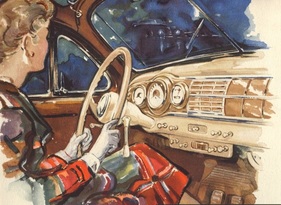
The gearshift mounted on the steering column was one of the features that helped to improve active safety. The driver only had to take their hand off the steering wheel briefly when changing gear and also benefited from greater legroom thanks to the elimination of the gearshift in the center tunnel.
Also available as an estate and commercial vehicle
The advantages of the all-steel body were not only evident in the notchback variant, but also in the light commercial vehicles. Production of these began in 1952 at the Vrchlabí plant. The ambulance versions were built at the Kvasiny plant, with space for two stretchers in addition to the crew. At the beginning of 1953, the practical Škoda 1200 STW station wagon with a one-piece, side-opening rear door was added to the range.
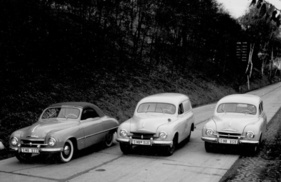
Some of the fold-down seats were only accessible from the right-hand side of the vehicle in favor of a stiffer body. In its two-seater version, the estate offered a 1,750 millimetre long and 1,380 millimetre wide loading area, which was 990 millimetres wide between the wheel arches.
Continuous improvements
The Škoda 1200 Sedan was continuously modernized. Thanks to the modifications, the body strength was optimized and the interior noise was reduced. The new features also included the indicators, which replaced the earlier indicators.
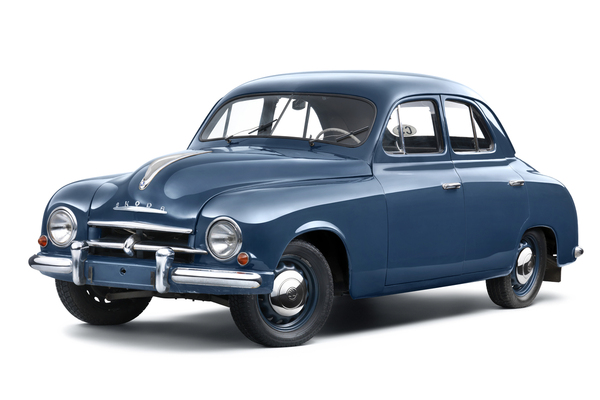
At the beginning of 1956, production of the modernized Škoda 1201 model with a more powerful engine started, with an output of 33.1 kW (45 hp) at 4,200 rpm. Production of the 1200/1201 series ended in the fall of 1961 after 67,071 vehicles had been produced, around 27,000 of them with notchback bodies and around 15,000 station wagons; the remaining units were commercial vehicle versions.