


Just in time for its return to Formula 1 with its own team, Renault is celebrating a motorsport anniversary: 110 years ago, on June 27, 1906, the French manufacturer won the world's first Grand Prix. With its triumph at the French Grand Prix, Renault laid the foundations for a success story that continues to this day and at the same time wrote a great piece of motorsport history: the race went down in history as the first Grand Prix and thus as the forerunner of today's Formula 1 races. The winning car was a 66 kW/90 hp two-seater with a displacement of 13 liters and the then legendary top speed of 154 km/h, driven by Hungarian Ferenc Szisz. For comparison: Kevin Magnussen and Jolyon Palmer's current R.S.16 company cars mobilize around 875 hp and are around 360 km/h fast.
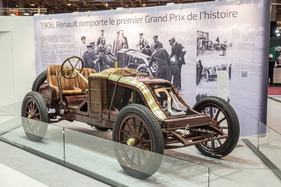
The first Grand Prix
The venue for the first Grand Prix in history was a 103.18-kilometer triangular circuit on public roads near Le Mans. However, the Sarthe Ring only had the name in common with the route of the later 24-hour race. In order to outdo the Ardennes race in Belgium and the Targa Florio in Sicily, the Grand Prix was held over twelve laps and stretched over two days.
The participants had to complete six laps per race day, a total of 1,248 kilometers. At night, the cars were parked in a strictly guarded and illuminated parking lot 110 years ago. Today, the corresponding facility is called a "Parc Fermé".
For comparison: a Formula 1 race in 2016 lasts a maximum of two hours. The current regulations stipulate a maximum distance of 305 kilometers, plus the distance required to complete the last lap.
Wheel changes decide the race
The outcome of the French Grand Prix was to be decided by a technical innovation: the removable rims for the rear wheels. The advantage: while the other racing drivers had to laboriously scrape the hot rubber residue off the rims with a knife before changing the tires, the well-trained Szisz and his co-driver replaced the complete wooden wheels in barely four minutes.
Another remarkable feature of the 1906 Grand Prix model was that the mechanic riding along was more comfortable than his colleagues in the competing vehicles. This helped him to perform his important tasks better.
Heat battle with a clever strategy
Renault traveled to the Grand Prix of the A.C.F. with three cars. Despite the groundbreaking innovations, the team was not one of the hot favorites, as Fiat and Clement-Bayard were significantly stronger vehicles in the field. A total of 32 cars from twelve teams were at the start.
In tropical temperatures of over 40 degrees Celsius, the race turned into an extreme test of endurance for man and material. The track surface specially laid for the Grand Prix, consisting of a forerunner of today's asphalt mixtures, also played a part in this. The melting tar whirled up by the vehicles caused severe burns to numerous drivers. Szisz, who drove carefully, took the lead after the first tire change on the third lap and had a comfortable 26-minute lead by the end of the first race day.
In the early morning of the second race day, the participants resumed the race at the same time as they crossed the finish line. Having barely returned to the track from the "Parc Fermé", race strategist Szisz immediately drove to the side of the road to change his tires. When he stepped on the gas again, he still had a 14.30-minute lead over the runner-up, Albert Clement, who was still waiting for clearance to start. In similar conditions to the previous day, Szisz's level-headed driving style once again proved to be the right recipe. With a top speed of 154 km/h, he was still the fastest in the field. Even the breakage of a rear axle spring on the fourth lap did not stop the Hungarian. After 12:14.07 hours, the Renault driver crossed the finish line first, 32 minutes ahead of the second-placed driver. His average speed: 101.19 km/h, a sensation at the time.
Technology package in a class of its own
Just like the Formula 1 cars of today, the Renault Grand Prix car of 1906 was packed with state-of-the-art technology. In addition to the removable wheel rims, the French manufacturer used hydraulic shock absorbers as a further innovation in racing car construction 110 years ago. Power transmission to the rear axle via a three-speed gearbox and cardan shaft was also far ahead of its time. In 1906, the drive chain was still the state of the art. However, the Renault only had brakes on the rear wheels - as was customary at the time. Braking distances are not recorded.
Engine designers were not bound by any regulations in 1906. The result was a field of participants with displacements ranging from 7.4 to 18.3 liters. With exactly 12,986 cubic centimeters, the Renault engine was "only" average. The four-cylinder engine, consisting of two blocks, reached its maximum output of 66 kW/90 hp at just 1,200 rpm. Other features of the cast-iron giant included non-removable cylinder heads, mechanically controlled side valves and a high-voltage magneto ignition from Bosch, which was an absolute technical treat even for Grand Prix cars at the time. For better aero-dynamics, Renault moved the voluminous water cooling system behind the engine to the center of the car - a configuration that allowed for a flatter front end.