


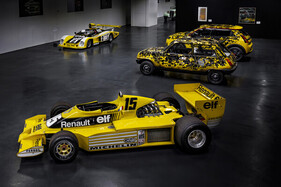


Renault will open a new exhibition center for its exceptional collections of historic vehicles, works of art and archive documents in Flins, just outside Paris, in 2027. The public will have the opportunity to explore the heritage of the Renault brand through guided tours and thematic exhibitions. This project will highlight the 125-year history of the brand, its automotive innovations and its social impact.
A unique heritage project
From 2027, the public will have the opportunity to immerse themselves in Renault's automotive history. The project is an opportunity to (re)discover significant models, each with its own story to tell: a story not only of technical innovation, but also of social change. And since cars contribute to shaping cities, lifestyles, art and culture, they are also a direct witness to everyday life. The new venue will evoke personal memories for visitors of specific cars from the brands or commercials that have shaped their time, and give them the opportunity to admire exceptional works of art from the Renault collection. This future venue will share Renault's history and bring it to life through experiences, interactions, special events and technology. For example, the history of the brand will be told through an immersive odyssey based on virtual reality.

Flins, the obvious choice
For this new site, Renault chose the Flins plant, just 40 kilometers from Paris. More than 18 million vehicles have been built at this site, which opened in 1952. In Flins, the memory of millions of vehicles meets the ambitions of more sustainable mobility through the new activities at the site.
Home to legendary models such as the Dauphine in the 50s, the Renault 5 in the 70s and 80s, the Renault 4, four generations of the Clio and the ZOE, Flins has reinvented itself. In 2021, Flins became a Refactory, a pioneering site dedicated to the circular economy of mobility.

A gateway between the past and the future, between the city and the industrial area
The building, designed by architect Jacob Celnikier from the CGA office, will blend harmoniously into the orthogonal lines of the original work, which was designed by Bernard Zehrfuss, winner of the 1939 Rome Prize. In contrast to the pronounced horizontal lines of the plant, the new venue has strong vertical lines. The building resembles a staircase with six interlocking cuboids. This façade is open and inviting in contrast to the large factory buildings in the background.
As a lively place, the center will offer a 2,800 m2 event space surrounded by work, consultation and storage areas. The most spectacular area will house the collection of hundreds of vehicles, which will be arranged on several levels. The cars will be placed on huge shelves and will be visible not only from the event space, but also from the outside through the openings in the façade.
The event space will take the form of a large hall, with a stepped, rising ceiling that will extend from the entrance to a gigantic display case - with cars on shelves. The building will also include a workshop for vehicle restoration and storage areas for parts and equipment.

Archives and objects that bear witness to 125 years of automotive history
Renault's heritage is not limited to its vehicles. The company also owns a large number of objects that tell the story of the brand since 1898. With more than 2,400 linear meters of archives, Renault has an impressive collection of documents and objects that trace the history of the company. The thousands of documents and objects in the collection include posters, design drawings, miniatures and toys, pedal cars, trophies and medals, as well as books that make up Renault's bibliography. The new venue will allow the public to discover all the richness of these archives.

Hundreds of historic vehicles in the spotlight
The project will give the general public access to a collection comprising several hundred vehicles in perfect condition. These carefully preserved and restored vehicles span the history of Renault, from the first car built by Louis Renault in 1898, the Type A, to pre-war models, Formula 1 cars, legendary Alpine models and visionary concept cars.
Remarkably, more than half of the vehicles are still in running order, which is proof of their careful preservation. For many years, six qualified technicians have been restoring and maintaining all the vehicles in the Renault Collection, ensuring that each model can take to the road and tell its own story. Building on this recognized expertise, the new site will also house a restoration workshop for powertrains and bodies.
The diversity of the collection is testament to Renault's rich heritage. A number of rare objects tell the story of automotive engineering and design over the years. Other objects, popular successes of the past, will evoke personal memories and emotions.

A unique art collection
Renault also owns several hundred works of art, which are also on display. This unique art collection was created to build bridges between art and industry.
The historical collection includes a 1967 work by Arman based on the Renault 4 and a series by Erró dedicated to the Renault 5.
It also supports contemporary urban art such as Bourgeon and Accrescent by Dan Rawlings, made from a historic Renault 5 and a new Renault 5 E-Tech electric, and Heritage by César Malfi, created from a side panel of a Scenic E-Tech electric.


