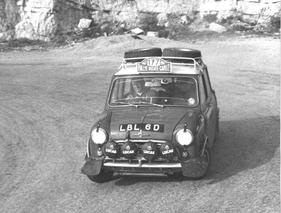
The winning car looked tiny, but the jubilation was huge. Relief, pride and a bit of satisfaction were mixed in with the enthusiasm when Rauno Aaltonen from Finland drove a BMC Competition Departement Mini Cooper S across the finish line as the overall winner of the 36th Monte Carlo Rally on January 20, 1967. This was the classic Mini's third triumph in Monaco after 1964 and 1965. But it was particularly symbolic. The year before, the British small car had been denied its third consecutive victory, which it had thought was certain, due to a decision by the race organizers that is still difficult for drivers and fans to understand today. However, the public's sympathy for the David in the field of high-powered Goliaths had actually grown as a result. And thanks to Aaltonen's driving skills, the classic Mini now had the right answer.
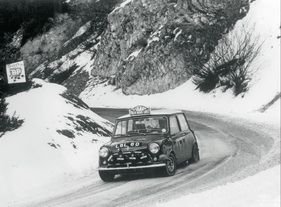
To this day, the three title wins at the Monte Carlo Rally are the quintessence of the brand's sporting reputation. They are commemorated at the production anniversary at the Mini plant in Oxford as well as at the debut of the new Mini John Cooper Works Countryman. And even the Mini John Cooper Works Rallye developed for the Dakar Rally, the ultimate endurance test of our time, follows in the tradition of the three-time "Monte" winner. The fascination is unbroken - even on the 50th anniversary of the victory that finally turned the classic Mini into a motorsport legend.
Rauno Aaltonen has decided to celebrate the anniversary in his own special way. He sat in the cockpit of a classic Mini, took on the hardships of a journey of almost 1250 kilometers to Monaco, drove the small British car on steep mountain roads through the French Maritime Alps and searched for the perfect braking point on icy tracks where average drivers in modern cars cannot even find the second or third best. In short: a few weeks after his 79th birthday, Aaltonen is driving the Monte Carlo Historique Rally. And he is thinking aloud about what it would be like to stand on the podium at Port Hercule in Monaco 50 years after his great triumph.
The classic Mini is ready for the start, the team is ready and the "write-up" is complete. Aaltonen's sporting ambition has also captured the BMW Group Classic.
For the 20th edition of the traditional rally, which commemorates the heyday of the "Monte" in the 1950s, 1960s and 1970s, it is sending the Mini Classic Rally Team to the start, which has the ideal car for the Finn: a Mini Cooper S, which already completed the Monte Carlo Rally in 1965 and has now been completely rebuilt and made ready for competition by the Swedish company Söderqvist Engineering. Company boss Hans-Åke Söderqvist and his son Jesper are also part of the service team, as are the Swede Stig Blomqvist, 1984 World Rally Champion, and Phil Anning from the British company Swiftune Engineering, which has been active in the development and production of engines for the classic Mini for more than 50 years. Also on board: ten sets of spike tires, which were specially produced in Finland for the 10-inch wheels of the classic Mini and then carefully prepared by hand.
Just like the team and the classic Mini, Aaltonen is also well prepared. Back in December, the Finn drove the entire route in a brand new Mini Cooper S Clubman in order to complete the "write-up". Curve after curve and climb after climb brought back memories of the winning drive in 1967, but the experienced driver was not prepared to rely on that alone. With the meticulousness that earned him the nickname "rally professor" decades ago, he noted down all the important details of the route. Aaltonen also has an experienced co-driver at his side. The Swede Hans Sylvan (72), also a multiple "Monte" participant and successful for many years together with Stig Blomqvist, will take on the task of taking care of navigation and timekeeping as co-driver.
From Bad Homburg to Monaco - and that's just the start.
For decades, the "Monte" has been regarded as the most spectacular and challenging race of its kind. Countless stories surround the marathon stages at the start, icy mountain pass roads, sudden snowstorms and the "night of the long knives" at the Col de Turini. To underpin its legendary status, the organizers from the Automobile Club de Monaco launched the new edition for historic cars in 1998. It is always held around two weeks after the original and begins with a rally, similar to the usual opening stages. This year, seven European cities serve as starting points. Aaltonen and Sylvan set off from Bad Homburg on Friday, January 27, 2017, on their way to Monaco. The first stage will take them to Valence. A round trip and the subsequent return to Monte Carlo will be followed by the final night drive on January 31.
Only vehicles of the types that competed in the Monte Carlo Rally between 1955 and 1980 are permitted to take part. No such restrictions apply to the drivers. However, relevant experience should not be a disadvantage. However, no one in the current starting field is likely to have had such an intensive, varied and ultimately successful acquaintance with the "Monte" as Rauno Aaltonen.
The fiery start was followed by a class victory.
The Finn had just become national rally champion of his home country at the end of 1961 and was now looking for a vehicle with which he could take on the "Monte" challenge. He found what he was looking for with the British Motor Corporation works team. Aaltonen made his debut with the Mini Cooper, which, in contrast to its less powerful predecessor, immediately proved to be competitive. However, the promising liaison almost came to a tragic end. Three kilometers before the finish, the car, which was in second place at the time, left the track, overturned and was engulfed in flames shortly afterwards. Aaltonen and his co-driver Geoff Mabbs were able to get out of the car at the last second. Despite the dramatic start, Aaltonen also competed in the Mini Cooper in January 1963. This time he finished the Monte Carlo Rally as class winner and third overall.
The following year, it was the Irishman Paddy Hopkirk who secured the first overall victory with the classic Mini. Aaltonen finished seventh. The "Monte" of 1964 also marked the beginning of the era of the "three musketeers", which included the Finn Timo Mäkinen alongside Aaltonen and Hopkirk. Mäkinen achieved his second overall victory in the classic Mini in 1965 with a penalty-free drive, while his compatriot dropped out of the classification due to exceeding the time limit. For Aaltonen, this was an unpleasant start to a year that would later bring him the title of national champion in Finland and overall victory in the European Rally Championship.
Successful trio: the "three musketeers".
The "three musketeers" had their strongest performance at the Monte Carlo Rally in 1966. Timo Mäkinen, Rauno Aaltonen and Paddy Hopkirk dominated the race from the start and finished first to third overall in that order. But the joy of the hat-trick for the classic Mini was short-lived. The trio was subsequently disqualified by the French race stewards due to a lighting system that allegedly did not comply with the official regulations.
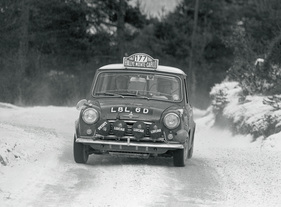
A year later, the anger had long since given way to fierce determination. At the 1967 Monte Carlo Rally, the hour of the third "Musketeer" struck. As the BMC team's fastest duo, Aaltonen and his co-driver Henry Liddon, who had already been victorious alongside Hopkirk in 1964, were in a promising position at the start of the "Night of the Long Knives". The decision was made in the driving snow on the Col de Turini. And there, as Aaltonen reported years later, the chase around the bends almost had a similar outcome to his "Monte" debut five years earlier. This was because the Mini Cooper S took an unplanned flight during the overly rapid descent, only to hurtle through the undergrowth and find its way back onto the track shortly afterwards, much to the surprise of its crew. Aaltonen and Liddon took a deep breath and brought the drive to a successful conclusion.
For the new edition 50 years later, Rauno Aaltonen wants to take things at a more leisurely pace. The Rally Monte Carlo Historique is held as a regularity stage. This means that not only too low a speed but also too high a speed can lead to penalty points. Aaltonen and Sylvan will also be competing in the "Low Average Speed" class. They are therefore relying entirely on routine and precision. And on victory, as a special detail indicates: their classic Mini bears the starting number 177 and thus exactly the same sequence of digits that became the lucky number for the winning car of 1967.
A report on the 1967 Monte Carlo Rally can of course also be found in our archive.