
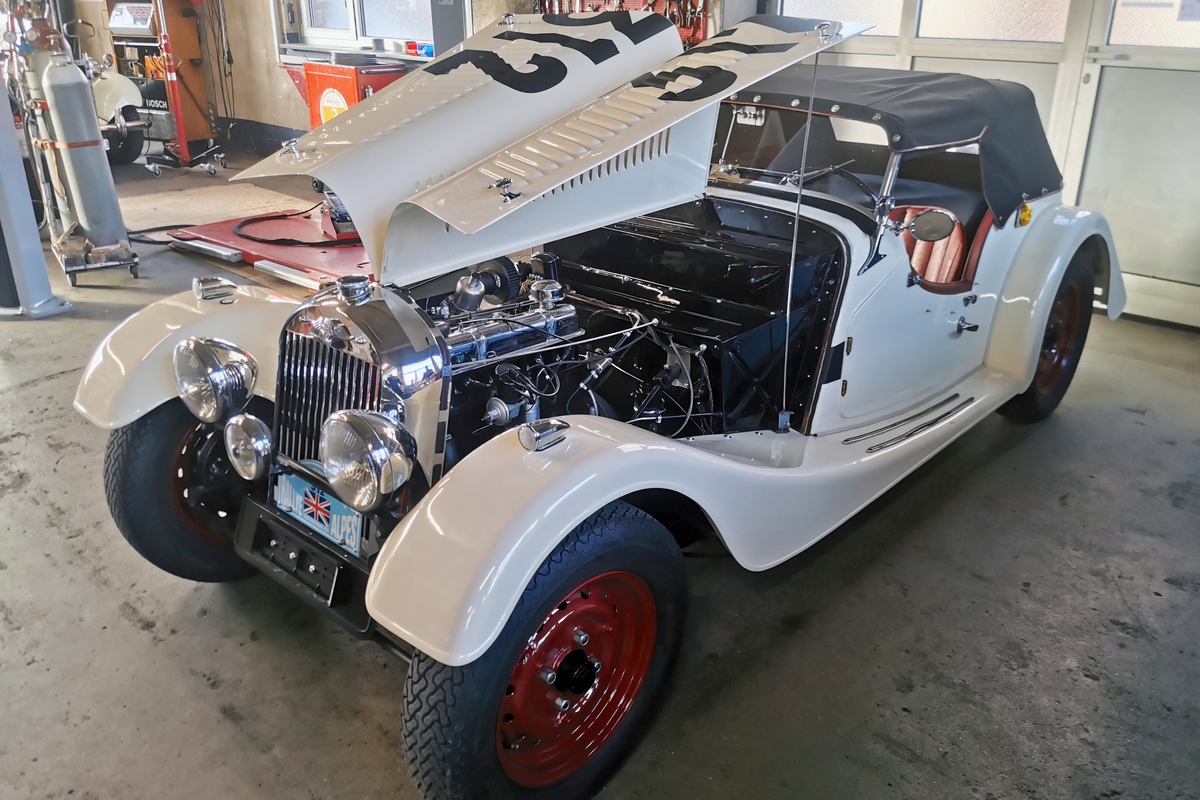


It's winter - time to tweak, optimize and ponder whether you could take this opportunity to bring a few things on your old car "up to modern standards"? Can you or should you do this? And if so, what is possible?
We get to the bottom of the issue together with Stefan Mäder. He is the Managing Director of British Inter Cars AG in Täuffelen, Switzerland. His company is now in its third generation of dealing with British and other classic cars, be it maintenance and repair or restoration work. Stefan Mäder has also been involved in the supply of parts and in the area of classic oils and other operating materials for many years under the company Products Solutions.

Mäder first had to get to grips with the subject of "tuning", as he tells us: "I used to be a staunch fan of originality. But with many years of experience, I realized that some manufacturers often only found half-hearted technical solutions, for example to reduce exhaust emissions at the end of the 1960s or for brakes and suspension. What was acceptable back then, we can do better today. But I would describe that as optimization first and not yet as tuning."

The transition from one to the other is of course fluid. Both could be summarized under the term "modification". In any case, Stefan Mäder's customers are increasingly asking for such adaptations. The demands on classic cars are growing, partly because the gap between the handling of classic and modern vehicles is widening, making it more challenging to keep up on the road.
Road contact is safety
In the discussion with Stefan Mäder, the topic of "safety relevance" comes up again and again. "A car that sits well on the road and brakes reliably is simply safer. Even driving over a mountain pass is much more fun if you don't break out in a sweat before every bend." However, it often only takes a little to achieve a noticeable improvement, especially in the chassis area. "If you use polyurethane bushes instead of the original soft rubber mounts on a British classic, the car already sits much more firmly on the road."

If you want to go even further, you have different options - depending on the era from which the vehicle originates. Until around the 1970s, cars were built in such a way that they felt rather spongy compared to today's vehicles. In addition to replacing the suspension bushings as mentioned above, it is also possible to install different springs and/or higher-quality shock absorbers, which ideally have adjustable rebound and compression damping. If a vehicle does not have a cornering stabilizer, one could be retrofitted to reduce the lateral inclination of the vehicle when cornering.

For vehicles with spoked wheels, it may be possible to use more stable models with more spokes. In general, better cornering grip can also be achieved with wider tires. However, it is important to clarify which dimensions are possible and sensible. If you overshoot the mark, you could be annoyed by excessive steering forces. If a vehicle is still equipped with cross-ply tires, switching to radial tires should bring a significant improvement.
Speaking of steering: those who like to speed around corners may be pleased with more direct steering. The Jaguar E-Type is a good example of this. It is also popular to retrofit steering support systems to reduce steering forces. Complete steering columns with (usually electric) steering assistance are available for many classic cars. This means that the vehicle can be retrofitted again if a new owner with stronger upper arms wants the original steering feel back.

There are also various options for the brakes. If a vehicle does not have a brake booster, it may also be possible to retrofit one. Conversions from drum brakes to disc brakes or the use of stronger brake callipers are also popular for suitable models. However, even higher quality brake linings provide better braking performance. And it is also possible to play with different friction coefficients. Stefan Mäder gives an example: "Older American vehicles often have a tendency to overbrake, i.e. they brake too hard at the rear. You should then use pads with a lower coefficient of friction at the rear."
Full power and even more
Of course, we don't just want to brake and steer, we also want to accelerate. And here too - in terms of performance - you can often get a lot out of a classic. But before you order sharper camshafts, different carburetors or air filters or sports exhaust systems, you should take a close look at the existing infrastructure. Stefan Mäder can tell you a thing or two about this: "People often think about tuning their engines straight away. But first of all, an engine should be properly adjusted. Customers are sometimes amazed at how much better the car runs afterwards. Even a well-functioning ignition can make a difference. Ignitions often no longer work optimally."

The latter is often not noticed. For example, the ignition timing may be correct at idle but off in the partial or full load range, but this is often not checked. Of course, the installation of a freely programmable electronic ignition offers the most possibilities for optimum ignition adjustment.
What few people think about: "The use of a good racing oil has been proven to increase performance by up to 7% in addition to reducing wear," says Stefan Mäder.

If more power is still desired after all these "simple" measures - which of course also include a clean carburetor setting with a measuring device or Colortune spark plugs - then classic engine tuning comes into play. The spectrum here is also wide: in addition to adjusting the timing or other cylinder head optimization, an increase in displacement can also be considered. Depending on the budget and the desired application, almost anything or at least many things are possible.

The important thing is that the various tuning measures must fit together. In other words: There is little point in simply replacing one carburetor and disregarding the rest. And even more important: the car should also be balanced after a power increase. "Everything has to fit together, i.e. the performance, the braking effect and the chassis. And all of this requires an enormous amount of experience and a feel for the interplay of all factors," Stefan Mäder sums up aptly.
