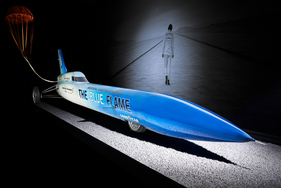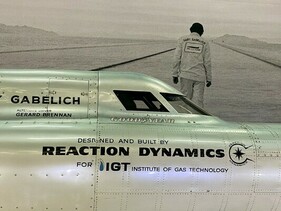
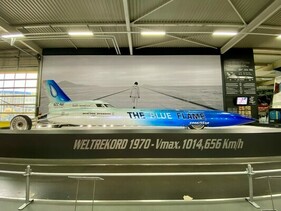

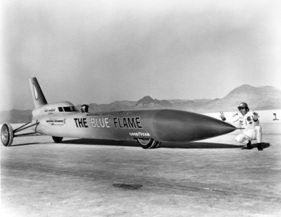
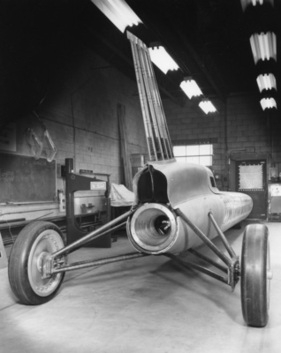
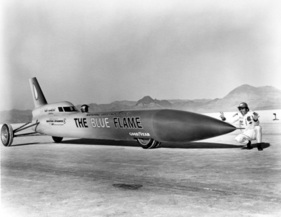
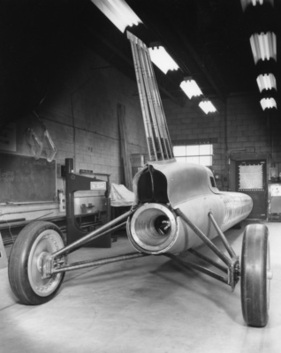
It is eleven meters long, steel blue and resembles a rocket - only the three wheels indicate that it could be a car. On October 23, 1970, the American Gary Gabelich drove this rocket vehicle faster than 1000 km/h, setting a new speed record for land vehicles. This projectile, known as "The Blue Flame", has been on display at the Technik Museum Sinsheim for over 30 years. As part of the redesign of the collection, the record-breaking car will be given a new exhibition area to mark the 50th anniversary of its record-breaking run.
World record as a PR coup
The whole operation was actually a PR coup for the natural gas industry: Americans should see that there is more than just crude oil. So the American Gas Association commissioned the specialist company Reaction Dynamics to build a vehicle that was accelerated with gas instead of kerosene. In mid-October 1970, after three years of tinkering, it was ready for take-off. At the Bonneville Salt Lake in Utah, a 58,000 hp, three-ton, rocket-shaped something was ready, powered by a highly explosive mixture of hydrogen peroxide and liquefied natural gas.
The cross between a car and a rocket had only one purpose: to break the land speed record of 966 km/h. Pilot Gabelich squeezed himself into his tiny cockpit and broke the record with 1001.474 km/h in just 22 seconds. In order to meet the official regulations, the average speed of one mile there and back in one hour, Gabelich catapulted himself again on October 23. The speedometer showed an incredible 1001.667 km/h. And the name "The Blue Flame" said it all: the recoil flame glowed blue. It was to remain the fastest car for 13 years. This record was then beaten by 15 kilometers per hour. In October 1997, the British military pilot Andy Green drove even faster than the sound: 1227.985 km/h with the Thrust SSC, a monster powered by two jet engines.
Found peace
Today, The Blue Flame rests in the Technik Museum Sinsheim and never fails to amaze visitors - surrounded by classic vintage cars, Formula 1 legends and helicopters, the steel-blue and aluminum-clad highlight stands out. The museum has been busy converting its huge halls since 2018. This exhibition area is also ready in time for the Blue Flame's anniversary.
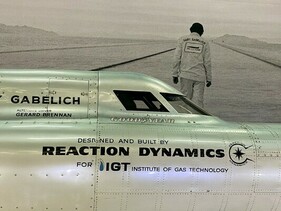
Set up in front of the iconic painting by Gary Gabelich, the elaborate image and film installation tells the exciting yet entertaining story of the fastest rocket-powered land vehicle of all time. The record-breaking pilot's original jacket and original salt from the Bonneville salt lake complete the new exhibition area. To complete the exhibition, an interview with one of the Blue Flame's engineers, Dick Keller, will be broadcast from October 23. The museum was actually planning an appropriate celebration to honor its exhibit. To mark the occasion, Mr. Keller was interviewed via Skype. The recording will be broadcast daily thereafter.