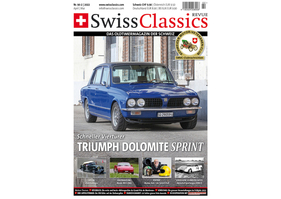
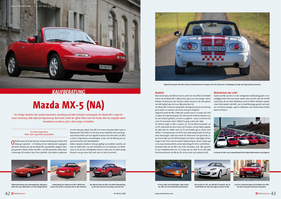

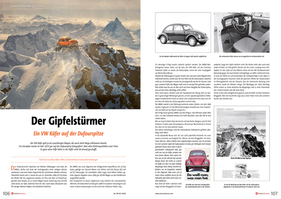
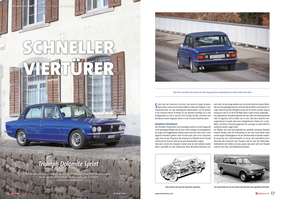
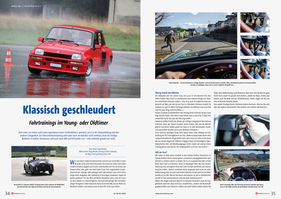
The new SwissClassics Revue 90-2/2022 has just arrived with our subscribers and can, of course, also be purchased with a trip to the local newsstand or on order. The feisty saloon on the cover is called the Triumph Dolomite Sprint and, with its innovative engine, was one of the raciest four-door cars half a century ago. The EDRA II self-built plastic flounder was also racy a decade earlier, but only on closed tracks. In 1977, Montreux commemorated the Grand Prix that had infected the town on Lake Geneva with motorsport fever 43 years earlier. The buying guide explains what you should consider when buying the popular neo-oldtimer Mazda MX-5 (NA), while the special feature focuses on driving safety. You can also read how the VW Beetle made it to the top of the Dufour rankings and what Markus Hotz, a racing icon from Thurgau, achieved in his long career.
Super Sedan thanks to a power injection
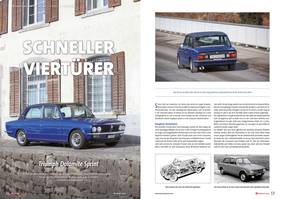
Today, Triumph is best known for its many popular sports cars such as the Spitfire and, of course, the TR Roadster series. However, the British company's model range also always included saloons. One of these was the Dolomite, which first rolled onto the roads in 1972 and was primarily aimed at domestic customers. Under the hood of the car beat a four-cylinder engine with a displacement of 1854 cubic centimetres and 92 DIN horsepower, while the chassis largely corresponded to the conventional design with a rear rigid axle. One year later, Triumph was the first manufacturer ever to install a multi-valve engine in a mass-produced car after remarkably little development effort and created a veritable sports sedan with the Dolomite Sprint. We researched how the extensively equipped and fast "Doli" came about and, of course, drove a fine example.
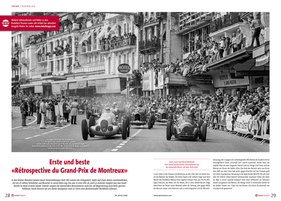
Remembering an extraordinary racing retrospective
When special events, such as the Montreux Grand Prix, cannot be repeated, one is apparently condemned to mourn the better days. This was not the case on August 21, 1977, when an unparalleled motorsport spectacle was staged on Lac Léman and the crème de la crème thrilled thousands of spectators with their roaring cars. We take a look back at a unique retrospective.

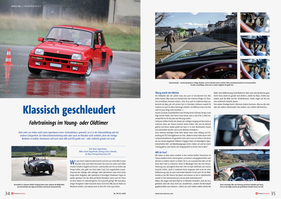
Experience driving physics in a classic car
Anyone in possession of a driving license today has most likely attended a driving safety course at least once, more or less voluntarily. Practicing evasive maneuvers and emergency braking on wet surfaces is impressive even in modern cars and helps you develop a feel for your car. Since accidents should also be avoided as far as possible when driving historic vehicles, but you can't count on the help of ABS, ESP and other systems in an oldie, there are courses that specialize in classic cars. Here you can read what these courses offer and how they differ from standard training courses.
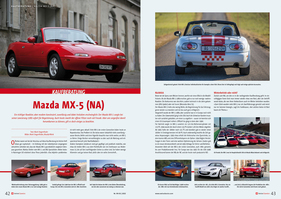
Mazda without defects?
When the Mazda MX-5 appeared in 1989, it triggered a veritable hype and revitalized the almost extinct genre of the affordable convertible. Even today, the compact roadster, which is not coincidentally reminiscent of the Lotus Elan, is still very popular with car enthusiasts and is generally regarded as an unproblematic guarantee of driving pleasure. However, you shouldn't buy an MX-5 (NA) blindly, as our buying guide shows.
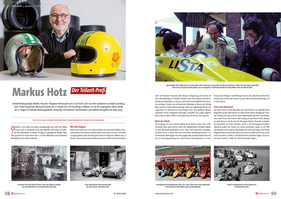
Racing made in Sulgen TG
Markus Hotz' passion for motorsport began early on. When an international circuit race was held in Erlen every year from 1948 to 1951, he stood at the side of the track as a young boy and cheered on Stirling Moss, Toulo de Graffenried and the other racing drivers. At the age of 24, the youngest son of the village blacksmith in Sulgen then launched his own career and revealed his skills behind the wheel and as a constructor, first in Formula Vee and later in numerous other racing series. The career of the Swiss racing great is traced over eight pages.
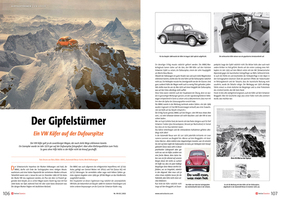
Advertising taken to the extreme
How do you demonstrate your own superiority over the public and the beaten competition in the most sensational way possible? A good approach, especially in an Alpine nation, would be to combine a high peak and a concise message. AMAG, Switzerland's largest car importer in 1969 (and still today), chose precisely this approach and launched a campaign the following year featuring a VW Beetle on the Dufourspitze. Despite all its off-road capabilities, the bestseller did not make it up there on its own wheels...
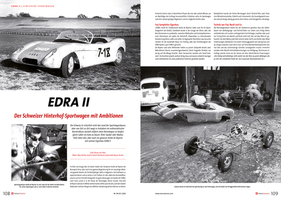
Spider racing car built by yourself
In Switzerland in the early sixties, only a few car inventors raced their own creations. Peter Sauber and Markus Hotz, who is portrayed in this issue, are two well-known exceptions. But André de Reynier also built sports cars, and rather unconventional ones at that. Thanks to its delicate tubular frame chassis and GRP body, his second vehicle weighed less than 300 kilograms dry and without a driver, and was powered by an enlarged Fiat 600 engine with three times the engine power. The EDRA Spider was quite competitive in slalom competitions and hill climbs, but its builder and driver were denied any real success. We tell its exciting story.
Would you like to order one or more issues?
Click here for the current issue. To take out a subscription visit this page. You can download all previous issues here.