


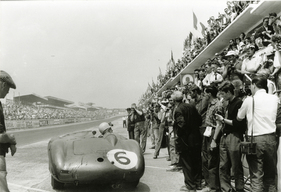
Aston Martin is known worldwide for its great successes in sports car racing and, of course, for first-class British sports cars. The famous overall victory at Le Mans and a third consecutive win at the Nürburgring 1000km race crowned Aston Martin World Sportscar Champion in 1959, while multiple class wins at Le Mans stretch from 1931 to this year's multi-class victory, which earned the brand the GT Manufacturers' World Endurance Championship title. Numerous race and class victories have cemented Aston Martin as one of the biggest names in the history of endurance racing.
However, Aston Martin's appearances in the European Grand Prix and later in Formula 1 are probably less in the spotlight. Although these are not quite as well known, they are just as worthy of mention. Ever since it was founded in 1913 by Lionel Martin and Robert Bramford in a small workshop in London, motorsport in the premier league has been an important part of Aston Martin's identity.

With Aston Martin's return to Formula 1 after more than 60 years, it seems the perfect time to look back at the brand's previous attempts in the premier class.
The twenties
From Aston Martin's earliest beginnings, founder Lionel Martin, along with co-founder Robert Bamford, dreamed of bringing Aston Martin into the limelight of prestigious Grand Prix racing.
Aston Martin began to make a name for itself on the hill climb scene in the UK, often with Lionel Martin himself behind the wheel. But he knew that only entering the highly competitive Grand Prix sport would bring the fame he dreamed of for his company.
At the start of the Roaring Twenties, this dream seemed to be slowly turning into a reality. Lionel Martin made the acquaintance of Count Louis Zborowski. He was the fabulously wealthy son of a Polish count and an American heiress and had an unbridled desire for speed and a keen interest in motorsport.

Zborowski's wealth, which would probably make him a billionaire several times over today, and his acquaintance with Lionel Martin prompted him to order two of Aston Martin's early formula cars.
Together with Lionel and his team, they decided to build two cars for the 1922 Isle of Man Tourist Trophy. Zborowski brought around £10,000 with him, which was a small fortune by the standards of the time. The money was not only used to build the racing cars, but also to develop a completely new four-cylinder racing engine with 16 valves and a double overhead camshaft.
Aston Martin's first Grand Prix car produced 55 bhp at 4200 rpm from a displacement of 1486 cm3. The car weighed 750 kg and reached a top speed of 85 km/h. It also had two seats, one of which was offset, which was part of the regulations at the time. One of the two seats was intended for the race mechanic, whose most important task was, among other things, to suck in fuel via a hand pump.
Although manufacturers such as Peugeot, Bugatti and A.L.F.A. had previously designed high-capacity 16-valve engines, Aston Martin's was believed to produce much more power.
Zborowski's close friend Clie Gallop knew an engineer at Peugeot, Marcel Gremillion. He in turn was a close confidant of the great engineer Ernest Henry, who was now working at Ballot. Gremillion persuaded Henry to give him details of Ballot's three-liter engine. Henry did nothing more than tear his plans in half, which gave Gremillion the opportunity to build the Bramford & Martin 16-valve engine, which turned out to be a great success.
But because the plans had been torn in half, the three-liter engine turned into a 1.5-liter engine, so the story goes.
The debut in Grand Prix racing
Although the two TT1 and TT2 chassis were scheduled for the Isle of Man Tourist Trophy in June 1922, the team ran out of time. It was decided to take part in the 2.0-liter French Grand Prix instead. However, both cars had to withdraw from the race due to engine problems. Nonetheless, the event was hugely exciting for the team based in Kensington, London, and reason enough to continue their involvement in Grand Prix racing.

However, Zborowski's death at the wheel of a racing car in 1924 brought the first stage of Aston Martin's involvement at the highest level of motorsport to a halt for the time being. It would be 20 years before Aston Martin decided to return to Grand Prix racing.
The forties
Racing after the Second World War was a rather organic endeavor compared to today's standard of development. Unsurprisingly, the cars that were used were often pre-war yet competitive, including the now famous 1946 Aston Martin 2-liter sports car that competed in the Belgian Sports Car Grand Prix of the same year.
At the wheel was St. John Ratcliffe Stewart Horsfall, better known as "Jock". He was one of six sons from a well-heeled family. "Jock" bought his first Aston Martin in 1934 at the age of just 24. He quickly became part of Aston Martin and helped with development and testing.

During the Second World War, "Jock" served in MI5. His job was to drive officers, agents and double agents as well as enemy spies quickly from A to B. Curiously, however, "Jock" had extremely poor eyesight and refused to wear glasses. He was also one of the drivers for "Operation Mincemeat" - a successful deception by the Axis powers to hide the Allied invasion of Sicily in 1943.
So it is not really surprising that a man with the steering wheel experience that "Jock" had won the aforementioned Belgian Sports Car Grand Prix in 1946 with "old" material.
The car was powered by a four-cylinder engine with a displacement of 1950 cc. The power output was around 125 bhp. The weight was only 800 kg. Top speed was around 120 mph (almost 200 km/h).
However, the victory in Belgium was not Horsefall's greatest success. This was followed three years later at the 24-hour race in Spa in 1949, where he finished second in his class and fourth overall. Of course, he was also at the wheel of an Aston Martin. Particularly noteworthy is the fact that although he had a co-driver, Paul Frère, at his disposal, he decided to drive the entire 24 hours on his own.
Tragically, "Jock" Horsfall was killed in an accident four weeks later at a race in Silverstone.
The annual St. John Horsfall Memorial Trophy shows just how respected "Jock" is among both Aston Martin and enthusiasts of the brand. This is organized by the Aston Martin Owners Club.
The fifties
Sir David Brown, who acquired Aston Martin in 1947 and added the Lagonda brand later that year, produced British sports cars that were in increasing demand. Sir David recognized the importance of motorsport to the commercial success of the brand. He drew up plans to build sports cars to compete in the World Sportscar Championship and the relatively new Formula 1 World Championship.

The history books tend to focus on the DBR1, which won Le Mans, and the equally successful DB3S. However, it was the DP155, which was an important attempt to build formula cars, that laid the foundations for Aston Martin's later Grand Prix cars. At the same time, Sir David Brown commissioned the construction of a new engine for the DB4, a later road car.
This is how the DBR4 came into being. Testing began as early as 1957, but the car would not make its racing debut until 1959 at the BRDC International Trophy at Silverstone, which was run under Formula 1 rules. Le Mans winner Roy Salvadori was at the wheel. He drove to a respectable second place behind Jack Brabham in the Cooper-Climax T51.

However, the DBR4 could do little against the mid-engined competition and its successor, the DBR5, was also completely disappointing. Aston Martin withdrew from 1960 formula racing.
The two thousand and ten
After around half a century, Aston Martin returned to the premier class stage. In 2010, the brand joined Red Bull Racing as title sponsor and technical partner. This cooperation also resulted in the ground-breaking Aston Martin Valkyrie super sports car, which was developed in close collaboration between Aston Martin and Red Bull Racing.
In 2021, the Aston Martin F1 Team will once again compete with its own team. This will mark the first time in over 60 years that Aston Martin has entered a works team in Formula 1.
Lawrence Stroll, Chief Executive Officer of Aston Martin comments: "The return of the Aston Martin brand to Formula 1, compared to its colorful and dynamic racing history, is a truly exciting time for all of us involved with this great British sports car manufacturer. Formula 1 is the right place for Aston Martin. It's where the brand should be and I know this next chapter will be incredibly exciting for fans of Aston Martin and Formula 1."
