


From June 19 to 21, Salzburg was once again dominated by historic automobiles. In fantastic weather, 130 teams took to the starting line.

A long tradition
From 1929 to 1969, a round of the European Hill Climb Championship was held on the Gaisberg. Racing legends such as Hans von Stuck in a Mercedes, Gerhard Mitter in a Porsche and Dieter Quester in a BMW competed for overall victory.
Now a regularity event, the Gaisberg race began with the vehicle scrutineering in the courtyard of Hellbrunn Palace and the vehicle line-up on Salzburg's historic Residenzplatz before the start of the Salzburg "City Grand Prix".
Broad starting field
The organizers of the SRC Salzburg Rally Club are particularly proud of the very diverse starting field. Several thousand spectators were able to admire racing and sports cars from 1899 to 1979.

However, the flair of past races was particularly evident at the Gaisberg and the races at the Salzburgring. At the latter, the classics were put through their paces.
Highlight Alfa Romeo P3
The return of the winning car from 1932 was a real highlight. Rudolf Caracciola won the overall victory at the 1932 Gaisbergrennen in an Alfa Romeo P3, which was entered by Scuderia Ferrari.

This vehicle was driven up the Gaisberg again in 2025 and ran as smoothly as it did 93 years ago.
Close fight for overall victory
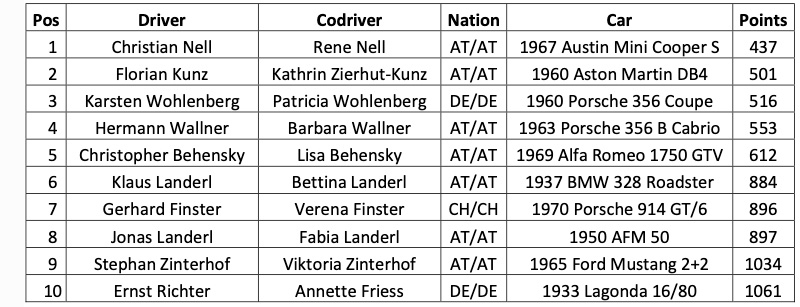
The award ceremony took place during a gala evening at Red Bull's Hangar-7. The battle for the overall victory was exciting this year. After several attempts and top ten results in previous years, classic car restorer Christian Nell and his son Rene were finally able to hold the winner's trophy in their hands with their 1967 Austin Cooper S.

However, 18 teams were also aiming for victory in the "Young Summit Conquerors" category, which allows drivers and co-drivers under the age of 35 to take part in the Gaisberg race at a greatly reduced entry fee.

In the end, Christopher and Lisa Behensky managed to win this class with their 1969 Alfa Romeo 1750 GTV.
Fossil-free on the road
The cooperation with the fossil-free and CO2-neutral fuel manufacturer P1-Fuels was also continued this year. Each team received 20 liters of e-fuel, which meant that the Gaisberg race could be completed CO2-neutrally due to the short distances.

Year after year, the Gaisbergrennen in Salzburg stands for an automotive journey through time, where special historic automobiles are presented on the road.
The next date of this journey through time is the Gaisbergrennen 2026, which will take place from June 4 to 6, 2026.
Further information on the Gaisbergrennen can be found on the event website.
