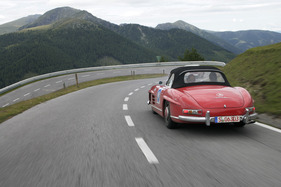
From August 22 to 24, 2013, the Saalbach Classic will be held for the first time on three rally days, covering a total of 600 km on unique roads in a magnificent setting.
Brand diversity and pre-war classic cars with a guaranteed start
The list of registrations for the Saalbach-Classic 2013 is getting longer and longer. Almost 20 different car brands have so far registered for the first edition of this new classic rally in the heart of the Alps. The registration deadline is coming up soon, but it is certainly worth trying your luck.
Incidentally, the Saalbach Classic organizers have a special heart for pre-war cars, which are guaranteed to start at the Saalbach Classic!
For example a Bugatti T51
In the Saalbach-Classic entry list, one particularly aesthetically pleasing car stands out, the Bugatti T51. In 1930, Ettore Bugatti decided to use a completely newly developed eight-cylinder engine with two overhead camshafts based on the T35 chassis for the upcoming racing season. The 2.3-liter engine delivered 170 hp to the rear axle.

Bugatti is one of the legendary car brands in Europe. Production in Molsheim ran from 1909 to 1963, and Ettore Bugatti created the most successful racing cars of his era and the most refined and elegant sports cars and saloons of his time.
Many other registered classic cars - from the Mercedes-Benz 300 SL to the AC Cobra - will make the Saalbach-Classic a unique event.
Breathtaking routes - Hexenküche and Schneizlreuth
It is mysterious, the mountain world. The route of the Saalbach-Classic 2013 has many a surprise in store for the participants.
On the royal stage over the Grossglockner on Friday, you come to the witches' kitchen. Participants will have to discover for themselves whether there are eerie rumblings or broom-armed creatures making the area unsafe.

According to old tradition, a hairpin bend on the Grossglockner High Alpine Road has been called the "witches' kitchen" for ages. The strong updrafts, the south-westerly orientation, the sunlight - all this makes the thermals in this area an extremely exciting affair, which many parachutists and hobby pilots have suddenly felt with their small aircraft. However, none of this will be an issue for the classic cars of the Saalbach Classic.
Further up, after the Fuscher Törl, the participants reach the Hochtor at an altitude of 2504 m, a 100 m long tunnel in the middle of which runs the state border between Salzburg and Carinthia. After that, the panorama changes abruptly - the wide view down into the Mölltal and to Heiligenblut welcomes the pilots and co-drivers.
And if the sun is still shining in August....(the organizers are working on it!)
Schneizlreuth in Bavaria is one of those idyllic spots surrounded by steep rock faces, whose existence you only become aware of when you want to stop time with leisure and humility (and an open roof...) in a classic car.
Historically, the village of Schneizlreuth on the German Alpine Road, which the Saalbach Classic will pass through on Saturday, August 24, goes back to an old country estate called Schnaezenreut dating back to 1285. The last battles of the Second World War in Bavaria are said to have taken place in this area on May 5, 1945.
Individual and team classification
In addition to the individual classification, there is also a team classification at the Saalbach Classic. Five vehicles per team can be nominated for the team classification. The scoring system is very simple. The best 4 results are included in the team classification, the worst result is dropped.
With Walter Röhrl as president and supporter of classic car driving
The patron and president of the Saalbach Classic is Walter Röhrl, a true classic car enthusiast:
"The relationship with the old cars has become stronger and stronger in recent years. Now that I'm constantly involved in new technical developments at Porsche, you really realize that the old cars were the real driving experience. Without electronic aids, it was up to the driver to make the most of it. You had to be sensitive, press the clutch, move the gearshift, brake with feeling, counter-steer - you were constantly challenged. What's more, the old cars were so much closer to the emotion in terms of sound than modern ones."
Walter Röhrl is a fan of old cars and rejoices in the driving pleasure:
"If you want to have fun driving in a modern car, you're quickly in criminal territory. In a classic car, you already have a lot to do at 100 km/h, so you're definitely on the move quickly and enjoy driving in a completely different way. The driving pleasure in a classic car is the outstanding thing, plus the feeling that I am the one in control of the car and not the little man in the computer on board."
Walter Röhrl also takes his hat off to the achievements of the builders of the old cars:
"The designer drew something 80 years ago and didn't know how the car would then react. Today, every detail is simulated with computer programs. Our grandfathers didn't have that opportunity. A dream car was simply created by the brainpower of people. That's why I have all the more respect for the engineering achievements of that time. If an engine didn't work in 1935, it was dismantled and a new camshaft was ground by hand. It was an incredible pioneering spirit that inspired people back then."
Röhrl is particularly impressed by Ettore Bugatti and Ferdinand Porsche:
"Bugatti and Porsche were geniuses. It is impressive to review the life's work of such designers. It makes you realize what they designed - and that's also the beauty of a classic rally. When you then get to experience the whole range of old cars and see how a Porsche 550 Spyder is driven around the corner - then you can only have even more respect for these people.
Of course, Walter Röhrl also stands behind the car as a cultural asset:
"Absolutely. Every single classic car enthusiast preserves a cultural asset, saves it from decay. And governments have also reacted to this in the meantime, making certain concessions so that this cultural asset doesn't gather dust in a museum, but can be driven in the wild. I have also noticed that the social acceptance of classic cars is incredibly high. When people see such cars, they are happy. They wave, applaud and immediately want to know more about the technology - this will also be the case in Saalbach in August."
You can find up-to-date information on the Saalbach Classic homepage.