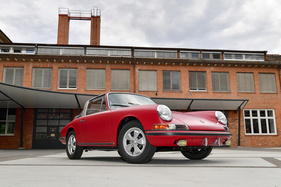
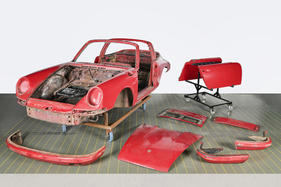
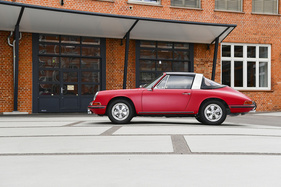
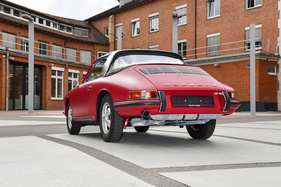
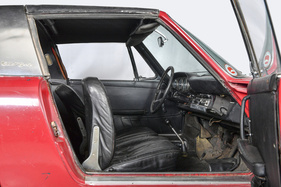
From a spectacular barn find to a collector's item in mint condition with patina: the first Porsche 911 S Targa delivered in Germany is back on the road after an extensive factory restoration lasting more than three years. Its owner, a long-time collector and Porsche enthusiast, discovered the vehicle in the USA. "The Targa had been sitting there for almost 40 years in a garage without a door, covered by a plastic tarpaulin. The former owner had probably simply forgotten about the car," says Uwe Makrutzki, Head of Porsche Classic Factory Restoration at Porsche AG. "The 911 S Targa was delivered to the Porsche dealer Hülpert in Dortmund on January 24, 1967. The restoration is a special project for us - this is one of the first 911 Targa cars to find its way back to Zuffenhausen."
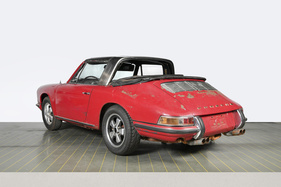
Rare softwindow version
As a so-called softwindow version, this early Targa has a soft rear window instead of the glass pane available from 1967. Only 925 examples with S engine, short wheelbase and softwindow were produced by Porsche between the end of 1966 and 1968. The condition of this rare sports car was desolate. After serving as a demonstration car for the Porsche dealer, it was sold to the USA in 1969. From 1977 until the end of 2016, the open-top 911 was parked in Long Beach (New York State) in the aforementioned garage. It was complete - particularly pleasing in view of the many optional extras such as Webasto auxiliary heating, tinted windshield, Blaupunkt Cologne radio, leather seats, halogen fog lamps and exterior thermometer.
Exclusive access
The philosophy of Porsche Classic factory restoration is to rebuild the vehicles as true to the original as possible. The search for authentic small parts such as cable clamps, rubber grommets and plugs for the 2.0-liter S engine proved particularly difficult. "Reproductions from third-party suppliers are out of the question for us. Fortunately, we can reach into our 'treasure chest' in such cases," says Makrutzki. Porsche Classic not only has access to the central warehouse with currently more than 60,000 different original spare parts. The in-house specialists also have access to the original straightening kits, frame gauges, data sheets and technical drawings.
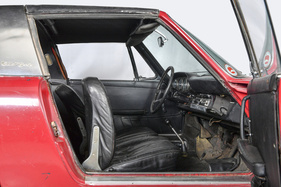
The second major challenge was the outer skin of the Targa roof. "Today's material has a different grain and is more robust than the original. But our customer didn't like it. So we had a visually identical cover made especially for this project. Despite decades of professional experience, our experts first had to get to grips with the processing, i.e. the gluing and sewing," says Makrutzki. The advantage: the matching, contemporary Targa roof cover for the next 911 Targa Softwindow is now already in stock.
Special requests are also taken into account
The client also had a special request for the coating of chassis parts, engine sheet metal and the air filter system: instead of the particularly robust powder coating that is common today, he opted for a two-component paint finish in black in favor of absolute originality - corresponding to the delivery condition from 1967.
After around 1,000 hours of work on the body, the 911 Targa was painted by hand as it was before it was delivered over 50 years ago - in polo red. Because the owner not only wanted to collect the sports car, but also drive it, he opted for a painted-on paint protection film with a light matt finish. This technology requires no adhesive and can therefore be removed without leaving any residue, even years later.
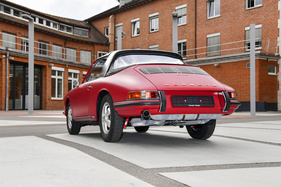
In total, it took more than three years to restore the first 911 S Targa delivered in Germany to as-new condition using the manufacturer's expertise - charming patina included. The Targa owner and passionate Porsche collector's next project is already in the Porsche Classic workshop, waiting to be rebuilt - a very early 928.
About the Porsche 911 Targa
In 1965, Porsche presented the 911 Targa at the IAA as the world's first "safety convertible" with a roll bar a good 20 centimeters wide, a removable roof and a rear mini soft top with a plastic windscreen. This was the company's typically pragmatic response to a debate in the USA that branded convertibles as "dangerous". A panoramic rear window with heated glass followed shortly afterwards. The name of the open-top variant - "Targa" - was derived from the Targa Florio endurance race in Sicily, which had previously been won four times. The surcharge compared to the Coupé was DM 1,400.
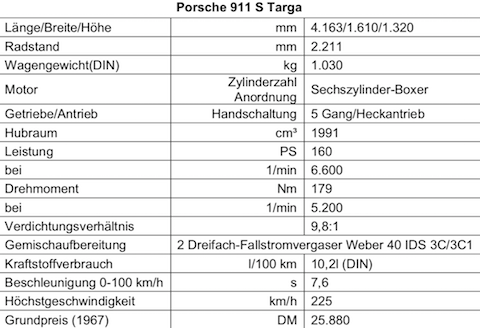
The now restored 911 S Targa had the following catalog data:
About the factory restoration
Made by Porsche, restored by Porsche: Porsche Classic awards this unique seal of quality up to eight times a year. This is when a completely factory-restored classic sports car rolls out of the workshop. In addition, around 70 other vehicles a year pass through the hands of the craftsmen for partial restoration, for example of the engine and gearbox. Around 30 specialists maintain, repair and restore customer vehicles here, from the 356 to the Carrera GT. All the trades of a workshop are represented in the 1,500 square meters of space: Body construction including paint shop, engine and gearbox construction as well as a saddlery.
Every complete restoration begins with a cost estimate. The specialists use photos to calculate the rough scope of the restoration work and the expected financial outlay. If this meets the customer's expectations, the sports car is examined in the Porsche Classic workshop and a detailed cost analysis is prepared.
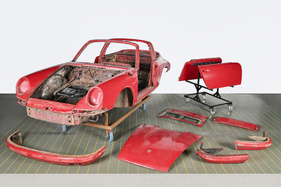
During a full restoration, the experts dismantle the vehicle. The engine and gearbox are always completely dismantled, cleaned and inspected. Worn or defective parts are replaced or, if possible, also repaired and restored on request. Adjusted according to the original factory specifications, the drive unit must first prove its performance in a test run on the test bench.
Porsche's love of the original knows no bounds
The experts proceed in a similar way with the body shell. The rough removal of corrosion is followed by the opening of all cavities - a necessary preparation for a successful paint stripping bath. The coachbuilders then repair or replace any sheet metal that has become old. The older the vehicle, the more intensive the adjustment work, even when using original new parts from the company's own stock. This is because early Porsches already contained a lot of manual work ex works. The subsequent trial assembly of the complete body is carried out with untreated components in order to check and adjust gap dimensions and functions. This ensures that the doors and hoods close precisely.
The body prepared in this way undergoes the same cathodic dip coating process in the factory paint shop as the current new vehicles from Zuffenhausen - a service that no other vehicle manufacturer in the world offers. Cathodic dip painting (CDP) guarantees a seamless, highly resistant primer right down to the last fold. Prepared in this way, the complete paint job begins by hand in the original vehicle color. The test painting of a sheet metal panel ensures that the color mixture matches.
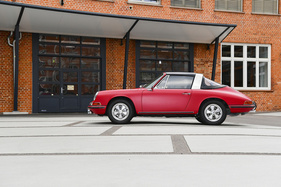
Each coat of paint is followed by an extended three-week drying process. The final stage of a full restoration is the interior. Finally, the refurbished classic then has to prove its qualities during extensive test drives.
A beautiful souvenir
The customer receives detailed documentation of all the work carried out by the Porsche Classic workshop in book form with extensive photographic material. This also includes an engraved plaque with the chassis number and signature confirming the original factory restoration on the second birthday by Porsche Classic.