



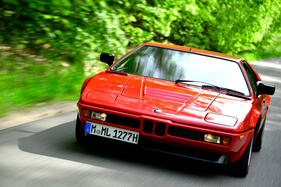


Anniversaries of various kinds dominate the events at Techno Classica 2018 in Essen. The world's most popular classic car trade fair will serve as a meeting place for the international classic car scene for the 30th time and will provide the perfect setting to celebrate the milestone birthdays of particularly fascinating models from March 21 to 25, 2018. In Essen, BMW Group Classic will be looking back on the debut of the BMW M1 40 years ago. With its timeless design and racing history, the mid-engined sports car is one of the milestones in the company's history. The era of the "large coupés" had already begun ten years earlier with the BMW 2800 CS. These models were also formative representatives of their time, both on the road and on the racetrack.

BMW M1: Italian lines, Bavarian engine design.
What the BMW M1 and the brand's large coupés have in common is their characteristic harmony of aesthetics and sportiness. The bodywork design under the direction of Italian designer Giorgio Giugiaro gave the BMW M1, which is only 1.14 meters high, an Italian line. Its in-line six-cylinder engine, on the other hand, was a masterpiece from Munich. Just like the vehicle concept, the drive technology was also designed to master both the challenges on the racetrack and the requirements for road approval.

In the production version, the BMW M1 was the fastest German road sports car with an output of 204 kW/277 hp and a top speed of more than 260 km/h. In the Procar series, which was held as part of the European Formula 1 World Championship program, it competed with an engine with up to 490 hp; for the races according to Group 5 regulations, turbocharging ensured an increase in power to 850 to 950 hp.

50 years ago: Premiere for large coupés in the new BMW style.
Twin headlights, air intakes on the side panels and a long hood characterized the new design style of the BMW brand, which the large coupés embodied in a particularly attractive way at their debut 50 years ago. In addition, the filigree roofline and the absence of B-pillars made the elegant coupé body an eye-catcher. In-line six-cylinder engines with initially 170 and later up to 206 hp provided adequate dynamics. At the top of the model range was the lightweight BMW 3.0 CSL variant designed for use in racing. The two-door model, which bore the abbreviation for "Coupé, Sport, Leichtbau" in its model name, became a series winner in touring car racing in the 1970s. By 1979, six European championship titles had been won with this model, the last one four years after the end of the production vehicle's production run.

1968: A spirit of optimism in the luxury class.
Just like the coupés, the saloons of the large model series also celebrated their debut in 1968. Half a century later, they still represent the spirit of optimism that also gripped the BMW company at the time. The four-door models came onto the market four years after the end of production of the BMW 502, known as the "Baroque Angel", and revealed a completely new style at first glance. With their stretched lines, modern equipment features and powerful six-cylinder in-line engines, they embodied the brand's typical combination of elegance, comfort and sportiness in the luxury class. The new start in this prestigious segment began with the BMW 2500 and BMW 2800 models, with further engines and variants with an extended wheelbase and particularly exclusive equipment being added in the following years. In 1975, the BMW 3.3 Li with innovative fuel injection and an output of 200 hp took the top spot in the model range.

The Mini Cooper S laid the foundation for the one-two-three victory at the Monte Carlo Rally.
Mini looks back on the birth of a legendary sports car at Techno Classica 2018. The Mini Cooper S came onto the market 55 years ago to inspire sporty, ambitious drivers and amaze rally fans. The most powerful version of the classic Mini achieved 75 hp thanks to an increase in engine capacity. This more than doubled the power of the original model. The little powerhouse was soon extremely successful in racing off-road. The three overall victories at the Monte Carlo Rally in 1964, 1965 and 1967 in particular caused quite a stir.

Classic cars are presented in an authentic setting.
As in the previous year, BMW Group Classic will be using the temporary Hall 14 at the eastern entrance to the exhibition grounds at Techno Classica 2018 to present its anniversary cars and numerous other rarities from different eras of automobile and motorcycle history. The involvement of dedicated members from a total of 21 BMW and Mini clubs ensures a particularly wide variety of historic vehicles.

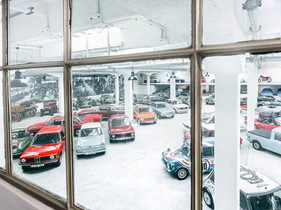
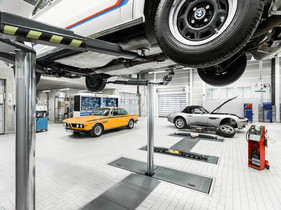
The list of classic cars on display in Essen includes 32 automobiles and four motorcycles. And an authentic visual environment is also provided, as the design inside the exhibition hall is inspired by the BMW Group Classic headquarters in Munich. Large-format images provide insights into the rooms of the vehicle collection and the workshop, from which many of the classic cars on display originate.
