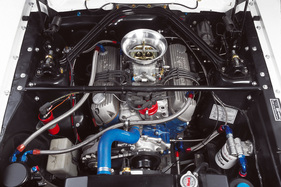
Old love never rusts! Whether pre-war veteran, vintage or classic car - all of them convey an unmistakable zeitgeist of the mobility of bygone times when driving. The comprehensive CLASSIC LINE is tailored to the individual lubrication requirements of each era and is available as a full range in all standard container sizes. It makes a significant contribution to the preservation of motorized cultural assets. We know what engines want, then and now - Welcome to Motorex.

What engine oil viscosities are available?
Application examples Monograde engine oils:
- For normal use. Engines with water cooling and vehicles with starter (no winter operation): SAE 40
- For engines with crank (manual start): SAE 30
- For air-cooled engines and motorcycles: SAE 50
- In case of overheating problems, SAE 50 can also be used (improve cooling performance)
- SAE 50 can also be used for high oil consumption
Application examples for multigrade engine oils:
- For large-volume engines: SAE 10W/30
- For high-performance engines: SAE 15W/40
- For racing engines with high speeds and temperatures: SAE 20W/50
Attention: Viscous engine oils have a longer oiling time (time until the oil pressure is built up and all lubrication points are supplied with oil).

The correct oil change interval
If possible, always carry out oil changes in accordance with the manufacturer's instructions. If no more documents are available, these general non-binding guidelines apply:
- REGULAR: 1000 - 2000 km or every 6 months
- SUPREME: 2000 - 5000 km or every 12 months
- HEAVY DUTY: 5000 - 7500 km or every 12 months
- EVOTEC: 5000 - 10000 km or every 12 months
These guide values depend on the oil quantity, performance, driving style, condition of the engine and thermal load on the oil (change more frequently for air-cooled engines). The oil should always be changed before longer periods of inactivity (> 6 months) (condensation), regardless of the number of kilometers driven. If the shutdown lasts longer than 2 years, the oil should be checked before the first start (possible ageing due to humidity at the storage location). Additional lubrication of the cylinders by lubrication via the spark plug hole should be checked.
If in doubt, it is better to change too much oil and filter than too little. If the operating instructions are available, study them thoroughly and proceed accordingly.

Oil changes should be carried out before the shutdown period, i.e. usually in the fall. The oil should be drained at operating temperature. This allows the combustion residues that have accumulated in the oil and lead to oxidation to be eliminated. The new oil should be brought to operating temperature in the engine so that all relevant parts come into good contact with lubricating oil, thus creating an anti-corrosion film.
Revised engine = running-in oil
Older engines that contain cylinders, pistons, piston rings and other friction partners that are not hard-chromed or surface-coated are run in after an engine overhaul. This process is intended to adapt the friction points to each other and smooth the surface structure.
To speed up the process, an unalloyed engine oil is used, which allows for greater friction. Running-in time between 10-20 hours. Avoid high speeds and high engine loads during running-in. Vary load and speed. Check the engine oil level frequently. After the running-in process, drain the oil hot and also replace the oil filter. Fill with the prescribed engine oil.
The Motorex recommendation: RUNNING IN SAE 30