





On Sunday, June 30, the Le Nôtre lawn at the Chateau de Chantilly will provide an idyllic setting for a meeting that, for a few hours, will become the most beautiful automobile museum in the world! Over 100 exceptional cars from different universes and all eras will be gathered there for the 5th Concours Arts & Elegance Richard Mille.
The concept of the Concours d'Etat is unprecedented. Each year, a committee of experts meets to draw up a list of around 15 brand classes or classes inspired by anniversaries. In 2019, the 100th anniversaries of Bentley and Ballot, the 50th anniversary of the Porsche 917 and the 110th anniversary of Bugatti will be celebrated, among others! More than 100 exceptional cars offer a large-scale panorama from 1913 to 2015, from the Delaunay-Belleville Coupe de Ville to the McLaren 650 S GT3. Here is a brief description of what visitors can expect, explained by eleven randomly selected cars.
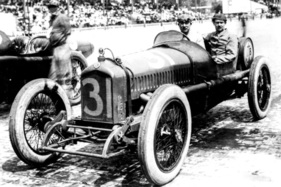
Class "100th anniversary Ballot"

Shortly after the founding of the 500 Miles of Indianapoliis in 1911, the French set out to conquer America. Brothers Ernest and Edouard Ballot were inspired by the victories of Peugeot in 1913 and Delage in 1914 and were determined to achieve the same feat in 1919. They specialized in supplying engines for the automobile and for boats (hence the anchor in the logo) and designed a 4.8-litre eight-cylinder unit for the race. René Thomas came 11th in the 5/8 LC racing car with chassis 1001, as it will be exhibited in Chantilly. Strengthened by this experience, the team returned the following year and finished second.
Class "Endurance GTs from 1994"

In the mid-nineties, several manufacturers engaged in an arms race, made possible by loopholes in the GT regulations, to achieve outright victory in the 24 Hours of Le Mans. The Mercedes-Benz CLK GTR is a perfect example of these excesses. Although designed for the road with a carbon fiber monocoque chassis and powered by a 6.9-liter V12 engine, it completed the 0 - 100 km/h in 3.4 seconds and reached a top speed of 320 km/h. The car won the FIA GT Championship in 1997 and 1998, but was unable to achieve success at Le Mans. The Mercedes-Benz CLK GTR from 1997 with chassis number 29739797WA0000000004 is on display
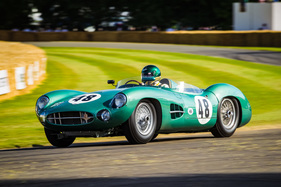
Class "Post-war racing cars from Aston Martin"

The car: Aston Martin DBR1 with chassis number DBR1/5 is one of the most famous British racing cars of all time. It was produced in 1956 and is characterized by the triangular air intakes on the flanks, which became one of the brand's most important styling elements. In the hands of some of the best drivers of the day, including Jack Brabham, Tony Brooks, Jim Clark, Stirling Moss, etc., the DBR1 won everywhere in 1959, including Le Mans, with Roy Salvadori and Carroll Shelby at the wheel. The car on display in Chantilly is the only one built for a private team.
Class: "Open-top pre-war Bentleys"

The Bentley Speed 6, launched in 1928, was the racing version of the 6.5-liter model that had appeared two years earlier. This car completed Bentley's dominance of the 24 Hours of Le Mans in the race's first decade with back-to-back victories in 1929 and 1930 at the height of the fame of the Bentley Boys, a group of well-to-do British sportsmen who won everything at the time. The 1930 Bentley Speed Six 'Old No. 3' on display at Chantilly, chassis number HM2869, is the third and last to be built for the works team. Better known as the "Old No. 3", it did not see the finish line at the 1930 24 Hours of Le Mans due to an accident.
Class "Marcello Gandini's creations"

Marcello Gandini was born in Turin in 1938 and designed some of the most beautiful Italian cars from the mid-sixties onwards. He was head designer at Bertone for a long time and was responsible for the famous Lamborghini Miura, which many consider to be the first super sports car in history. The S version on display in Chantilly, a Miura P400 S from 1969 with chassis number 4127, is a further development with a more powerful 3.9-liter V12 engine with 370 hp.
Class "The Porsche 917 years"

This Porsche 917 (built in 1971, chassis number 917-030) is special in several respects. Firstly, it was the first racing car in the world to be equipped with an ABS system, which didn't really impress Marko-Larousse at the 1971 Zeltweg 1000 km. What happened next was even more surprising. In 1975, Count Gregorio Rossi di Montelera, owner of a famous aperitif brand, had the prototype modified (exhaust, indicators, leather seats, etc.) and managed to get it registered in the state of Alabama in the USA!
Class "Iso Rivolta"

The Iso Rivolta Company, a manufacturer of electrical household appliances, motorcycles and then the Isetta cabin scooter, began building a sports car, the GT 300, in 1962. Its success encouraged the company's top men to strive for more and set the bar even higher, competing against Ferrari. Nothing was left to chance. Giotto Bizzarrini, the father of the Ferrari 250 GTO, was commissioned to develop the car. In contrast to the competition, the car was not powered by its own engine but by a V8 Chevrolet engine. Only a small number of A3/Cs were produced, one (Iso A3/C Grifo from 1964 with chassis number I-3507) will be on display in Paris.
Class "Japanese sports cars"

James Bond only drove a Toyota once in his life: it was the legendary 2000 GT, which was produced from 1967 to 1970. And for good reason, because this very modern car was a cocktail of the cutting-edge technologies of the time. It was the first Japanese series production car to be equipped with four disc brakes and individually suspended rims all round, as well as rack-and-pinion steering. Due to the limited number of cars produced (351), very few were exported (only 25 to Europe), making the car very rare in this country. The example shown here dates from 1969 and bears the chassis number 1207.
Class "Voisins with Voisin bodywork"

At the Paris Motor Show in1934, crowds flocked to the Citroën stand to admire the Traction Avant. Nevertheless, one small manufacturer managed to shine. His name? Gabriel Voisin. Unlike André Citroën, he never produced cars in series. The C25 Aerodyne was pure haute couture with its motorized sliding roof. As a former aircraft manufacturer and designer of the entire car, aerodynamics were particularly important to him. But the C25 Aérodyne was not a great commercial success and only seven were built. Shown here is the Avions-Voisin C25 Aérodyne from 1935 with chassis 50010.
Class "McLaren racing car"

Although the McLaren MP4/4 arrived late for winter testing, it beat its rivals in 1988. It was also the beginning of the legendary Prost-Senna rivalry. The car, designed by Gordon Murray and Steve Nichols, is easily recognizable by its very flat silhouette and very low ground clearance. It owes its strength to its exceptional aerodynamic efficiency and the powerful V6 Honda Turbo. No other F1 racing car won more races in such a short space of time, as the MP4/4 from 1988 (the ex-Senna car is shown) won 15 out of 16 races.
Class "Cars up to 1961 at the Paris Motor Show in the Grand Palais"

The T26 Grand Sport chassis 110103 left Talbot-Lago in October 1948 and it is the only one that was delivered to Figoni & Falaschi. It is also the only one to receive a teardrop-shaped body from this French coachbuilder in the post-war period. The car with its sleek lines was presented at the Paris Motor Show in 1949. The first owner was an industrialist who was called the "king of the zipper", as the decorations on the hood remind us!
That was just a small selection, you have to go and see the other 100-plus cars on site ...
More information about the Chanttily Art & Elégance Richard Mille Concours can be found on the event's website.