

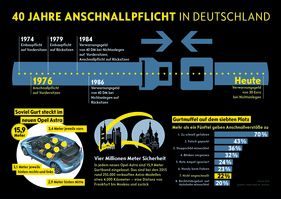


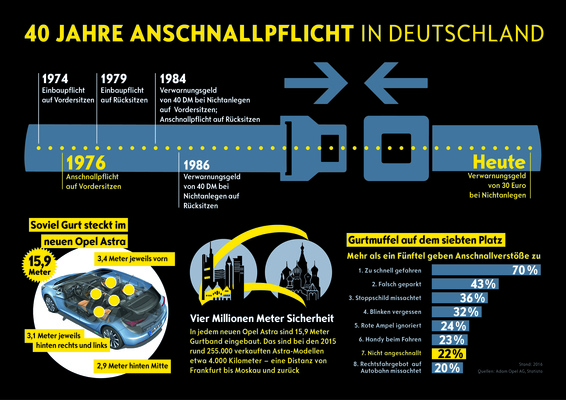
Formerly criticized as superfluous, today recognized as life-saving: The seatbelt requirement celebrates its 40th anniversary in Germany this year and is still regarded as the starting point for numerous safety innovations in the automotive world. Despite all the protests and discussions, the law was changed in Germany on January 1, 1976, requiring seat belts to be worn in the front seats of passenger cars. In 1984, seat belts were also made compulsory for rear seats. For many vehicles, this was the first step on the long road to ever greater vehicle safety.
The fact that the seat belt found its way into cars at all was thanks to the accident statistics introduced in 1953. These showed only too clearly how dangerous driving on German roads was at the time and how important seat belts were as a restraint system in the event of a collision. The number of fatalities was rising just as rapidly as the volume of traffic, prompting both the government and the automotive industry to take action.
The beginnings of seat belts
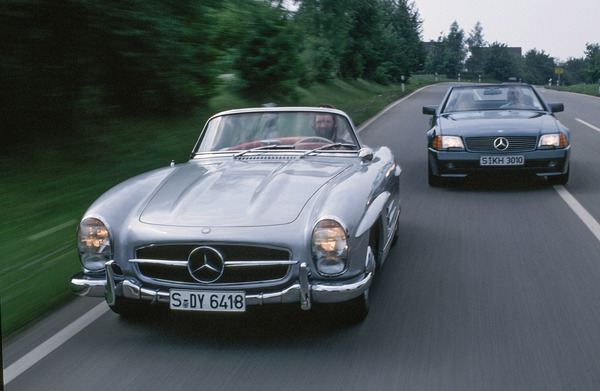
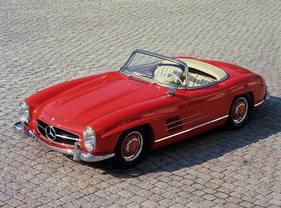
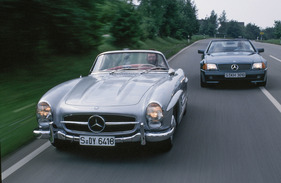
As early as 1958, a new restraint system was available for the open-top Mercedes-Benz 300 SL (W 198 II), designed to protect the occupants of the roadster in the event of an accident. This seat belt was designed as a lap belt - similar to those used in airplanes - and was primarily intended to protect the driver and passenger from being thrown out of the car. The special equipment cost DM 110 per seat at the time. By way of comparison, buyers of the sports car at the time had to pay DM 810 for a radio with automatic aerial as an optional extra. In the same year, Mercedes-Benz offered comparable seat belts for all passenger cars with individual front seats.
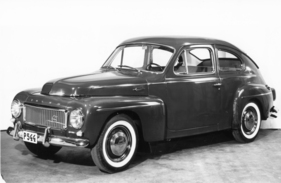
In 1959, Swedish Volvo engineer Nils Bohlin made automotive history: on August 13, the first vehicle equipped with his invention, a three-point seat belt, was delivered as standard. It is a Volvo PV 544 ("humpback").
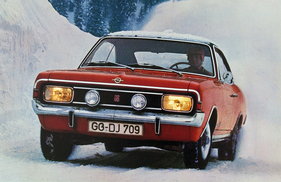
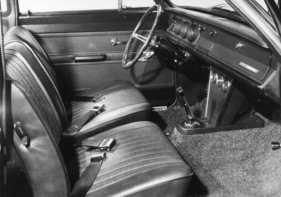
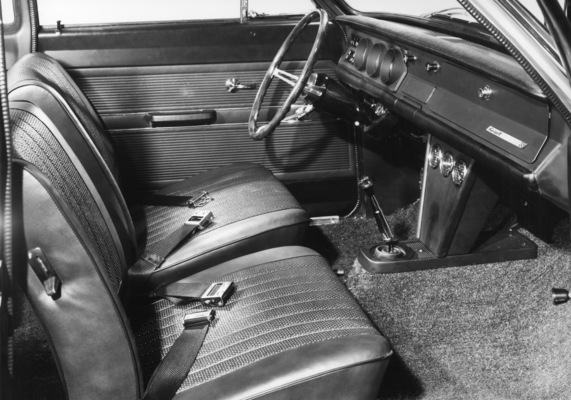
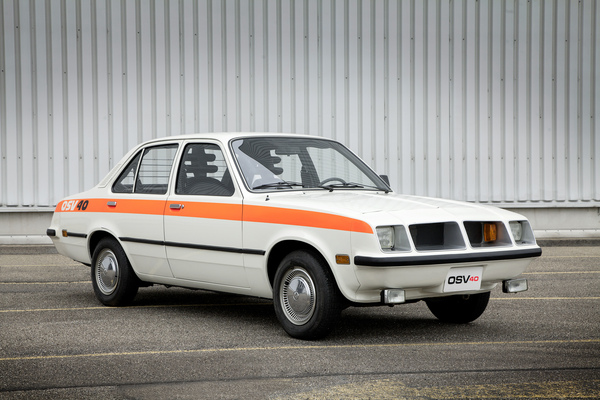
Opel was also a role model when it came to safety, even before seat belts were mandatory. Seat belts began to be fitted as standard in all passenger cars as early as 1973. Seat belts were even available as an extra some time earlier: from April 1968, the Kadett, the Admiral and the Diplomat, among others, could be ordered with front seat belts. The classic coupé Manta A followed in October 1970. Opel also offered the lifesaver as standard much earlier, for example from February 1967 in the Kadett B Rallye and a year later in the Commodore A GS.
Major resistance
At the end of the 1960s, the three-point seat belt, which combines lap and shoulder belts, gradually became the definitive form of seat belt. But the biggest problem at the time was that drivers first had to be persuaded to actually wear the existing belts. Despite intensive safety education by the Minister of Transport, pro-belt campaigns by German automobile clubs and drastic examples of accidents in the ARD traffic program "Der 7. Sinn", the Germans' allergy to seat belts hardly changed.
Although practically all new cars and retrofitted older models had seat belts from 1974, only 39 percent of drivers and passengers buckled up in the following year. The logical consequence: another year later, Paragraph 21 of the Road Traffic Regulations made seat belts mandatory. But resistance to the regulation was strong.

This was also the case in Switzerland, where voters only narrowly approved a mandatory seat belt requirement for drivers in 1981. At the time, the obligation to wear a seatbelt was seen by many as unjustified interference by the state in the freedom of citizens.
So the mere obligation did not change much. As belt wearers in Germany also got away with a warning for eight years, many drivers ignored the new law. It was only when a fine of DM 40 was introduced in August 1984 that seatbelt morale changed abruptly - the seatbelt usage rate rose from 60 to 90 percent in a very short space of time. To this day, the rate has stabilized at an even higher level: Over 97 percent buckle up in the front seats and 94 percent in the rear seats.
Over one million lives saved
Today, 40 years after the introduction of compulsory seat belts in Germany, the benefits of seat belts are largely undisputed. This is because the numerous safety innovations of the past decades have paid off. According to estimates, the invention of the Swedish Volvo engineer has saved the lives of over one million people worldwide since 1959.
An unbelievable 21,332 traffic fatalities in 1970 are still a sad record today; in 2015, only 3,475 people lost their lives on German roads - despite the volume of traffic being around three times higher than in 1970 and a significant increase in average speeds. And in Switzerland alone, 13,000 serious injuries and 1,600 deaths have been avoided since 2000.