Even in the full parking lots, you can tell from the license plates from the Netherlands, England, France, Germany and, of course, Belgium that something special is taking place here. Large banners with the words "Sound of History" hang above the access road, and you immediately realize that this is not just folkloristic brass band music when the music of the racing engines rings through the Ardennes forest. We are at the legendary Spa-Francorchamps race track in the Belgian Ardennes for the SPA SIX HOURS. For the 30th anniversary, the organizer has once again managed to fill the starting grid with classic racing and sports cars.
Whether historic Formula 1 cars, sports prototypes, GTs or touring cars, every category was well represented and offered exciting competitions. And while some heavy rain caused problems for drivers and visitors on Friday, the sun shone brightly on Saturday for the 6-hour main race, giving everyone an unforgettable motorsport event at the end of the season.
The Spa Six Hours 2023 6-hour race
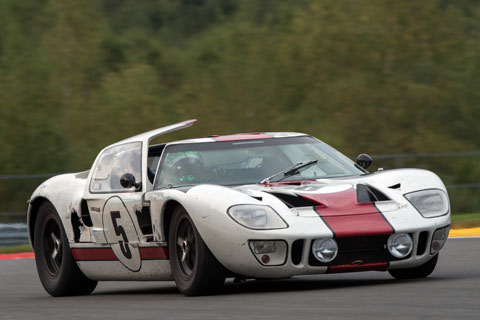
More than 100 historic vehicles were entered for the SPA SIX HOURS ENDURANCE Race alone. The results lists of recent years made one thing very clear: if you want to finish on the podium, you should drive a Ford GT 40. There were 18 of these successful endurance racing cars on the starting grid alone. The drivers entered included seven-time NASCAR champion Jimmie Johnson, three-time Indy 500 winner Dario Franchitti, Le Mans racer Nicolas Minsassian, multiple European and World Touring Car Champion Andy Priaulx as well as Gary Pearson, Alex Brundle, Sam Hancock, Nikolaus Ditting, Craig Davies and not forgetting the winning team of 2022 Olivier Hart, David Hart, N. Pastorelli. Competition was expected above all from the Shelby Cobra and Daytona and, of course, from the E-Types. Starting number #34 was considered the most exciting opponent before the start of the race, driven by five-time Le Mans winner Emanuele Pirro and co-driven by probably the best-known classic racer Katarina Kyvalova.

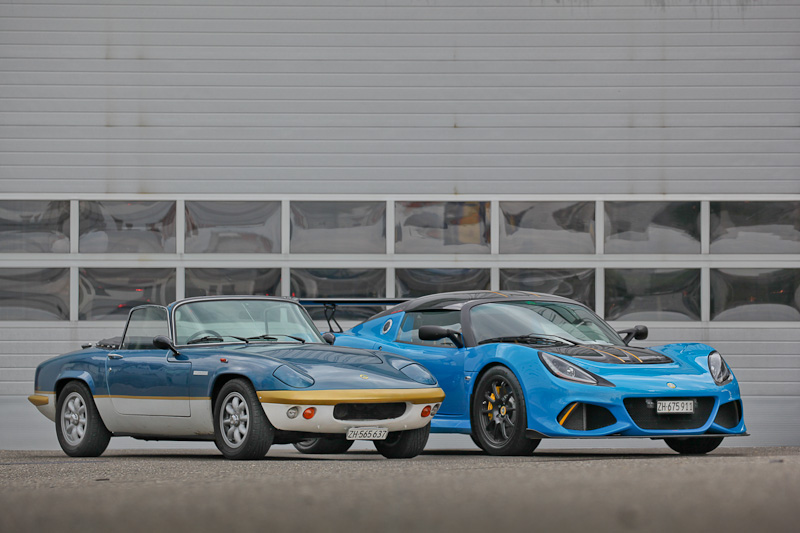
The other classes were filled with various Lotus Elan, Ford Mustang, Shelby Cobras, Shelby Daytona Coupes, Jaguar E, Aston Martin, Porsche 911, Ford Falcon, Marcos and a Fiat Abarth 1000 that had traveled from Italy. Easy to overlook in the large starting field was a Morgan +4 Super Sports, with the license plate TOK 258. After all, this vehicle won the 24 Hours of Le Mans in its class in 1962.

The turquoise GT 40 with starting number 30 took pole position on the grid.

Marcus Graf von Oeynhausen was the fastest with a best time of 3.07.361 minutes, followed by Oliver Bryant in second place with a time of 3.09.602 minutes. Nikolaus Ditting was third behind the Count with a time of 3.10.519 minutes, with David Hart next to him with a time of 3.11.991 minutes.
Let's take a look inside the cockpit of a GT 40 while the other cars are taking their positions.

The driver sits on the right-hand side of the vehicle. Depending on the size of the driver, the helmet distance to the roof is quite tight. Behind the small steering wheel is a very tidy and clear dashboard, with perfectly arranged instruments and many small, labeled toggle switches. On most GT 40s, the fuses are located to the left of the instrument panel for easy servicing. The driver's view to the front is very good. You can see the two slightly curved fender arches and also the fuel filler caps on the right and left side. The tanks together hold 120 liters. The view to the rear is very restricted and you have to rely on the rear-view mirrors. The gearshift is to the right of the driver's seat.
The first kilometer from the driver's perspective
Whistles sound and the starting grid has to be cleared so that the field can set off on the formation lap. Let's climb into the passenger seat of the pole setter for the first few kilometers (this is only possible virtually, of course). After a good five minutes, we return from the formation lap with the rest of the field and turn onto the start straight. As we're driving a flying start, we roll towards the start lights, which are mounted roughly in the middle of the new pit area above the track, with restrained throttle. Those behind us are already trying to get into a good starting position. As the lights change from red to green, the engines roar to life. We get off to a perfect start and easily pull away from the field.

At the end of the start straight, we stay fairly to the right so as not to open up a gap for the chasing pack. Before "La Source", the car brakes hard and downshifts. Turn right, aim for the small wall in "La Souce" and steer the car just over the curbs. At the exit of the bend, the GT 40 accelerates fully, slips a little at the rear, accelerates and steers slightly into the opposite direction. The attempt by the chasing group of four to get through the familiar hairpin bend side by side cost them a lot of time and we were able to pull away from the field. The downhill section to the "Eau Rouge" follows. The engine roars as 3rd and 4th gear are fully revved. The pit wall of the old pit lane flies past on the right, reflecting the sound of the engine like an echo. Our distance to the first pursuer is a good 50 meters, to the side of the pit wall about 40cm.
The Eau Rouge is not called the Courage Corner for nothing, but it is actually a wild left-right-left combination of bends, including a steep incline, which also obscures the driver's view of the next section of the track. Nevertheless, it is important to keep up as much speed as possible for the long uphill section that follows. Shortly before the Eau Rouge, the GT 40 reduces the throttle slightly. The combination of bends is approached with full concentration, aiming for the first apex on the left and then over the curbs. Now the next right-hand bend is uphill. The steering wheel no longer remains steady in the hand; with a firm grip and a few throttle strokes, small corrections are made again and again until the vehicle is positioned on the ideal line to the curbs at the next right-hand apex. We just miss the curbs and can clearly feel the movement in the car.

We fly blind towards the left-hand bend of the Raidillon. In order not to lose too much speed, we straighten the bend a little and go right over the curbs. Again and again, we make quick and violent corrections to the steering wheel, as if we were trying to tame a continuous horse. The centrifugal forces push us onto the curbs on the opposite, right-hand side of the road. Again, quick and easy counter-steering. We shift into 4th gear and then into 5th gear just before the slight bend to the right. This is followed by the uphill section of the "Kemmel Straight", which is almost a kilometer long. A quick glance at the instruments and in the rear-view mirror gives us a quick overview. Shortly before the end of the long straight, we position ourselves on the left-hand side of the road. Just after the 200-metre bend sign, we ease off the accelerator, brake slightly and shift into 4th and immediately into 3rd. The driver aims for the right-left bend combination "Les Combes".

Our lead is now just under 100 meters. The rider's pulse rate slowly drops from maximum to fierce. The most important sector of the first lap is completed by the leader with a slight lead.
Exciting until 21:50
Graf von Oeynhausen managed to stay at the front of the field for the first 13 laps, but a spirited GT 40 driven by Andy Priaulx, Gordon Shedden and Miles Griffiths, who had started from 5th on the grid, took the lead on lap 14. But the GT 40 of Team Oyenhausen, Nico Verdonck, could not be shaken off. Until lap 38, when the number 21 GT 40 of Oliver Bryant, James Cottingham, took the lead. But their luck ran out and after 10 laps in the lead they had to park their car due to technical problems. Last year's winning team also had bad luck - Hart, Hart, Pastorelli, started from position 4, dropped to position 17 in the meantime, then fought their way back up to position 2, but unfortunately also retired due to problems.

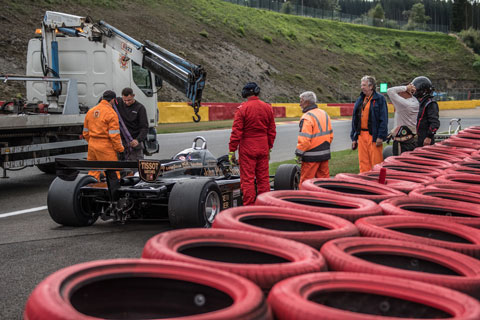
Numerous race incidents with a total of 8 safety car phases shuffled the cards again and again. Although the weather was great, the technology and small inattentions during the six hours took their toll. The GT 40 with the starting number 6 of the Andy Wolfe, Michael Gans, Jason Wright team entered the "Les Combes" corner combination at the end of the long "Kemmel Straight" with a little too much speed, caught the curbs at the wrong angle and then spun once around its own axis before getting stuck in the deep gravel bed on the right-hand side of the track.

The track marshals immediately waved the yellow flags to warn those behind them who were coming from the maximum speed zone. In the meantime, the race control center had also recognized the dangerous situation on large monitors and switched to the safety car warning. While 2 safety cars collected the field, the driver of the GT 40 gesticulated excitedly to the marshals to please push him out. But even 4 strong men were unable to do so. The car was stuck like a ship on a sandbank. Heavy equipment was urgently needed. This arrived a few minutes later in the form of a recovery vehicle with heavy-duty tires. Again, it took minutes to free the tow hook from the gravel under the radiator opening and attach the tow rope. Slowly, the recovery vehicle pulled the GT 40 out of the deep gravel bed, across the track onto the large asphalt surface inside "Les Combes". The cable was released and the stricken GT 40 slowly returned to the track and threaded its way into the ongoing safety car phase.
The incident caused the team to fall hopelessly down the position list and after a few laps the No. 6 no longer appeared.
They still refuel themselves!
Luck was also needed again at the spectacular refueling stops at the central filling station below the old pit area.

If you caught the right moment, you could roll your vehicle right up to a free fuel pump, get out, fill up on your own, get in, buckle up, hope the hot engine started up again and make your way to the pit exit. Those who arrived to join a queue of 3 - 4 vehicles were out of luck. Until a fuel marshal with a loud whistle and hand signals assigned the fuel pump to the next vehicle. This little show at the filling station has become a spectator magnet. Where else can you see 2 Ford GT 40s, a Shelby Daytona Coupe and a Jaguar E Type with running racing engines waiting impatiently for a free refueling space?
When the final hour of the race began in complete darkness, the GT 40 with starting number 14 of the team - Andy Priaulx, Gordon Shedden, Miles Griffiths - was in the lead and did not relinquish it until the end. The GT 40 of the Graf von Oyenhausen team, Nico Verdonck, battled for the lead for hours with start number 14, but had problems with the brakes 12 laps before the end and undeservedly dropped back to 4th place. The Lotus Elan 26R of Andrew Jordan, Sam Tordoff and James Dorlin was lucky instead. They drove the light and fast Lotus with only 1600 cc practically flawlessly. From 31st on the grid, they fought their way through the phalanx of the various Ford GT 40s to finish second. Third place on the podium went to the team of Tony Wood, Will Nuthall and Michael Lyons with their GT 40 and starting number 25.

In the 30th anniversary event of the SPA SIX HOURS, a Ford GT 40 celebrated its 16th victory.
Great field of Belcar touring cars
After the bad weather conditions of the previous day, the Belcar Historic Cup finally found optimal conditions for its second race. This was enough to bring the strong Ford Capri 3100 RS of Dutchman Wim Kuijl back to the front of the field.

The Corvette C4 of Belgian Luc Branckaerts, who could have won the Youngtimer category for the first time, was pushed out of the lead. The American beauty finished ahead of the magnificent BMW 320i E36 STW of Erik Qvick and the Porsche 964 of Luc Moortgat.

The anniversary started 1 day earlier
For many loyal Spa Six Hours fans, the fact that the race weekend started a day early was probably unusual. While Sunday normally also offered really good racing, Sunday was reservedfor the Belgian classic car club BEHVA. While there was still some racing at breakfast time, there was nothing going on for a very long time afterwards and the entire paddock was empty. Too bad for the visitors. It would probably have made more sense to hold the club day on Thursday so that the usual professional fields could have been used on Sunday.
Pre-crawlers on Sunday
At least the field of pre-war vehicles provided some variety on Sunday.

Although the spectacular GN Parker from Justin and Charles Maeers had taken pole position in the sports cars of the 20s and 30s, technical problems soon heralded the end for this original.
Rudi Friedrichs (Alvis Firefly Special) and Gareth Burnett (Talbot 105) benefited from this by taking the overall lead one after the other... before they got into trouble themselves! Ross Keeling and Callum Lockie then took the win in their superb Delahaye 135 ahead of Christopher Mann's Alfa Romeo 8C Monza and Martin Halusa's Bugatti Type 35!

Special jewel among the touring cars
There were many Lotus Cortina cars in the pre-66 touring car field, but one of them was very special. While the original Lotus engines were already classified as race-ready and reliable, the most enthusiastic racing teams swore by Neil Brown's engines. And the very first engine he improved, number #1, was installed in the Cortina #156. Neil Brown passed away on August 4, 2023. The team at Spa with driver Cunnington did not win, but drove in the name of the deceased with a dedication on the car.

Many more fields with beautiful racing cars
Thanks to the many different racing fields before the 6-hour main race, visitors to the event were able to take home a wide range of impressions. The offer ranged from well-known Le Mans cars to old Grand Prix monoposti and GT cars from the 60s and 70s.

And even the Formula 1 cars were of course not missing, even if there weren't that many at the start, unfortunately.

Anyone who has been to a historic race at the Nürgburgring or the Hockenheimring but has never considered going to Spa is highly recommended to do so. Because the atmosphere is also enchanting, you can watch countless other cars that don't otherwise race in any other series in Germany, and: other types of beer sweeten the evening after the race day. Cheers and see you next year!
Racing action from the cockpit of a GT40
This video gives you a good impression of how hard they drive at the limit, including spins to Pif-Paf at night, have fun!
Video summary Spa Six Hours 2023
And in this three-minute video you can see very nicely what makes Spa so extraordinary...