In Turin in November 1965, it is not a vehicle that attracts attention, but just the chassis: without cladding, rustic, consisting of bent sheet metal and with numerous holes to save weight. A V12 engine with a displacement of 4 liters is mounted on the chassis and positioned transversely at the rear. What looks like a racing prototype is in fact the basis of the later Miura. On the Lamborghini stand at the Turin Motor Show, this frame reveals the unadulterated mechanical nature of the next production model from Sant'Agata Bolognese. It is a declaration of intent, a radical gesture that marks the beginning of a new era. A memorable moment in the history of Lamborghini. In 2026, the brand celebrates 60 years of the Miura - with festivities and an official tour of the Polo Storico.
The first idea for the future architecture of Lamborghini was born in the summer of 1964 from the intuition and courage of three young members of the Lamborghini team in Sant'Agata Bolognese: Giampaolo Dallara, Paolo Stanzani and test driver Bob Wallace. Just over twenty years old, they shared the dream of taking Lamborghini into the world of motor racing. As this did not fit in with Ferruccio Lamborghini's plans, they decided that if their cars could not come to the race track, the race track would have to come to the road cars - with performance, technology and emotion. This idea took shape in the L105 project, which was initially created as a lightweight, compact vehicle frame. It was intended to support an extreme and revolutionary Gran Turismo body. Although Ferruccio Lamborghini was initially skeptical, he trusted his team and the P400 chassis and engine became a reality: a manifesto for creative freedom and technical avant-garde.

A skeleton
Presented at the Turin Motor Show on November 3, 1965, together with the 350 GT and the 350 GTS, the chassis appeared painted in satin black and with four white exhaust pipes.

Reports at the time described it as the skeleton of a ready-to-run racing car and emphasized its innovative technical configuration. The structure, made by Marchesi in Modena, consisted of 0.8 millimeter thin sheet steel, folded and perforated to ensure lightness and rigidity. A central tunnel served as the load-bearing element and mounting base for the suspension, while two subframes at the front and rear supported the mechanical components, suspension and accessories.

The total weight was no more than 120 kilograms - an impressive figure for the time. Independent suspension with double wishbones, Girling disc brakes and Borrani rims completed the technology with solutions that had been adopted from motorsport and had never before been used on a road-legal vehicle.
Its striking feature was the unprecedented integration of the engine and transmission into a single, compact unit behind the driver's cab. This solution reduced the size of the platform and created a completely new drive architecture. The twelve vertical intake funnels of the Weber carburettors rounded off the technical spectacle and provided a powerful visual statement of the extreme concept.

Body wanted
The chassis fascinated both the public and the press: A statically presented prototype without a body became the center of attention at the motor show. In those days, the most important Italian coachbuilders gathered at the Lamborghini stand. Originally, Carrozzeria Touring was to have completed the project, which was then known as the Tigre. The coachbuilder, which had also built the 350 and 400 GT models, also proposed a design, but financial difficulties clouded the future collaboration. Pininfarina was also unable to get involved with the brand from Sant'Agata because it was already committed to other manufacturers. This created a unique opportunity, which was seized by Nuccio Bertone.
Legend has it that Bertone arrived at the Lamborghini stand towards the end of the show and was greeted by company founder Ferruccio Lamborghini with the words: "You are the last of the coachbuilders to show up here." Bertone looked at the chassis and replied that his workshop would produce "the perfect shoe for this wonderful foot". Whether the conversation actually took place in this way is uncertain, but the story highlights the instant understanding between the two entrepreneurs. It was at this meeting that the decision was made to commission Bertone to build the body of the future Lamborghini. During the Christmas vacations, when the factory was closed, Ferruccio Lamborghini, Giampaolo Dallara and Paolo Stanzani received the first sketches. They found the design lines so innovative that they were immediately recognized as the final project.

The legend lives on
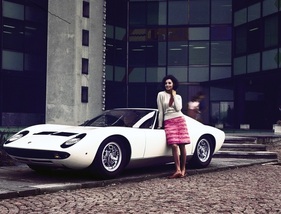
In March 1966, the P400 chassis presented in Turin took its final form at the Geneva Motor Show and became the legendary Miura. 60 years later, this model is celebrating its anniversary, but its origins are forever here: in a satin-black structure with four white exhausts, twelve vertical carburetor funnels and the bold decision to show the world not the body, but what lies beneath. In that moment, Lamborghini turned a bold idea into reality and paved the way for a legend that will never fade.

In 2026, Lamborghini will dedicate an anniversary year to the Miura with an official tour of the Polo Storico as a tribute to a model that changed the world of super sports cars forever with its performance and innovative design language. A car so revolutionary that a term was created for it that had never existed before: supercar (coined by an English journalist to describe this very car).