


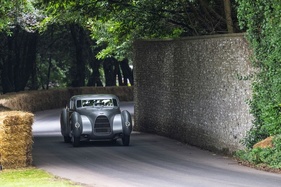

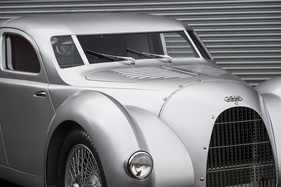
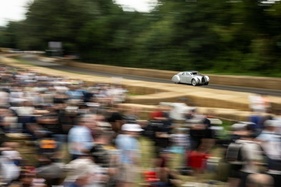
Who doesn't know them: the Auto Union Silver Arrows, those legendary Grand Prix racing cars of the 1930s. However, hardly anyone knows that a road-going sports car version with a 16-cylinder engine was also planned on the basis of these pioneering racing machines, the Auto Union Type 52. Audi built this high-speed sports car and presented it to the public for the first time at the Goodwood Festival of Speed in England in mid-July.
Records and Grand Prix victories
Back to the time when the Auto Union Type 52 was conceived: Auto Union AG, which was formed in 1932 from the merger of the companies Audi, DKW, Horch and Wanderer, became involved in motorsport at an early stage in order to make its new company logo, the four rings, internationally known. Also in 1932, the regulations for the new 750 kg formula were published, which were to apply to the Grand Prix competitions from 1934 to 1936. In 1933, Auto Union AG commissioned Ferdinand Porsche's design office in Stuttgart to develop a racing car based on this 750 kg formula.
Work on the Auto Union Type A - known as the "Type 22" according to Porsche's internal nomenclature - began in March 1933 and just one year later Hans Stuck set a world record with the car at the AVUS circuit in Berlin. When the completely new racing cars from Auto Union and Mercedes-Benz also entered the international racing scene in 1934, the legend of the Silver Arrows was born.
The lightning-fast cars captivated the public: powerhouses with a futuristic design, equipped with revolutionary technology. While Mercedes-Benz favored front engines, Auto Union placed the power unit behind the driver for the first time in its racing cars - this mid-engine concept is still standard in Formula 1 today. More and more speed records were set in the following years, Auto Union won numerous hill climb championships, three German championships and in 1936 the European Championship with the further developed Auto Union Type C. And the rest is history...
Plans for a road-going sports saloon
Not quite: now it's the turn of something untold. Previously known only to a few, plans for a road-going sports saloon also began at the same time as the development of the Grand Prix racing cars at Auto Union AG and in Ferdinand Porsche's design office. The concept documents contain the term "high-speed sports car", under which the automobile was probably to be marketed.
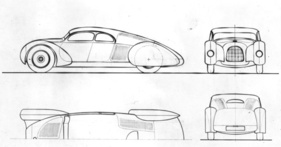
Due to its special characteristics, the car embodies a classic Gran Turismo in today's parlance. The Auto Union Type 52, as the project was later called, was to be sold to customers and could be used by them in long-distance competitions such as the Mille Miglia or sports car competitions. The endurance races at Spa-Francorchamps or Le Mans, for example, would have been possible. There were also plans for works events.
Project discontinued
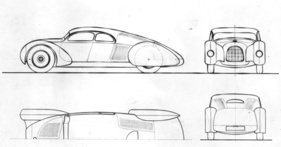
As early as the end of 1933, the Porsche design office produced the first design sketches, which took on a more concrete form in the course of 1934. Those responsible for the project also decided to build a test car - although as far as we know today, this never actually took place. The project was discontinued in the course of 1935 and all traces of it are lost in the Audi and Porsche archives. Until then, however, the developers put a great deal of groundbreaking work on paper based on the technology of the Grand Prix racer developed at the same time: the chassis of the Auto Union Type 52 was designed as a ladder frame with a mid-engine.
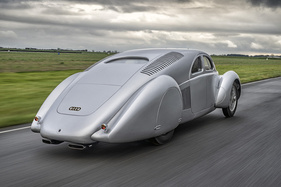
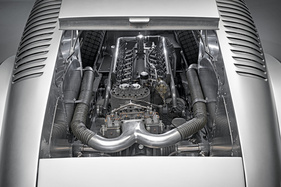
The drive unit from the Auto Union Type 22 is used, but the compression of the potent 16-cylinder engine is reduced so that the car can run on normal gasoline. At the same time, the technicians reduced the ratio of the Roots compressor. The engine in the Auto Union Type 52 is said to produce around 200 hp from a displacement of 4.4 liters at 3,650 rpm. Its maximum torque of 4,450 cmkg (436 Nm) is available at a moderate 2,250 rpm. Although this is less powerful than the Grand Prix cars, the performance of around 200 km/h calculated by the engineers shows that the high-speed sports car would have lived up to its name. In its day, it would have been one of the most powerful road-legal vehicles and also one of the most powerful in possible sports car competitions: a true high-speed sports car.
The vehicle body project: historical documents as a starting point
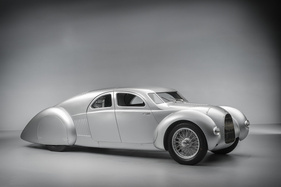
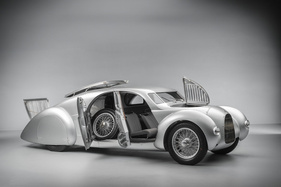
Audi had the Auto Union Type 52 built by Crosthwaite & Gardiner on the basis of surviving archive documents, plans and design drawings. The English restoration specialists also look after the Silver Arrows in Audi's historic vehicle collection and completed the "fast sports car" project in 2023 after several years of construction. All components are custom-made and handcrafted especially for the model. At over five meters long, the Auto Union Type 52 is an imposing sight: the elongated silhouette shows that the engineers have trimmed the car for the best possible aerodynamics and maximum performance. In contrast to its Grand Prix siblings, it was designed to be more suitable for everyday use: with a roof over its head, headlights and space for luggage. There is also storage space for the double spare tire. The up to three passengers have to do without additional comfort.
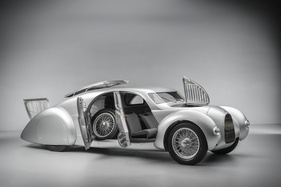
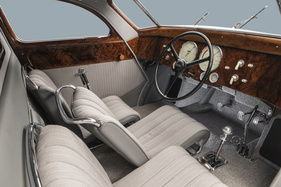
In typical racing style, the driver sits in the center of the Auto Union Type 52, with the passenger seats slightly offset to the rear. With three occupants, 70 kilograms of luggage and 150 kilograms of equipment, the technical data sheet indicates a total weight of 1,750 kilograms, with an unladen weight of 1,300 kilograms. While the drive unit and gearbox in conjunction with the open 5-speed gearshift gate are taken from the Grand Prix racing car, the engineers have chosen different technical solutions for the suspension and damping, for example: Instead of a transverse leaf spring in combination with friction dampers as in the Auto Union Type 22, the Type 52 uses longitudinally arranged torsion bar springs on the rear axle in conjunction with hydraulic dampers.
The tank, designed for 110 liters according to the plans, was moved under the seats during development - in the Grand Prix racing car, the significantly larger tank sits directly behind the driver in the vehicle's center of gravity, which results in optimum weight distribution in the Silver Arrows when the tank is full and empty. As with the Type 22, the Auto Union Type 52 was braked by drum brakes on all four wheels and wire-spoke wheels.
Voices on the Auto Union Type 52: Stefan Trauf and Hans-Joachim Stuck
Audi Tradition presents the high-speed sports car to the public for the first time at Goodwood in 2024 Stefan Trauf, Head of Audi Tradition: "We are delighted to be able to present the Auto Union Type 52 at the Goodwood Festival of Speed. This car inspires enthusiasm for design and technology. For me, it is an absolute dream car. Unfortunately, it was only a dream back then - a dream that we were able to make come true after 90 years. With the Auto Union Type 52, we are showing just how inventive its inventors were and how innovative the technology was at the time. To now experience the high-speed sports car live is a great pleasure for me."
The Auto Union Type 52 will be driven at Goodwood by Le Mans record winner Tom Kristensen and racing legend Hans-Joachim "Strietzel" Stuck. His father Hans Stuck went down in history as the "Hillclimb King" due to his many successes with the Auto Union Grand Prix racing cars in the hillclimb races that were popular in the 1930s. Hans-Joachim Stuck after his first test drive in the Auto Union Type 52: "I occasionally drive the Auto Union Type C, which my father drove back then, at Audi Tradition events and feel the great enthusiasm and fascination of the motorsport fans. To be able to drive the Auto Union Type 52 at Goodwood for the first time is a special honor and pleasure for me. The high-speed sports car is simply breathtaking: its sound is super-sonorous, like an orchestra. And the design of the Auto Union Type 52 almost blows you away - brilliant!"
Last but not least: insights into the challenges of building the unique car
No final development status of the Auto Union Type 52 has been handed down, nor are there any pictures of a completed vehicle. In the course of the dissolution of Auto Union AG in the Russian occupation zone after the Second World War, not only the historic Grand Prix racing cars but also numerous files and photos were largely lost. There are also no reliable reports from contemporary witnesses that would allow conclusions to be drawn about the final configuration - if there ever was one - of the planned high-speed sports car. Nevertheless, the existing plans make it easy to understand the direction of development and the goals that the engineers were pursuing at the time.
During the construction phase, there was a constant and intensive exchange between Audi Tradition and the specialists from Crosthwaite & Gardiner. During this process, Timo Witt, head of Audi's historic vehicle collection, clarified numerous questions of detail; decisions had to be made in favor of one technical solution or another. Witt today, after the completion of the body project: "Even in the 1930s - this is one insight from our intensive exchange - the developers would probably have made technical adjustments to one or two details in the course of testing. For example, we had to make the wheelbase of the now built Auto Union Type 52 longer than in the original planning documents, because it was technically impossible to implement this differently in the package with the other components such as the front axle suspension, power unit, steering or gearbox. On the other hand, we based the interior on the Auto Union Grand Prix racing cars and at the same time interpreted the colors and fabrics in a contemporary way."
Deviations
There are no further details on the exterior paintwork in the documents. Audi Tradition has therefore also taken the racing car as a basis here and chosen the color Cellulose Silver (satin silver) for the paintwork. The engine used in the now-built Auto Union Type 52 is a deliberate deviation from the designers' original plans: Audi Tradition uses the 16-cylinder unit from the Auto Union Type C, which was not throttled for the Type 52 in favor of interchangeability with the Grand Prix racing cars. The engine therefore runs on a special methanol mixture.
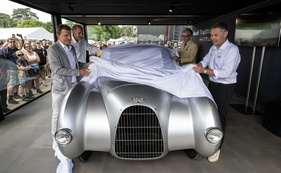
Based on the information handed down to us, which has been interpreted and implemented by Audi Tradition with the greatest possible care, the Auto Union Type 52 presented for the first time at Goodwood is the result of a maximum approximation to the Auto Union Type 52 high-speed sports car conceived around 90 years ago, which never existed in this form.
