


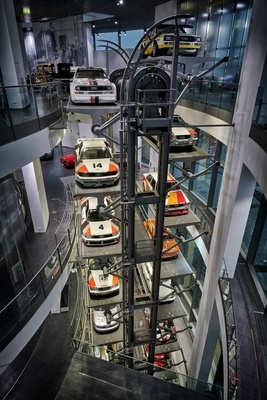


It has been 20 years since the Audi museum mobile opened on December 15, 2000. In these first 20 years of the new millennium, Audi AG has added numerous chapters to its success story. In the process, automotive classics have been created and new milestones in technological development have been set. A gap that is now being closed on the occasion of the 20th anniversary to bring visitors to the Audi museum mobile closer to the more recent years of Audi history. 34 newly exhibited historic automobiles await visitors to the Audi museum mobile from December 15.
Audi racing since the sixties
The large paternoster will be a feast for the eyes of all motorsport fans. Where exhibits on special themes used to rotate, the motorsport history of Audi AG will now be on display. With the exception of the Auto Union Silver Arrows, which will remain in their traditional place on the third floor of the museum, everything that has made Audi a sporting brand since the 1960s will now be presented on the surrounding platforms, which will accompany visitors across all four floors.

The motorsport exhibition will take on a completely new significance. Instead of the previous five, there are now 14 exhibits. For example, the Audi A4 DTM winner from 2007, the Audi Le Mans prototype R8 LMP from 2002, the Audi A4 STW from 1996, an Audi Rallye quattro Group 4 from 1980, the Audi Sport quattro Rallye Group B from 1985, the NSU 1300 TT "Jägermeister" from 1975 and an early DKW F11/64 touring car from 1963.
Some of the most important models
This restructuring allowed the previous motorsport exhibition area on the second floor to be given a fresh new look and fitted out with more recent Audi icons. In future, visitors will be able to see the design icon Audi TT Coupé, the legendary Audi A2 and the Audi A8, a witness to Audi's return to the luxury segment. The same applies to the Audi RS 4 and the Audi Cabrio with five-cylinder engine, which stand for the brand's new sportiness, as well as the Audi Allroad quattro from 2001, which heralded the start of Audi's extremely successful SUV segment.

This field is rounded off by the Audi Duo III, with which the brand with the four rings tested electric mobility back in the 1990s. Technology fans can also look forward to three models with special engines from the company's history. A functional replica of August Horch's first innovation, the shockless engine from 1901, will be on display on the pre-war floor on the second floor. On the second floor, a DKW in-line two-cylinder two-stroke engine from the 1950s and an NSU/Wankel engine from 1968 are now on display alongside the other engine cutaway models.
Not only restructuring, but also replacement necessary
After 20 years, however, it is also necessary to replace some exhibits with exhibits of equal value, as the long service life is not conducive to the historic automobiles in the long term. For example, the Horch 303 from 1927, the first German eight-cylinder, is leaving the museum. However, this special automobile is spectacularly replaced by the successor model Horch 305 from 1928 with the special Landaulet body - one of the last survivors of this type.

The Audi Front Roadster from 1936, of which there were only two examples and which Audi Tradition had faithfully rebuilt years ago, also finds its way into the exhibition. There are also two very exciting cars from the pre-war period. In 1939, Audi's predecessor company Auto Union AG presented the Horch 930 S, a study with a streamlined body, at the Berlin Motor Show. The DKW F 9 prototype from 1940 was also included in the permanent exhibition. The war was to prevent series production of both models. Visitors to the Audi museum mobile can now see them.
All-terrain vehicle essential for survival
There is also a special automotive contemporary witness that does not serve as a replacement for a withdrawn exhibit, but stands for an extremely important moment in the company's history: The DKW Munga, which Auto Union GmbH built from 1956. The off-road vehicle ordered by the German army 65 years ago ensured the survival of the young Ingolstadt-based company in the tough post-war period and helped to make the future in which Audi AG finds itself today possible.
