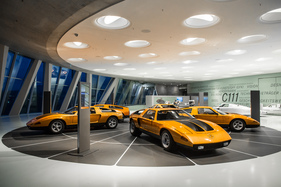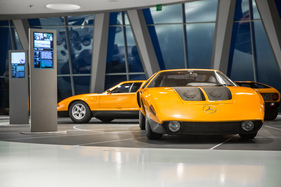

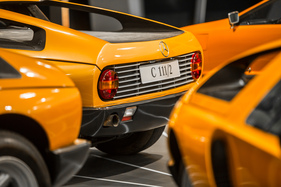
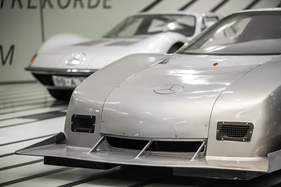
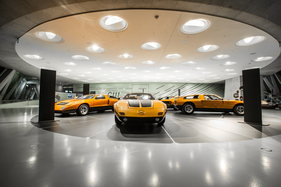
With the special exhibition "C 111 - timeless and visionary", the Mercedes-Benz Museum has been telling the story of a unique superstar in automotive history since April 28, 2015.

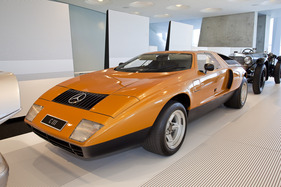
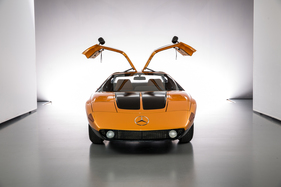
The Mercedes-Benz C 111 was created in 1969 as a highly innovative research vehicle for testing the Wankel engine and new lightweight materials. Although the futuristic gullwing coupé with its eye-catching paintwork never went into series production, its fascinating design and the speed records set at the end of the 1970s still thrill people today. The special exhibition will be on display in Collections Room 5 of the Mercedes-Benz Museum until November 15, 2015. It stages the "car" biography of the C 111 with original vehicles from the company collection in the context of authentic exhibits from contemporary history, design and art. Admission is included in the regular museum ticket.
Pop culture: Intensive dialog with art and design
The show "C 111 - timeless and visionary" tells the story of the C 111 in the context of its time: an era of new design language and the aesthetics of strong colors such as orange, which also adorns most examples of the C 111 with the color designation "Weißherbst".

The C 111 has also found a great echo in the visual arts: over the years, artists as diverse as Andy Warhol, Sylvie Fleury and Michael Sailstorfer have explored the research and record-breaking vehicles of the model series. Many of these works can be found in the Daimler Art Collection. From mid-May, the special exhibition will show the sculpture "C 111" by Michael Sailstorfer, which was commissioned by the Daimler Art Collection in 2011. For this real collage, the Berlin sculptor Sailstorfer painstakingly reworks a Mercedes-Benz 190 E (W 201) saloon by hand (which clearly shows its traces) into his very personal version of the C 111. The result is an individual approach to the shape and physicality of the exclusive C 111 research vehicle - which Sailstorfer also calls his childhood dream car.
Vehicle exhibits: from research vehicle to record-breaking car
The C 111-I presented in 1969 with the three-disc Wankel engine and the C 111-II from 1970 with the four-disc Wankel engine, which was further developed in numerous details, represent the birth of the C 111 from the Mercedes-Benz brand's consistent culture of innovation: Both vehicles are not only technically pioneering test vehicles for the rotary piston drive and for new materials, but also set standards with their aesthetically visionary design. Two examples of each of these two original C 111 models are on display in the special exhibition.

From the mid-1970s onwards, the second career of the C 111 was characterized by spectacular record-breaking runs. It began in 1976 with the C 111-IID, which now had a three-liter, five-cylinder diesel engine with exhaust gas turbocharger instead of a rotary piston engine. The fundamental technical differences between these two concepts for a modern combustion engine are illustrated by a technology island in the special exhibition. Here, the engines can be experienced both as complete exhibits and as cutaway models.

The first diesel-powered C 111, which set sixteen speed records in the summer of 1976, was followed two years later by the record-breaking C 111-III. This vehicle was built in the course of 1977 and set nine new world records in April 1978. Externally, the aerodynamically optimized body now differs significantly from the original C 111.

The record-breaking C 111 IV, with which Mercedes-Benz set a spectacular new circuit record of 403.978 km/h, marked the end of this extraordinary series of developments. However, this final development stage of the C 111 is not powered by a turbocharged diesel engine, but by a V8 engine with a displacement of 4.8 liters and two turbochargers.

The fascination of the C 111 super sports car, the concept of which resonates with the legacy of the iconic 300 SL "Gullwing" (W 198) sports car from 1954, was taken up once again by Mercedes-Benz in the fall of 1991: The C 112 experimental vehicle, in which solutions for active safety in particular were tested, premiered at the IAA in Frankfurt. As with the presentation of the C 111 at the same venue 22 years earlier, the study impressed experts and the public alike. But just as the C 111 will never go into series production, the technically pioneering C 112 remains a fascinating one-off.
Further information
Admission to the special exhibition is included in the price of the museum ticket. The guided tour "Icons and Form" takes place every Wednesday at 2:30 pm. Visitors discover the fascinating design of automotive icons from 1886 to the birth of the C111.

The Mercedes-Benz Museum is open daily from Tuesday to Sunday from 9 am to 6 pm. The ticket office closes at 5 pm.
Registration, reservations and up-to-date information can be found on the museum's website.