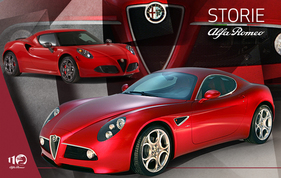


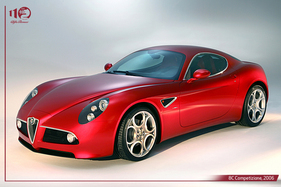
The super sports car with a 332 kW (450 hp) eight-cylinder engine presented in 2006 was inspired by the history of Alfa Romeo, while at the same time offering a glimpse into the future of the brand.
The bridge to the 21st century
Optimum power-to-weight ratio, perfect balance, precise handling and typical Italian design set new standards. The experts praised Alfa Romeo's contribution to the transition into the 21st century. The Alfa Romeo 8C Competizione summarized the essence of the brand, starting with the model name: 8C was reminiscent of successful eight-cylinder racing cars of the 1930s, Competizione was a reference to the legendary Alfa Romeo of the 1950s, which celebrated victories in the 24-hour race at Le Mans and the famous Mille Miglia road race, among others. The design of the Alfa Romeo 8C Competizione featured strong quotes from the brand's history.

Success and milestone at the same time
The style of the super sports car, which was built in small series, inspired later production models from Alfa Romeo, including the Giulietta, the MiTo and the 4C. The Alfa Romeo 8C Competizione was a success and a milestone. Around 1,400 orders were received within a few weeks - the limited series of 500 units was sold out even before production started.

The Alfa Romeo 8C Competizione fulfilled a dual role. It represented a return to the brand's roots and at the same time a laboratory for the future. This unique super sports car was developed in the midst of a period of profound restructuring in the automotive sector. It became a flagship with which Alfa Romeo was to redefine its identity and values - a stylistic and technical starting point for future vehicle models.
From show car to series product
At the beginning of 2006, Sergio Marchionne, CEO of Fiat Group Automobiles (now Fiat Chrysler Automobiles FCA) at the time, gave the signal to start series production of a concept car that had caused quite a stir at the IAA 2003 in Frankfurt. The Alfa Romeo Centro Stile under the direction of Wolfgang Egger and other design departments of the company developed the Frankfurt show car to production readiness within just eight months. The Alfa Romeo 8C Competizione was presented in its final form at the Paris Motor Show in the fall of 2006. Within a few weeks, around 1,400 orders were received from all over the world. The planned edition of 500 numbered units was sold out long before the start of production.

The essence of Alfa Romeo
The history of the Alfa Romeo 8C Competizione begins with its name. 8C - short for "otto cilindri" (eight cylinders) - refers to the Alfa Romeos designed by Vittorio Jano with eight-cylinder engines that won races around the world in the 1930s. With the Tipo 8C 2300, the brand celebrated four consecutive victories in the 24 Hours of Le Mans and three in the legendary Mille Miglia road race in Italy. The Tipo 8C 2900 contributed a further four Mille Miglia victories. "Competizione" - Italian for competition - was first used as a designation for a racing version in the Alfa Romeo 6C 2500, which the future Formula 1 world champion Juan Manuel Fangio drove in the 1950 Mille Miglia.
The 21st century Alfa Romeo 8C Competizione was designed to embody and revitalize the essence of Alfa Romeo. The super sports car took up technical themes that are close to the brand's heart. These include lightweight construction, in this case through a special chassis design and the use of aluminum, titanium, carbon and composite materials. A balanced weight distribution between the front and rear axles was ensured by the so-called transaxle design, i.e. with a longitudinally installed front engine and transmission on the rear axle. The elaborately designed chassis with double wishbones all round guaranteed exceptional driving precision.

The Alfa Romeo 8C Competizione was powered by a naturally aspirated V8 petrol engine with a displacement of 4.7 liters and an output of 332 kW (450 hp). This made it possible to accelerate from a standstill to 100 km/h in 4.2 seconds. It was also the first time since the early 1990s that an Alfa Romeo production vehicle was powered exclusively by the rear wheels.
A tribute to the history of automotive design
And then there was the not insignificant question of style. The seemingly rearing hood looked as if it wanted to bite into the asphalt. The side line was soft and sensual. A horizontal corrugation connected the wheel arches and led into the muscular shape of the rear fenders. The rear window was framed by the C-pillars, which extended into the rear of the vehicle.
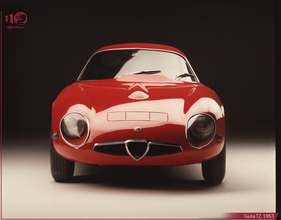
The design had much in common with a quiz on quotations from Alfa Romeo's brand history. The headlights protruding slightly over the hood were similar to those of the famous Tipo 33 Stradale from 1967, while the steeply raked rear end - known as the "Coda Tronca" in Italian - was reminiscent of the second series of the Alfa Romeo Giulietta SZ from 1961. The circular rear lights were a tribute to the Giulia TZ, like the Giulietta SZ a queen of the racetrack. In short, the design of the Alfa Romeo 8C Competizione flirted with history, as if Centro Stile were paying tribute to an entire era of automotive design.
Creativity and science
From the 1930s onwards, designers and coachbuilders had begun to understand and improve the aerodynamics of automobiles. Low drag was also recognized as the key to increasing the competitiveness of racing cars. The first step was to integrate external elements such as fenders and headlights into the bodywork. Subsequently, increasingly flowing, smoother and more streamlined bodies were created.
This challenge for the great designers of their time also stimulated their imagination. They were convinced that everything that is beautiful must also be efficient. The designers unleashed their creativity and skills to create some of the most beautiful and successful racing cars of all time. And many of them bore the Alfa Romeo crest.
The 2006 Alfa Romeo 8C Competizione was a tribute to cars from this era, symbolically bowing to them with its bold body design, clean lines and almost provocative quotes of distinctive brand features from Alfa Romeo's past.
Alfa Romeo and the "Trilobo"
From the front, every Alfa Romeo is unmistakable. The central, shield-shaped radiator - "scudetto" in Italian - and horizontal air intakes on both sides are striking. This combination, perhaps the most famous face in the world of automobiles, is called the "trilobo" in Italian. It was created in the 1930s.

Until then, little attention was paid to the design of the front of the vehicle. It usually consisted solely of the radiator flanked by free-standing headlights, only sometimes protected from flying stones by a grille. The "Scudetto" from Alfa Romeo was one of the first attempts to give the air intake to the radiator a distinctive shape. When the opening of the "Scudetto" became too small to supply the increasingly powerful engines with cooling air, the engineers added additional horizontal air inlets. Fans gave them the name "Baffi", Italian for moustache.
The "Trilobo", which came about more by chance due to technical constraints, was officially used as a brand symbol for the first time on the Alfa Romeo 6C 2500 Freccia d'Oro of 1946. Like all icons, the "Trilobo" evolved over time, reflecting tastes and fashions. Nevertheless, it remained unique and unmistakable. The Alfa Romeo 1900 wore the "Trilobo" in a more curved and concise manner, while the Giulietta model was almost dainty. For the Alfa Romeo Giulia, it took on a more aerodynamically favorable shape, only to become more angular in the 1970s and 80s. In the 1990s, the "Trilobo" became minimalist and almost stylized. It was not until the Alfa Romeo 156 and the 8C Competizione that the "Scudetto" and "Baffi" were clearly pronounced again. Alfa Romeo retained this basic design for all subsequent models.

The legacy of the Alfa Romeo 8C Competizione
The body design of the 8C Competizione cited the most famous elements of Alfa Romeo's style and became a natural inspiration for all of the brand's later ranges, including high-volume models such as the Alfa Romeo MiTo and Alfa Romeo Giulietta. In 2011, the Alfa Romeo 8C Competizione received a younger sister - in Italy, cars are traditionally feminine - the compact high-tech sports car Alfa Romeo 4C. The relationship was clear, although the Alfa Romeo 4C was not built in a limited edition.
With the 4C model, Alfa Romeo not only returned to the compact sports car segment. The Alfa Romeo 4C also offered innovative materials and technologies, combined with minimal weight and exceptional dynamic characteristics.
The Alfa Romeo 4C
When developing the Alfa Romeo 4C, the engineers did not adopt the popular strategy of focusing on maximum engine power. Instead, they reduced the weight by using high-tech materials. Ready to drive, the Alfa Romeo 4C weighed just over 1,000 kilograms and the power-to-weight ratio was less than four kilograms per horsepower. Two values that guaranteed maximum agility and high performance.

In order to achieve the lowest possible weight, the body was partly made of special plastics. The most innovative component, however, was the monocoque made of carbon fiber using the so-called honeycomb construction method, a technology also used in Formula 1. The monocoque, formed from individual fiber mats impregnated with resin, consisted of a single component that was baked in a large oven under vacuum. The entire monocoque of the Alfa Romeo 4C weighed only 65 kilograms, but still fulfilled the tasks of a load-bearing structure.
The engine of the Alfa Romeo 4C was also ultra-light. The turbo engine, which produced 177 kW (240 hp) from a displacement of 1,750 cubic centimetres, was made almost entirely of aluminum. In order to achieve optimum weight distribution of the entire vehicle, the four-cylinder engine - hence the model designation 4C - was positioned transversely behind the cockpit as a mid-engine. A dual-clutch gearbox provided the connection to the rear axle.
The chassis of the Alfa Romeo 4C also showed the proximity to motor racing. The front axle was guided by double triangular wishbones and the spring/damper assembly was bolted directly to the monocoque. A further development of the classic McPherson system was used on the rear axle. The Alfa Romeo 4C reached a top speed of over 255 km/h and accelerated from a standstill to 100 km/h in 4.5 seconds.