


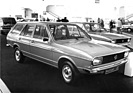


In 1973, the Volkswagen Passat with front-wheel drive, water-cooled four-cylinder engines and a design by Giorgetto Giugiaro was introduced, a departure from the previous model philosophy, which had focused on air-cooled rear engines.

Volkswagen has perfected the Passat over four decades. Internally, the eight generations now bear the designations B1 to B8. At Volkswagen, the B stands for the Passat's segment affiliation (mid-range), while the number indicates the respective generation.
To the top of the registration statistics with the first generation

It was unveiled in May 1973 and deliveries began in July - exactly 40 years ago: the hatchback designed by Giorgio Giugiaro, which was followed by an estate version called the Variant in 1974, won over the customers of the mid-range newcomer. One year later, it was already at the top of the German registration statistics. The first Passat - which was based on the Audi 80 at the time - remained in the range until 1980. 2.5 million units of the so-called B1 were produced.
In 1977, the first generation model was updated, which was mainly reflected in the bumpers and the quality (materials).

Also in 1977, the VW engineers built a Volkswagen Passat GTI in elegant Bahama Blue Métallic. Red trim strips, front and rear spoilers, fender extensions, sill trims, a stiffer chassis with wider tires and, of course, the 110 hp injection engine distinguished the fast family transporter from the rest of the B1 series. Who knows, perhaps this Passat would also have started a trend, but it remained a one-off. The motto at the time was everyday utility before driving pleasure.
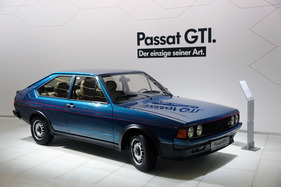
In 1979, however, the Passat drivers' hunger for power was finally satisfied: the variant with the 1.6-liter injection engine, which produced 110 hp, was now called the GLI.
Second generation with all-wheel drive for the first time

The successor to the B1 was again available with a hatchback and estate rear; it was offered until 1987. New technical features were introduced: all-wheel drive, turbodiesel, five-cylinder petrol engine and the fuel-saving Formula E as the forerunner of today's BlueMotion Technology. However, the notchback version of the B2, which was given the name Santana, became an evergreen.
As the world car of the 1980s, it was not only produced in Emden, but also in Belgium, Spain, Brazil, Mexico, South Africa and Japan.
Above all, however, the car established the success of the Volkswagen brand in China: the Santana B2 was produced there until 2012, and a modified long-wheelbase version - the Vista - continues to roll off the production line. With almost 5.5 million units, the second Passat, including all its variants, is the most produced model series in the entire Passat family.
The drag-optimized third generation

The third-generation Passat models (1987 to 1993) were produced exclusively with a notchback or estate hatchback; there was no longer a hatchback version for the Passat family. The new, air resistance-optimized models offered significantly more space in the interior thanks to the transverse installation of the engine and transmission. And they were visually very different from their predecessor, although not all traditional Passat customers liked the new nose without the radiator grille.
TDI technology, a turbocharged petrol engine and even a compact six-cylinder engine were introduced. Around 1.6 million units of the third Passat model series were delivered.
Gentle optimizations for the fourth generation

The completely optimized Passat B4 (1993 to 1997), around 700,000 of which were produced, was given a stiffened body, more safety features and even more powerful diesel engines - giving the mid-range model a noticeable upgrade.
Focus on quality for the fifth generation with up to eight cylinders

The fifth generation (1996 to 2005) set even higher standards. Volkswagen initiated a paradigm shift with the Passat B5: Whereas all previous Passat generations had already been well-balanced all-rounders with a high level of comfort, very good everyday characteristics and an above-average amount of space, the quality and design now took a leap that was to catapult the Passat into the premier league of its class and that of the most successful company cars.
With a fully galvanized body, advanced TDI technology, powerful four-, five-, six- and eight-cylinder engines and a level of quality previously only seen in the luxury class, the Passat finally became a role model in its class. In China, where even a long-wheelbase version was offered, the Passat continued to be sold until 2009. In total, over four million fifth-generation models were delivered worldwide.

The Passat W8 with W8 engine and all-wheel drive was a real rarity. Although it served to enhance the image, it did not sell particularly well.
Sixth generation with a new body variant and driver assistance systems

The path initiated with the B5 was successfully continued with the sixth generation. The Passat B6, which was offered from spring 2006 to 2009 and produced around 1.7 million units, brought an additional body variant into play: the CC, a stylish four-door coupé.
A dual-clutch gearbox was offered for the Passat for the first time, along with powerful diesel and petrol engines and fuel-efficient BlueMotion versions.
Seventh generation with a smoothed design

The B6 was followed by the seventh edition, which was visually trimmed for elegance, further refined and even more luxuriously equipped, setting the bar even higher in terms of safety and driver assistance systems.
In addition to the now independent CC, the Passat B7 brought with it another derivative - the Alltrack with a higher body and optional all-wheel drive. Independent models manufactured abroad, such as the Chinese New Midsize Sedan and the Passat produced in the USA, completed the global Passat family.
During the course of B7 production, 20 million Passats including derivatives were produced in 2012.
The Passat B8 with premium aspirations

The eighth generation of the Passat made its debut in July 2014. The successful business vehicle has been upgraded with the latest engine technology, less weight, more interior space with almost unchanged exterior dimensions and, last but not least, the latest assistance, infotainment and comfort systems and is therefore set to merge class boundaries, i.e. grow into the premium segment. The future will show to what extent this has been achieved.
All model series at a glance
| Model series | Generation | Type | Construction period from | Construction time to | Length from (mm) | Width from (mm) | Weight from (kg) | Special features/comments |
|---|---|---|---|---|---|---|---|---|
| B1 | 1 | 32 | 1973 | 1977 | 4200 | 1620 | 880 | also as 2-door hatchback version, longitudinally mounted engine |
| B1 | 1 | 32A | 1977 | 1980 | 4200 | 1620 | 880 | also with diesel engine, GTI only as prototype |
| B2 | 2 | 32B | 1980 | 1985 | 4435 | 1685 | 920 | Twist-beam rear axle, with all-wheel drive for the first time |
| B2 | 2 | 32B | 1985 | 1988 | 4435 | 1685 | 965 | Santana becomes a Passat |
| B3 | 3 | 35i | 1988 | 1993 | 4575 | 1705 | 1130 | Engines now transversely mounted |
| B4 | 4 | 3A | 1993 | 1997 | 4595 | 1720 | 1220 | ABS as standard, also available with VR6 |
| B5 | 5 | 3B | 1996 | 2000 | 4669 | 1740 | 1345 | longitudinally mounted engines, also with turbo, Can-Bus for control systems |
| B5 GP | 5 | 3BG | 2000 | 2005 | 4682 | 1746 | 1356 | Diesel now with pump-nozzle injection |
| B6 | 6 | 3C | 2005 | 2010 | 4765 | 1820 | 1343 | again with transversely mounted engines |
| B7 | 7 | 3C/36 | 2010 | 2014 | 4769 | 1820 | 1440 | Cd value below 0.30, complete redesign, but retained technology platform of the B6 |
| B8 | 8 | 2014 | 4767 | 1832 | 1380 | Completely new, focus on assistance systems, fully digital cockpit and head-up display for the first time |
