


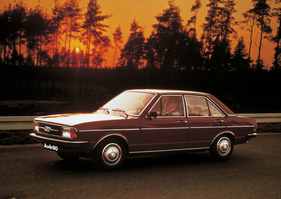
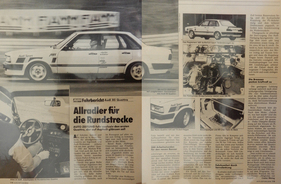
Many people first think of the 1972 Olympic Games in Munich. But there was also plenty on offer for car fans, as several epoch-making models saw the light of day 50 years ago. One of the most important of these athletes started with four rings on its "proudly swelling chest": the Audi 80 B1. After the successful 100, it was the second model to drive the Ingolstadt-based company's image change.
If you ignore the renaming of the series in 1994 and only look at the market segment, nine generations of the bestseller have been created to date. "We have taken care of all generations of the Audi 80/A4, which today is one of the most important pillars in the vehicle refinement division, and we have been able to offer customers a tailor-made package over the many years," explains Hans-Jürgen Abt, Chairman of the Board of Directors of ABT SE. While the first B1 had to make do with 95 tuning horsepower (70 kW), the spectrum of the current Audi RS 4 - standard output 450 hp (331 kW) - only ends at 530 hp (390 kW). The corresponding ABT Power R performance upgrade consists of the high-tech ABT Engine Control control unit, additional water cooler kit and air intake panel.

For its time, however, the first Audi 80 was already fast on the road, the first Audi ever to be built in excess of one million units. With its low weight and sporty handling as well as the body designed in the style of the new objectivity, it also appealed to younger drivers. For ABT Sportsline, it was the perfect starting point, so that the aforementioned performance upgrade was introduced as early as 1973. It impressed the trade press not only with its power, but also with its efficiency, which ensured extremely fair fuel consumption.
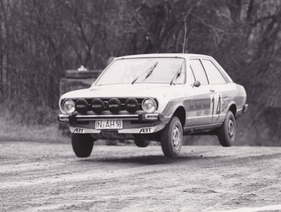
In the fall of the same year, Audi added the 80 GT with 100 hp (74 kW). From 1975, the 110 hp (81 kW) GTE with front spoiler, racing stripes and twin headlights, whose engine was later to be found in the first Golf GTI, was available ex works as the sporty top model. Incidentally, all the embellishment did not seem artificial, as the factory successfully entered the Audi 80 in the German Rally Championship from 1978 - supported by ABT Sportsline. Johann Abt had already developed the first racing version of the Audi 80 in 1974 and one year later won the title in the Europe-wide Trophée de L'Avenir with the 24 Hours of Spa as the highlight.
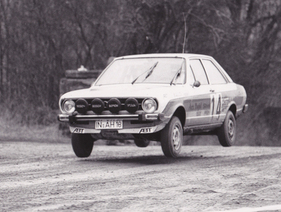
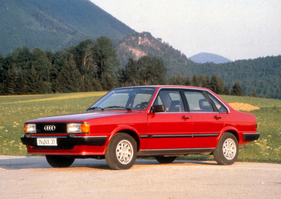
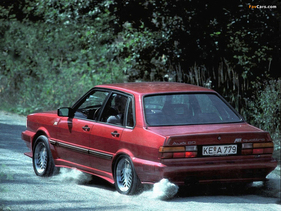
This was followed in 1978 by the Audi 80 B2, designed in collaboration with star designer Giorgio Giugiaro, which continued the success story with 1.6 million units built. Further refinements were made to lightweight construction and air resistance, making it one of the most economical cars in its class. Especially with the new diesel. Many features that are iconic for Audi today were already available in this model series: From 1982, for example, permanent all-wheel drive (quattro) was available on request for the first time in a large-series car. As previously in the Audi 100, a five-cylinder engine was also on the options list. And, of course, the B2 could be made even faster than its predecessor. ABT Sportsline tuned a GLE from 110 (81 kW) to 135 hp (99 kW). But there was much more: with the five-cylinder turbo from the Urquattro, the Allgäu-based company even created "Germany's fastest Audi 80".
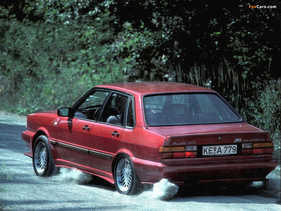
Even more power
With the B3 generation, which was "rounded" to a Cd value of 0.29 in the wind tunnel, Audi once again set a technical exclamation mark. The body, fully galvanized for the first time, looked significantly more modern than that of its angular predecessor. "This model marked the company's real entry into the tuning business," recalls Hans-Jürgen Abt. In addition to the saloon, the model series also received not only a coupé, but also a convertible. In 1991, there was a facelift that was so extensive that one could justifiably speak of a generational leap and the B3 thus became the B4.
In addition to the modern twist-beam rear axle, six-cylinder engines were now available for the first time. And with the chic Avant sports estate, an innovative new body shape was also introduced. Just like the saloon and coupé, it was available as the ultra-fast S2 with 230 hp (169 kW), which accelerated to 100 km/h in under six seconds. But this was just the prelude to a furioso that Audi started in 1994 with the Avant RS2, which is regarded as the forefather of all current RS models. The estate car built by Porsche had 315 hp (232 kW) and needed just 5.4 seconds for the standard sprint to country road speed. If that wasn't enough, ABT Sportsline modified the supercharger and installed a stainless steel exhaust system on request. In the end, 360 hp (265 kW) was recorded in the vehicle registration document.
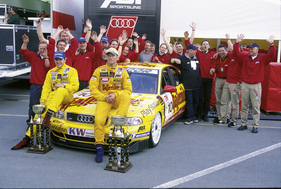
With this bang, the era of the Audi 80 came to an end, even if only in name. This was followed in 1994 by the B5 generation, whose nameplate read A4 instead of 80 - the success story continued seamlessly. ABT Sportsline stayed on the ball and also developed a comprehensive tuning range for the A4, and the motorsport commitment now even took on a whole new quality. In 1996, Christian Abt entered STW with the A4 and won the title three years later. Audi finally returned to the DTM with the sedan in 2004 - Audi Sport Team Abt Sportsline was involved from the very beginning. Until the A4 was replaced in the 2012 season, the "abbots" shaped the racing series and won four drivers' championships with Mattias Ekström (2004, 2007) and Timo Scheider (2008, 2009), three team titles (2004, 2007, 2011) and 31 victories.
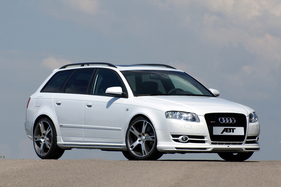
The experience gained in motorsport flows directly into the road models. Such as the ABT AS4-R from 2005, which accelerates from 0 to 100 km/h in just 4.6 seconds with 480 biturbo horsepower (353 kW). Today, it can do even better. In the final expansion stage, the RS 4 with ABT Power R mentioned at the beginning completes the same exercise in just 3.8 seconds. The top speed is 300 km/h. The handling can be further improved with coilover suspension and sports stabilizers. Other options include a stainless steel silencer system and various aerodynamic and interior components. As always, the complete overview is available in the ABT configurator.

